
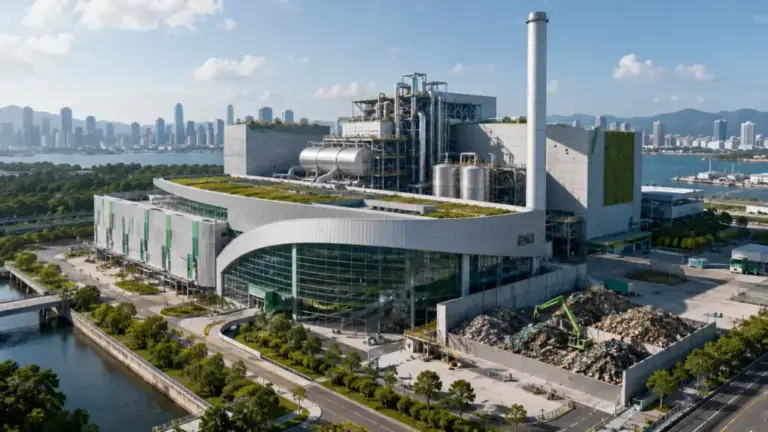
In the traditional ‘take-make-waste’ linear economy, resources are extracted, used, and then discarded as useless trash. This model is increasingly viewed as unsustainable in a world of finite resources and growing environmental pressures. The transition toward a circular economy seeks to decouple economic growth from resource consumption by keeping materials in use for as long as possible. Within this framework, the energy recovery from non-recyclable materials plays a pivotal role. PowerGen Advancement highlights that the integration of Waste to Energyin circular economy represents a vital bridge between waste management and sustainable energy production, ensuring that the residual value of our discarded products is captured rather than buried in the ground.
The Waste Hierarchy and the Priority of Recovery
To understand the role of energy recovery, one must first look at the internationally recognized waste hierarchy. This hierarchy prioritizes waste prevention, followed by reuse and recycling. However, even the most efficient recycling systems reach a technical or economic limit. There are always materials—such as contaminated plastics, composite packaging, and certain textiles—that cannot be recycled back into new products. In a linear system, these materials would end up in landfills, where they produce methane, a potent greenhouse gas.
In a Waste to Energy circular economy, these non-recyclable residuals are viewed as a fuel source. By combusting or gasifying this waste under controlled conditions, we can generate heat and electricity. This process effectively extracts the final bit of utility from the material before it leaves the economic loop. Far from competing with recycling, modern energy recovery facilities act as a filter for the circular economy, safely destroying pollutants and pathogens while recovering the energy content of the residues that remain after the recycling process is complete.
Landfill Diversion and Climate Change Mitigation
One of the most immediate benefits of integrating energy recovery into the circular model is the massive reduction in landfill dependency. Landfills are not just land-intensive; they are environmental liabilities that can contaminate groundwater and emit methane for decades. Diverting waste to modern WtE plants reduces the volume of waste by up to 90 percent and the weight by about 70 percent. This dramatic reduction is a cornerstone of the Waste to Energy circular economy, as it preserves land and prevents the long-term ecological damage associated with traditional dumping.
Furthermore, the climate impact of energy recovery is significantly better than that of landfilling. For every ton of municipal waste diverted from a landfill to a WtE plant, about one ton of CO2-equivalent emissions is avoided. This is due to the prevention of methane emissions and the offset of electricity that would otherwise have been generated using fossil fuels. In this context, WtE is not just a waste management tool; it is a vital component of local and national climate mitigation strategies.
Recovering Metals and Minerals from Combustion Ash
A common misconception is that the process of energy recovery ends with the production of electricity. In reality, a modern Waste to Energy circular economy involves the recovery of materials from the post-combustion ash. The bottom ash that remains after waste is burned contains significant amounts of ferrous and non-ferrous metals, such as iron, aluminum, and copper. Advanced mineral processing techniques are now used to separate these metals, which are then sent back to smelters to be turned into new products.
Beyond metals, the remaining mineral portion of the ash can be processed for use as a sustainable aggregate in construction. It can be used in road bases, as a constituent in concrete blocks, or as a sub-base for parking lots. By utilizing the waste of the waste, we further close the resource loop. This transformation of ash into a construction material is a perfect example of circularity in action, reducing the need for virgin stone and sand extraction and further lowering the environmental footprint of the entire waste management chain.
Sustainable Urban Infrastructure and District Heating
The true potential of the Waste to Energy circular economy is often realized at the municipal level. Many European and Asian cities have integrated WtE plants directly into their urban infrastructure. These facilities provide steam and hot water for district heating and cooling networks, supplying sustainable thermal energy to hospitals, residential buildings, and industrial zones. Because the waste is produced where the people live, the energy is generated close to the point of consumption, minimizing transmission losses.
This synergy between waste management and urban heating creates a resilient energy system. During the winter months, when heating demand is high, WtE plants provide a steady, reliable baseload that reduces the city’s reliance on imported natural gas or coal. By powering our cities with our own waste, we move closer to the ideal of self-sustaining, circular urban environments where nothing is wasted and every resource is valued.
Incentivizing Design for the Environment
An effective Waste to Energy circular economy also provides important feedback to product designers and manufacturers. When the cost of managing non-recyclable waste is transparently accounted for, it creates an incentive for companies to design products that are easier to recycle or reuse. The existence of high-quality energy recovery options ensures that we have a safe and efficient way to handle the transition materials while the world moves toward 100 percent recyclable designs.
Furthermore, the heat and power generated by WtE facilities can be used to power the very recycling facilities that form the upper tiers of the hierarchy. By creating these industrial symbioses, we improve the overall efficiency of the resource management sector. The circular economy is not a single technology but a network of interconnected systems, and energy recovery is the safety net that ensures the system remains robust and carbon-efficient even when perfect recycling is not yet possible.
The Role of Carbon Capture in Future Circularity
As we look toward the future, the integration of Carbon Capture and Storage (CCS) or Utilization (CCU) with WtE plants represents the next frontier of the Waste to Energy circular economy. Because approximately half of the energy in municipal waste comes from biogenic sources (like food waste and wood), capturing the CO2 from WtE facilities can result in negative emissions. The captured carbon can be stored underground or used as a raw material in the chemical industry to produce sustainable fuels or plastics.
This evolution turns WtE plants into carbon sinks, effectively reversing the flow of carbon from the atmosphere back into the industrial loop. This is the ultimate expression of circularity: transforming waste into energy, materials, and even carbon feedstock. Such advancements ensure that the energy recovery sector remains a dynamic and indispensable part of the global transition to a net-zero, circular future.
Economic Viability and Social Acceptance
For a circular system to thrive, it must be economically viable and socially accepted. Modern WtE plants are designed with world-class architecture and public amenities, such as the famous CopenHill in Denmark, which features a ski slope on its roof. By turning a waste facility into a community asset, we can improve public understanding of the role of Waste to Energy in circular economy. When citizens see their trash being transformed into power and recreational space, it fosters a stronger culture of resource responsibility.
Economically, WtE provides stable jobs and long-term infrastructure value. While the initial capital investment is high, the multi-decade operational life and the dual revenue streams from waste tipping fees and energy sales make it a sound investment for municipalities. By investing in these facilities, cities secure their waste management future while contributing to a broader economic shift toward sustainability and resource efficiency.
Conclusion
The transition to a circular economy is one of the most significant challenges of our time, requiring a fundamental rethink of how we produce and consume. Within this transition, the Waste to Energy serves as a vital pillar of circular economy, ensuring that the energy and material value of non-recyclable waste is not lost to landfills. By diverting waste, recovering metals, heating our homes, and capturing carbon, energy recovery facilities turn a global problem into a sustainable solution. PowerGen Advancement believes that as we continue to refine our recycling technologies and product designs, WtE will remain the essential partner in our quest to build a world where the concept of waste no longer exists, and every resource is treated with the respect it deserves.