Open RAN is changing how mobile networks are built by separating functions that were traditionally delivered as tightly integrated systems. Radio units, distributed units, centralised units, cloud infrastructure and software applications can increasingly operate across a wider range of suppliers and platforms. This creates greater flexibility, but it also increases the number of components that operators need to configure, monitor, update and coordinate. As a result, Open RAN automation is becoming increasingly important to the practical scaling of disaggregated networks.
The operational challenge grows as networks become more distributed. In an integrated RAN environment, many lifecycle tasks can be managed within a relatively unified system. Open RAN introduces additional interfaces and software dependencies, requiring operators to coordinate functions across different infrastructure layers. Provisioning, configuration, software updates, fault management and performance monitoring consequently become more complex.
The O-RAN architecture addresses this through the Service Management and Orchestration layer, or SMO. The SMO is designed to coordinate disaggregated RAN functions and the cloud infrastructure supporting them, with management interfaces such as O1 and O2 providing mechanisms for lifecycle and infrastructure management. The O-RAN ALLIANCE has identified a mature, decoupled SMO and production-ready O1 and O2 interfaces as priorities for making Open RAN easier to deploy at scale.
Disaggregation is Increasing Operational Complexity
An Open RAN environment can contain separate radio units, distributed units, centralised units, cloud resources and software applications. Each component can have different configuration requirements, software versions and operational dependencies. The challenge is therefore not simply keeping individual network elements running, but ensuring that they continue to function together as one network.
This is increasing the importance of automated lifecycle management. Provisioning new network functions, validating configurations, applying software updates and responding to faults manually can become increasingly resource-intensive as deployment footprints grow. Automated workflows can standardise these processes while reducing repetitive intervention.
The need for automation also extends to cloud infrastructure. The O2 interface provides a framework for managing cloud resources and workloads within the O-RAN architecture, while the wider SMO environment connects infrastructure management with RAN operations. This creates a more structured relationship between the physical computing environment and the software functions running on it.
Efficiency is Strengthening the Business Case
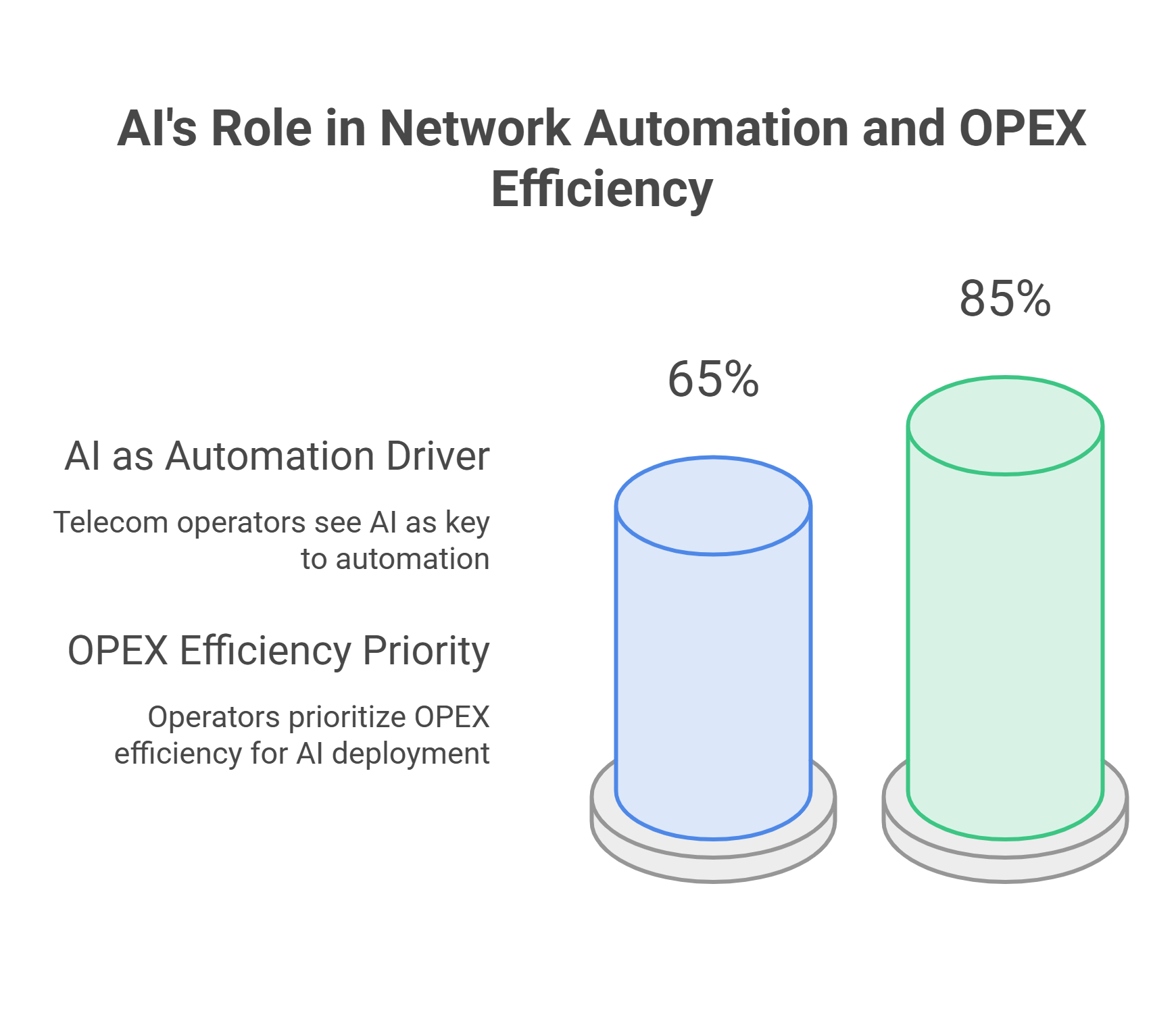
The commercial motivation is also becoming clearer. Operators are under pressure to reduce operating costs while managing increasingly complex networks. GSMA Intelligence’s 2026 Network Transformation research found that 85% of operators identify OPEX efficiency as a priority business objective for deploying AI in their networks. Although this statistic concerns AI deployment rather than Open RAN specifically, it demonstrates the wider importance operators place on improving network efficiency through automation and intelligent systems.
NVIDIA’s 2026 global telecom survey provides another indicator of this direction. Among more than 1,000 telecom professionals surveyed, 65% of operators said network automation is being driven by AI, while 90% reported that AI was helping increase revenue and reduce costs. The survey is vendor-sponsored, so these figures should be treated as industry sentiment rather than independent performance measurements.
The significance for Open RAN is that automation can help operators absorb some of the additional operational complexity created by disaggregation. Automated provisioning, policy-based configuration and software lifecycle management can allow network teams to manage more components without increasing manual workloads at the same rate.