Radio resource management is becoming a more important application for artificial intelligence as mobile networks become more dynamic and traffic patterns become harder to predict. Operators must continuously balance limited spectrum, radio capacity, transmission power and physical resources against changing user demand, mobility and interference. Traditional RRM approaches depend largely on predefined rules and optimisation algorithms, but increasingly variable network conditions are creating an opportunity for more adaptive decision making. This is where AI Radio resource management is beginning to gain importance.
The objective is not simply to monitor network performance. AI can analyse radio measurements and help determine how available resources should be allocated across users and cells. Scheduling, link adaptation, beam management and interference coordination are among the areas where machine learning can identify relationships that may be difficult to capture through fixed rules.
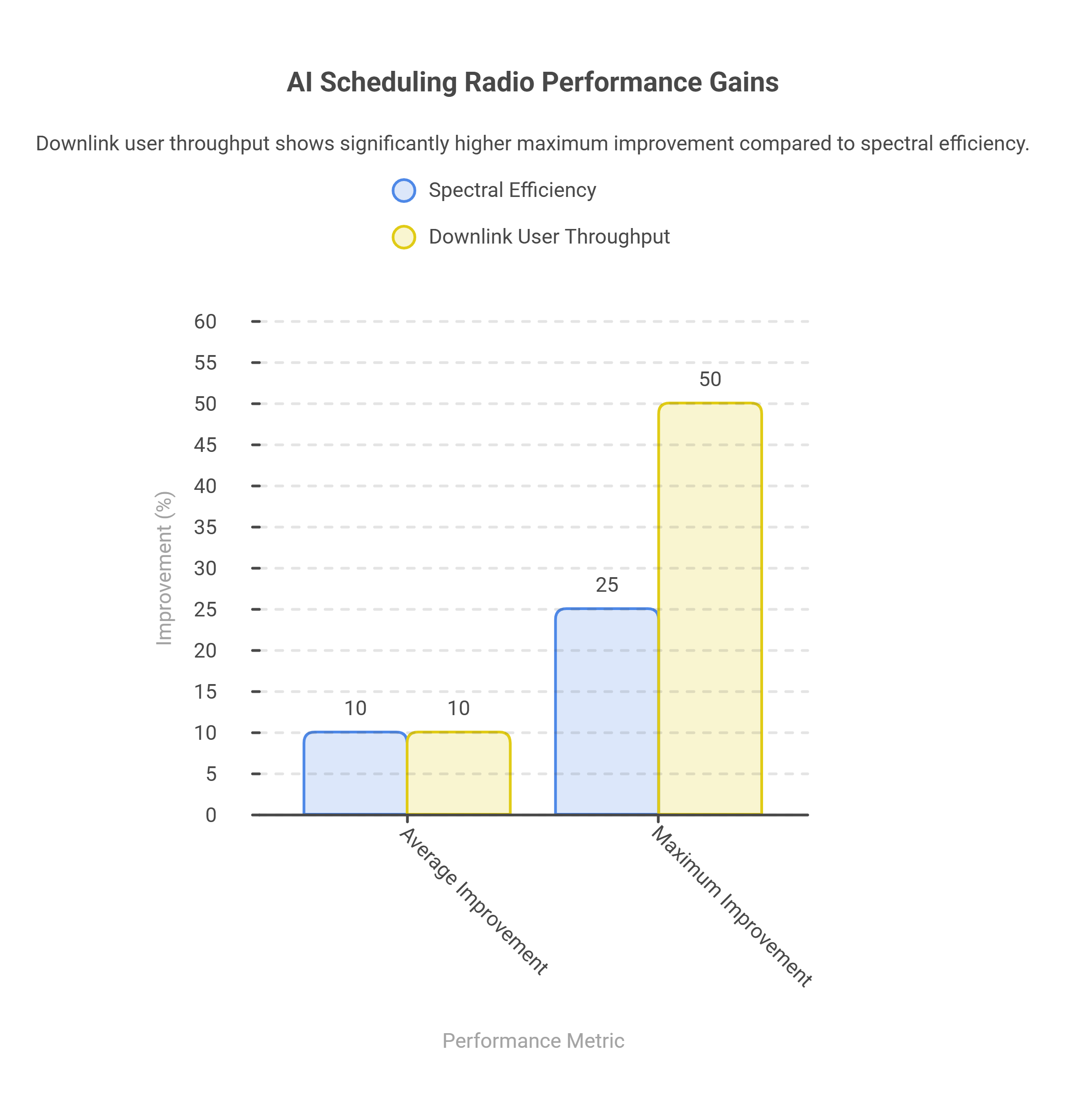
Recent commercial testing provides evidence that this approach is moving into live network environments. A 2026 commercial 5G validation of an AI native scheduler focused on link adaptation reported maximum improvements of approximately 25% in spectral efficiency and 50% in downlink user throughput. Average gains across evaluated locations were approximately 10% for both measures. The results are specific to the tested deployment, but they demonstrate how AI can influence radio decisions with measurable performance effects.
Scheduling is Becoming More Adaptive
Scheduling is one of the clearest applications because the network must continuously determine how available radio resources are distributed between users. Demand can change rapidly between cells, while users can experience very different channel conditions at the same time. AI models can process current measurements alongside historical patterns to support allocation decisions that adapt to those changes.
Link adaptation is closely connected to scheduling. The network needs to select transmission conditions that maximise data rates without increasing error rates beyond acceptable levels. AI can incorporate signal quality, interference, mobility and previous performance to support more responsive decisions.
The O RAN Alliance is incorporating these capabilities into its evolving architecture. Its 2026 Release 5 introduced enhancements for massive MIMO optimisation and AI and machine learning workflows connecting the Non Real Time RAN Intelligent Controller and Near Real Time RAN Intelligent Controller. These developments provide a framework for intelligent applications to influence network optimisation across different timescales.
The potential therefore extends beyond throughput. AI Radio resource management can be designed to balance competing objectives such as latency, reliability, energy consumption and user fairness. That becomes more important as a single network supports services with different performance requirements and increasingly variable traffic patterns.