
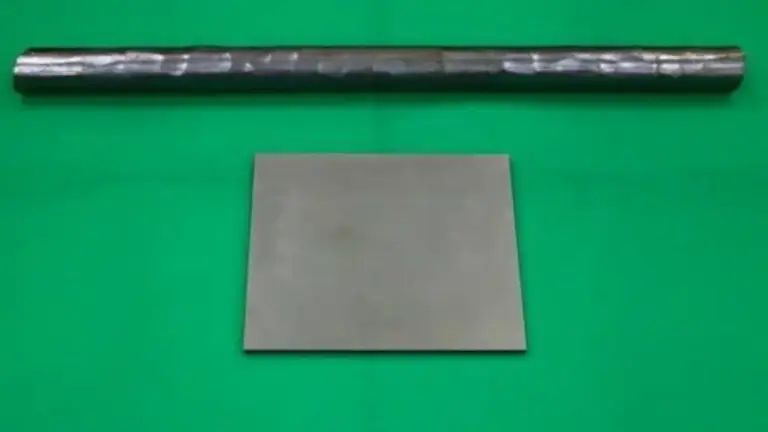
Kyoto Fusioneering, Ltd., from Japan, has launched a joint development program with Daido Steel Co., Ltd. in order to develop commercial manufacturing technology for low-activation vanadium alloy, which is one of three candidate structural materials as far as fusion blankets are concerned.
The two companies have together melted and forged 200 kg of high-purity vanadium into round bars and plates through the program and are now jointly assessing the manufacturing and processing technologies that are needed to manufacture these materials. The companies are proceeding with the fabrication of a blanket mock-up in view of the future practical use of this material as a blanket structural material for fusion machines.
A key technical obstacle on the road to fusion energy is the development of the blanket, an in-vessel component that captures the neutrons produced by the fusion reaction, reclaims heat, and generates the tritium fuel. Reduced-activation ferritic-martensitic – RAFM steel as well as several other candidate materials, is being researched and developed, but low-activation vanadium alloy is drawing renewed interest from private fusion developers seeking higher-temperature blanket designs.
Vanadium retains strength to about 700°C and is the only one of the three candidates that is both non-ferromagnetic as well as ductile, has good chemical compatibility with liquid lithium, and may also be desirable with FLiBe – a molten salt of lithium fluoride and beryllium fluoride.
The Fusion Science and Technology Roadmap of the U.S. Department of Energy names vanadium alloys as one of the structural materials that need to be established and qualified for fusion service. In the U.S. Fusion Materials Community Roadmap, vanadium-based alloys are identified as a higher-performance, higher-risk structural alternative to RAFM steels. Both point out the same limitation, and that is the lack of supply chain infrastructure to produce large vanadium alloy heats, since until now there has been virtually no commercial demand for them.
It is worth noting that fusion applications need exceptionally low impurity levels in high-purity vanadium alloys, which necessitates advanced manufacturing technology and is an area with scarce production experience at present. In the US and Japan, heats of about 200 to 1,200 kg were produced in the 1990s and early 2000s, almost exclusively in national programs. Commercial supply was never defined, and published roadmaps now have targets in the range of 500 kg to one tonne per heat, in multiple heats, to prove industrial qualification. Professor Takuya Nagasaka of the National Institute for Fusion Science – NIFS is a leading figure in this field and has been promoting research and development for many years. By doing joint research with his group, KF has accumulated knowledge of the specifications and evaluation methods that materials for fusion energy plants need. KF has begun to shift production of high-purity vanadium alloy from national program research heats into a commercial specialty steel supply chain in partnership with Daido Steel, which is a company that has advanced metal materials manufacturing technology.
Joint Development Overview
Under this joint development program, Daido Steel will develop the manufacturing technology necessary for practical application of vanadium alloy by utilizing its technological capabilities accumulated through the development and manufacturing of specialty steels and different alloys. In addition to the expertise of KF in the design of fusion energy plants and the specification of materials, the two companies seek to develop a repeatable industrial process for the production of low-activation vanadium alloy structural materials in terms of fusion applications.
The companies are specifically working together to test manufacturing and processing technologies for vanadium alloy materials such as plate and round bar. The first finished material, 7.3 kg of round bar and 2.6 kg of plate, was completed in August 2026. A total of about 70 kg will be delivered to KF. The material will be machined and joined by the KF, and fabrication of a blanket mock-up is estimated to start in 2027.
What Lies Ahead
KF will drive blanket development and commercialization by producing a blanket mock-up with the structural materials developed in this joint development.
KF is working on blanket structural materials in parallel, such as the vanadium alloy as well as the SiC/SiC composite, and it is developing autonomously, because a blanket structural material cannot be chosen independent of the coolant, breeder, and operating temperature, and those choices differ among fusion developers.
KF provides the blanket, not the machine, and therefore must be able to manufacture it in multiple material systems.
Moving forward, KF will keep working together with Japanese companies that have advanced materials manufacturing and processing technologies to build a fusion supply chain and industrial ecosystem based on collaboration among private-sector companies located in Japan.
According to the General Manager, Corporate Research & Development Center, Daido Steel Co., Ltd., Shigeki Ueta, “In our 2026 Medium-Term Management Plan, Daido Steel has positioned the achievement of carbon neutrality by 2050 as one of its key priorities, with clean energy identified as one of our priority target fields. Vanadium alloy is widely recognized as a material with excellent properties, but its manufacturing difficulty has, until now, prevented it from achieving widespread global adoption. This development aims to establish the manufacturing technology needed to bring vanadium alloy to practical use, building on the technological capabilities we have cultivated through the development and manufacturing of specialty steels and various alloys, in support of the social implementation of fusion energy that Kyoto Fusioneering is advancing. Establishing mass-production technology for vanadium alloy represents a major technical challenge, but we will contribute to the realization of fusion energy through this development.”
Remarks Representative Director, President & COO, Kyoto Fusioneering, Ltd., Kiyoshi Seko, “The blanket is one of the most critical components on the path to the practical application of fusion energy, and the development of its structural materials is key. By combining Daido Steel’s advanced materials manufacturing technology with the expertise KF has built up in fusion materials, we have been able to move blanket development forward. Going forward, we will continue to work with companies across the industry to advance the technology development and supply chain construction needed for the social implementation of fusion energy.”