
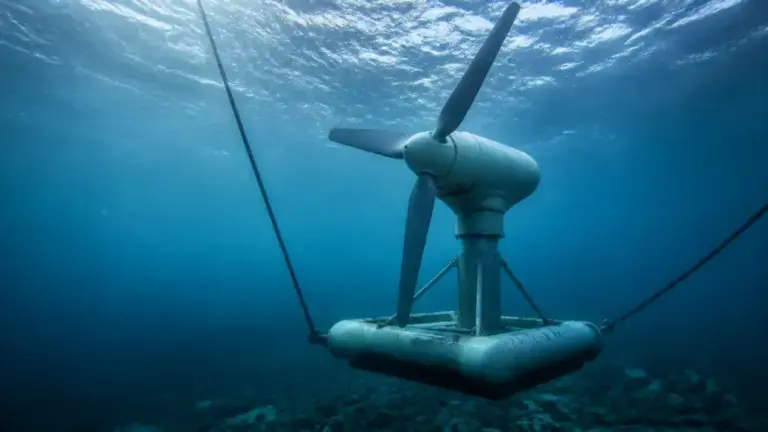
The marine renewable energy sector is entering a new phase of commercial maturity and technological innovation, and at the forefront of this evolution are floating tidal turbines. While the first generation of tidal technology focused primarily on seabed-mounted units in relatively shallow, near-shore waters, the industry is now looking toward the vast and untapped energy potential of deeper channels and stronger surface currents. By mounting high-performance turbines on stable floating platforms, the sector is unlocking deep-water marine power that was previously considered too expensive or technically impossible to harvest. PowerGen Advancement notes that these innovative systems not only significantly increase the geographical reach of tidal energy but also offer game-changing advantages in terms of maintenance accessibility, environmental monitoring, and overall lifecycle economics.
The technical rationale for floating tidal turbines is grounded in the fundamental physics of fluid dynamics in high-flow environments. In a tidal channel, the highest current velocities are typically found in the upper water column, near the surface, where the flow is less affected by the boundary-layer friction of the ocean floor. By positioning the rotors in these high-velocity surface layers, a floating system can capture significantly more energy than a seabed-mounted unit for a given rotor area, as power density increases with the cube of the velocity. Furthermore, floating tidal turbines are not limited to shallow depths of 30 or 40 meters. Using advanced mooring and anchoring systems, these platforms can be deployed in channels exceeding 100 meters in depth, opening up massive new resource areas in regions like the North Sea, the Bay of Fundy, and the coastal straits of East Asia.
Design Archetypes and Maintenance Accessibility
The architectural design of floating tidal turbines has evolved into several successful and robust archetypes. Perhaps the most prominent is the twin-rotor floating superstructure, exemplified by the Orbital Marine Power O2. This 2-megawatt platform features a 72-meter barge-like hull with two massive 20-meter rotors mounted on articulated hydraulic leg arms. The primary advantage of this design is its surface accessibility: when the rotors or nacelles need servicing, the legs can be lifted out of the water, bringing the generation equipment to horizontal deck level. This allows for routine maintenance and even major component overhauls to be performed using standard local workboats and crew transfer vessels (CTVs), completely eliminating the requirement for multi-million dollar offshore heavy-lift jack-up vessels.
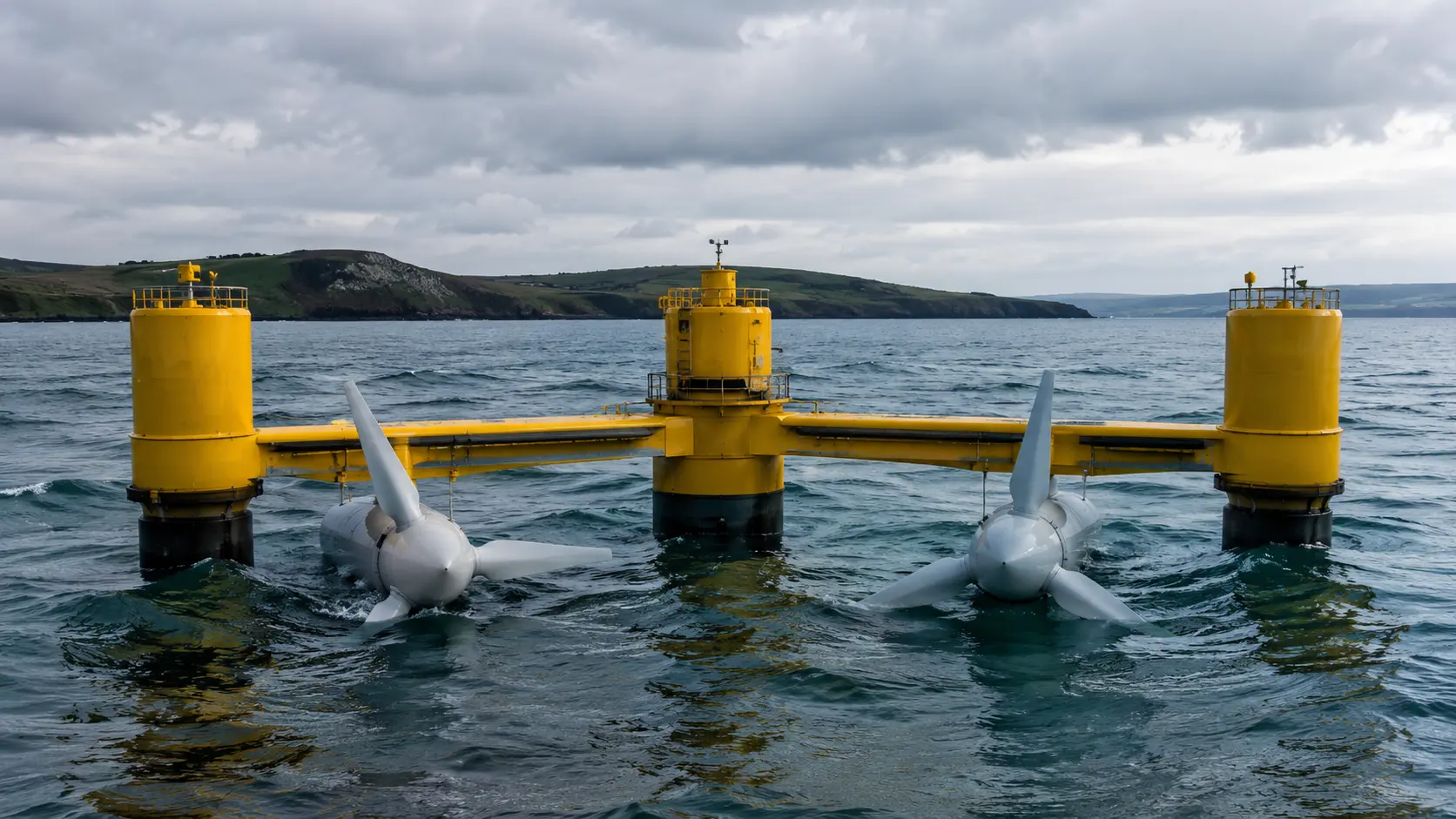
Other innovative designs include single-hull barge and trimaran platforms, as well as tethered subsea kites like Minesto’s Deep Green technology. These floating tidal turbines utilize sophisticated station-keeping systems involving multi-point catenary or tensioned mooring spreads. By using high-modulus synthetic fiber ropes (such as HMPE) combined with heavy seabed chains and pin piles or rock anchors, these platforms can remain stable and operational in the face of extreme tidal flows and severe surface weather. The power export is managed through dynamic subsea cables equipped with lazy-wave buoyancy modules and bend stiffeners, which allow the cable to absorb the multi-axis platform motions without fatigue failure, ensuring a reliable connection to the grid for the asset’s 20- to 25-year design life.
The Economic Advantage: Reducing LCOE and CAPEX
One of the most compelling arguments for floating tidal turbines is their potential to significantly reduce the Levelized Cost of Energy (LCOE) of marine renewables. The capital expenditure (CAPEX) for a floating project is often lower than for a fixed-bottom equivalent because it eliminates the need for expensive subsea foundation drilling, pin-piling, or massive gravity-base installations. Because the entire system can be fully assembled and commissioned in a local port and then towed to the site using standard tugboats, the logistical complexity and weather risk of the installation phase are greatly reduced. This towed-to-site model is essential for scaling tidal energy into the multi-megawatt commercial arrays of the future.
Moreover, the operational expenditure (OPEX) for floating tidal turbines is substantially lower due to their surface accessibility and the elimination of diver-based interventions. In the tidal sector, unplanned maintenance is the single largest driver of financial risk. By allowing for nacelle-level repairs and sensor replacements without the need for specialized marine assets, floating systems provide a more bankable and resilient investment profile for utility companies. As the industry moves toward larger arrays, the use of shared mooring networks and automated docking systems for service vessels will further improve the economics of floating tidal power, bringing it closer to grid parity with offshore wind.
Environmental Stewardship and Acoustic Monitoring
As with all marine renewable technologies, floating tidal turbines must be developed with a relentless focus on environmental stewardship and the protection of marine biodiversity. A key concern for regulators is the potential for collision with marine mammals, such as harbour porpoises and seals, and diving seabirds. Floating platforms have a distinct advantage in this area, as they serve as ideal mounts for a suite of above-water and underwater monitoring sensors. This includes active sonar, passive acoustic monitoring (PAM), and high-definition cameras that are far easier to power and maintain than seabed-mounted equivalents.
AI-driven computer vision systems can track marine life in real-time, providing the data needed to assess collision risks accurately and to demonstrate compliance with environmental permits. If a protected species is detected in close proximity to the rotors, the AI can trigger an adaptive velocity throttling or a safe-stop maneuver. Furthermore, the operational acoustic noise of the turbines is carefully monitored to ensure it does not disrupt the echolocation or communication of cetaceans. By integrating these environmental protection protocols into the core of the technology, the floating tidal sector is building the social license needed to operate in sensitive coastal ecosystems.
Digitalization, AI, and the Blue Economy
The future of floating tidal turbines is inextricably linked to digitalization and the broader blue economy. AI-driven predictive control algorithms are used to manage the pitch and yaw of the blades in real-time, optimizing energy capture wave-by-wave while mitigating the fatigue loads caused by surface turbulence. Digital twins of the floating platforms are utilized to monitor structural integrity and mooring tension, allowing for condition-based maintenance that maximizes asset availability. This level of digital intelligence ensures that floating tidal turbines can operate reliably in one of the most hostile environments on Earth.
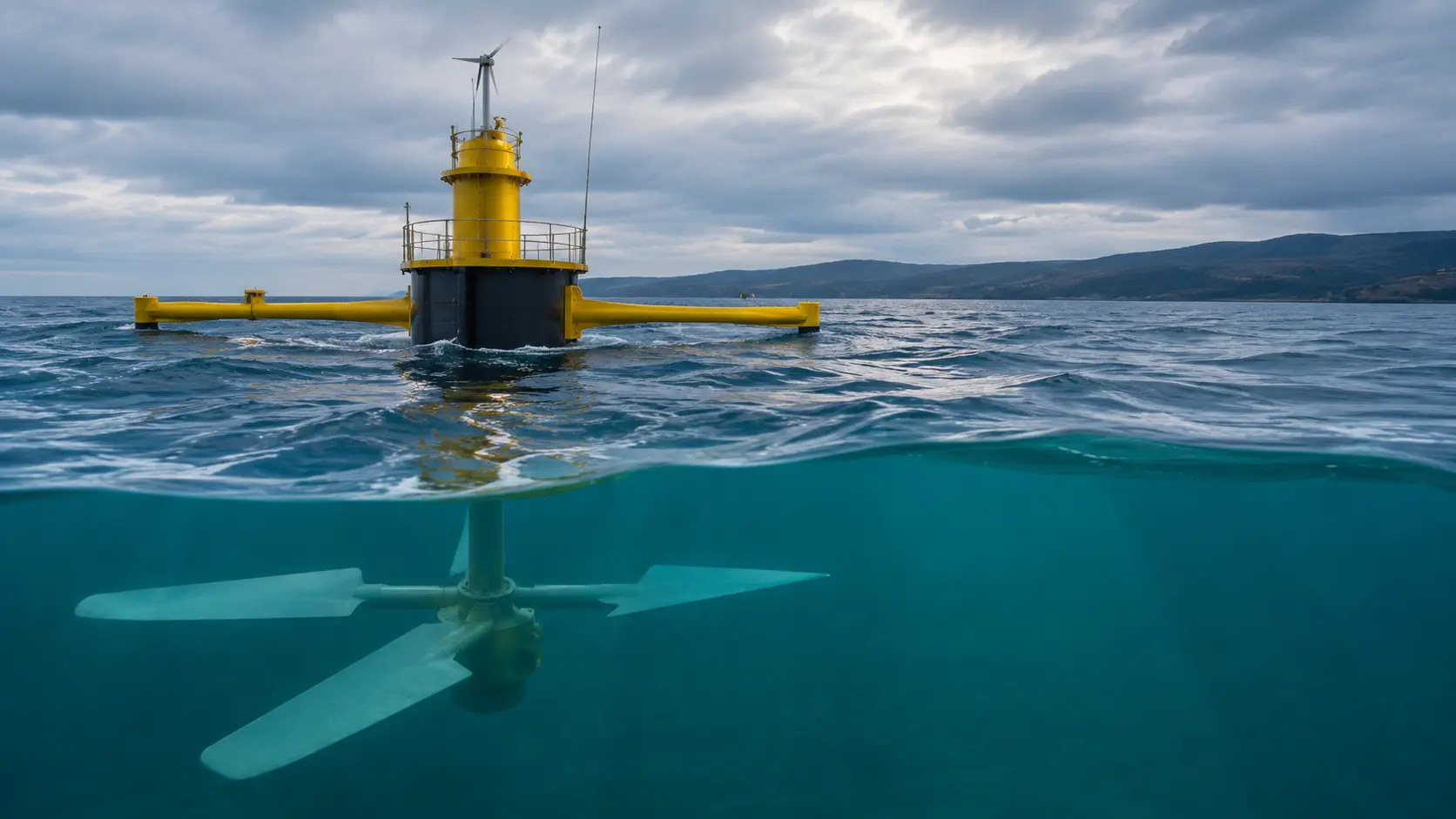
Furthermore, floating tidal turbines are increasingly being viewed as multi-purpose offshore energy hubs. They can provide localized, zero-emission power for offshore aquaculture, subsea oil and gas decommissioning projects, and oceanographic research stations. In remote coastal regions, they can be coupled with subsea electrolyzers to produce green hydrogen, providing a versatile energy carrier that bypasses the constraints of the onshore electrical grid. This versatility ensures that floating tidal technology remains a central and leading component of the sustainable ocean economy, providing a powerful and predictable source of renewable energy for a carbon-constrained world.
Future of Deep-Water Tidal Power
The rise of floating tidal turbines represents the next major milestone in the quest for predictable, clean, and powerful marine renewable energy at scale. For the global energy industry, the opportunity lies in unlocking the vast and reliable resources of the deep ocean through innovative engineering.
Floating tidal turbines are the definitive solution for harvesting energy in deep-water channels and high-velocity surface currents, where power density is highest. PowerGen Advancement believes that by integrating surface-accessible maintenance, advanced mooring systems, and AI-driven monitoring, the industry is overcoming the technical and economic hurdles of traditional fixed designs. The success of this transition depends on the continued reduction of LCOE through array-scale deployments and the adoption of standardized, modular floating platforms that can be easily scaled across different maritime regions.
To lead in this sector, stakeholders must prioritize the development of resilient dynamic cabling and the creation of a specialized, localized marine engineering supply chain. The move toward floating tidal power requires a holistic strategy that includes not only the turbines but also the port infrastructure, remote supervision systems, and environmental protection protocols needed to operate them safely at scale. By investing in floating tidal turbines today, the energy industry can secure a predictable and powerful source of renewable electricity, providing a resilient foundation for the global energy transition and a sustainable future for our oceans.