
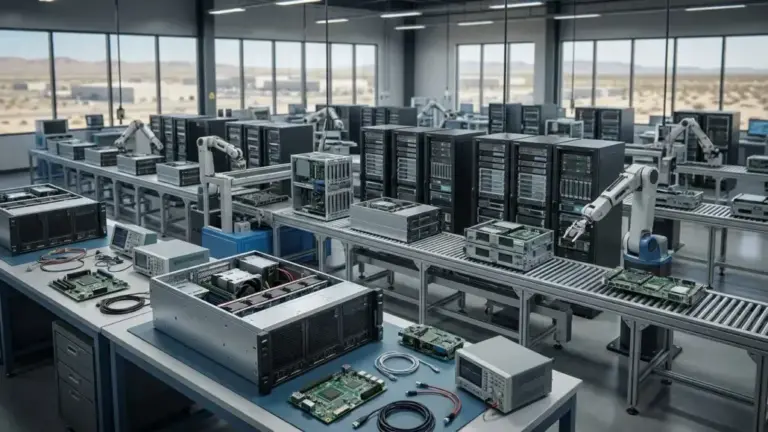
Ciudad Juarez is solidifying its position within the global technology supply chain as exports of servers and computing equipment topped US$87 billion in 2025, accounting for nearly 20% of the national total in the segment for Mexico. The activity provides the border city with a ready manufacturing ecosystem as consumer interest in artificial intelligence – AI, data processing, and digital services leads to investment in technology infrastructure.
The expansion also offers possibilities for companies in Ciudad Juarez to move beyond mere manufacturing and engage in higher-value parts of the technology supply chain. Local manufacturers and small and midsize enterprises – MiPyMEs could produce components and services for an industry that is increasingly driven by demand for computing capacity, cybersecurity, and data center infrastructure.
The opportunities were among the topics addressed during the first Artificial Intelligence Festival in Ciudad Juarez, which was carried out in collaboration with Coparmex Juarez. The event gathered industrial leaders, developers, academics, and entrepreneurs to discuss how AI is transforming production and business models and identify opportunities for companies in the region.
Ciudad Juarez builds on server-making
As a hub for server and computing equipment manufacturing, the city is connected to a technology ecosystem with global semiconductor and electronics companies such as TSMC, Samsung, SK Hynix, and Micron. The export levels show how much Ciudad Juarez participates in the assembly of technological infrastructure in a moment when AI increases the demand for processing capacity.
That industrial base could become more relevant as businesses across Mexico deploy AI applications and expand their digital operations. As enterprises roll out AI-enabled tools, cloud services, and connected systems, they’ll be faced with more complex environments at data centers, cloud platforms, and edge infrastructure.
Technology providers are reacting with platforms that combine application management, monitoring, and security. For example, F5 has created an Application Delivery and Security Platform to centralize application management, operational visibility, and protection. With F5 Insight for ADSP, organizations can use telemetry and advanced analytics in order to turn operational data into useful data for identifying performance issues, predicting failures, and responding to cybersecurity incidents.
These environments are becoming more complex, creating additional demand for companies that can provide specialized components and services. That means for Ciudad Juarez the current manufacturing ecosystem can be a launching pad for increasing participation in technology-related value chains.
MiPyMEs Look for Higher-Value Opportunities
With the increased production of servers, there will be opportunities for local suppliers in areas like connectors, cabling, metal structures, and packaging. While these elements may not be the most visible parts of the AI infrastructure, they are part of the industrial network necessary to produce and supply computing equipment at scale.
The next challenge is linking those vendors to companies developing and deploying standard artificial intelligence (AI) technology. The Artificial Intelligence Festival provided a forum for businesses, entrepreneurs, and researchers to identify potential collaborations and discuss applications of AI in manufacturing and other productive activities.
For Chihuahua, reinforcing those links could contribute to greater local participation in higher-value activities. The state already has an industrial base that can support manufacturing, and the development of specialized skills could create opportunities in advanced manufacturing, technology services, and digital infrastructure.
The wider growth of AI in Mexico offers more background for that opportunity. Almost 40% of Mexican companies use artificial intelligence, and about 5,600 industrial robots have been installed in the country in the last few months, according to the 2024 Economic Census. Centro México Digital estimates Mexico’s gross domestic product could be boosted by as much as 6% with greater AI adoption, MBN reported.
These trends suggest that AI is moving beyond the domain of specialized technology companies and is becoming more relevant to the wider productive sector in Mexico. The challenge for industrial centers like Ciudad Juarez is to translate that demand into new business opportunities for local firms.
Data Centers Drive Infrastructure Demand
AI adoption is also driving demand for more data center capacity, reliable energy, and efficient cooling systems. The Mexican Association of Data Centers considers AI infrastructure a key element for Mexico to be competitive in the next phase of digital development.
Industry data from DCD Intelligence and IDC show Mexico has 235 MW of operational data center capacity, 74 MW of capacity under construction, and 1,516 MW announced through 2030. That projected expansion translates into potential demand for manufacturers and service providers across a wider infrastructure ecosystem, MBN reported.
The issue of available and sustainable energy is becoming more and more important, as data centers use a lot of electricity and require increasingly sophisticated cooling systems. Operators are looking at renewable-energy purchase agreements, battery storage, and more efficient computing architectures, while water-saving cooling technologies are gaining in importance.
For Ciudad Juarez, the growth of these infrastructure markets may complement its current role in server manufacturing. Companies that support traditional manufacturing operations today may be able to convert their capabilities to meet data center, AI infrastructure, and advanced computing needs.
Create a Local AI Ecosystem
The convergence of manufacturing, AI, cybersecurity, and digital infrastructure is creating a larger opportunity for Ciudad Juarez and Chihuahua. The region’s server exports offer an industrial base, and the spread of AI use across Mexico is fueling demand for the infrastructure and services to support it.
To capture more of that value, local companies will need to engage with global technology supply chains and build specialized capabilities. Collaboration among industry, academia, and government will continue to be important in building the workforce and supplier networks that advanced technology industries need.
Ciudad Juarez is entering this next phase of digital expansion with a well-established manufacturing platform that has already exported more than US$87 billion in server and computing equipment. The region has the chance to use that platform to increase the participation of local suppliers and position more firms in the higher-value activities that are emerging around AI, advanced manufacturing, and digital infrastructure.