
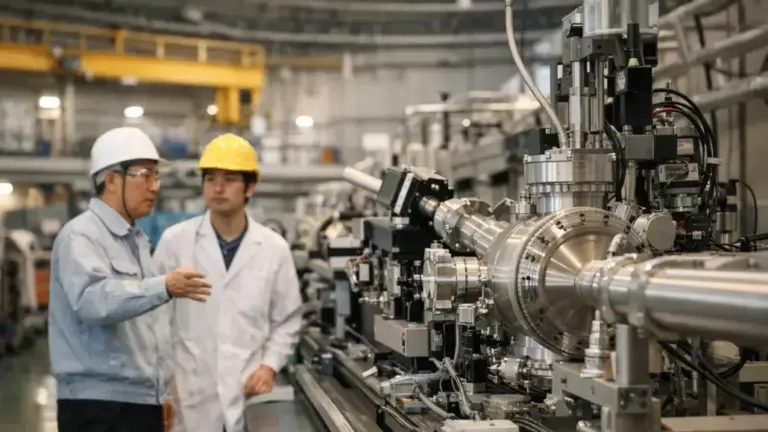
New Energy and Industrial Technology Development Organization – NEDO from Japan and Kyoto University will set up an exclusive beamline for hydrogen energy research at the next-generation SPring-8-II synchrotron facility, NEDO announced on August 20, 2026.
The beamline, designated as the Hydrogen Energy Material Multimodal Measurement Beamline, or BL34XU, will be the world-first dedicated hydrogen beamline at SPring-8-II. NEDO said BL34XU is the world’s first dedicated beamline specialized in the hydrogen energy sphere in the world. It is one of the projects of NEDO’s research and development program that will strengthen common infrastructure in order to expand hydrogen usage.
It is worth noting that the dedicated hydrogen beamline at Spring-8-II is designed for real-world studies of fuel-cell and water-electrolysis materials using multiple state-of-the-art measurement techniques on the identical sample and also under the same conditions at the same time. The idea behind this approach is to enable researchers to see what is going on inside devices like fuel cells and electrolyzers without having to split up tests across separate instruments.
SPring-8-II is a planned successor to the large-scale synchrotron radiation facility SPring-8 in Hyogo Prefecture. The new facility is a fourth-generation synchrotron and will have a brightness roughly 100 times that of the existing SPring-8, achieving what NEDO claimed to be the world’s highest brightness.
The beamline will cover an energy range of 4.5 to 35 keV, +100 keV, linking analysis of materials and devices as well as manufacturing processes on one research platform. In the first experimental hutch, researchers are going to be able to control conditions like temperature and gas as well as electric potential while simultaneously measuring catalysts and polymer electrolyte membranes, which are used in fuel cells as well as water electrolysis.
As per NEDO, simultaneous measurement could mean evaluation about 30 times faster than the previous method, where measurements took almost a month with multiple beamlines. The organization also said the beamline will be used in conjunction with AI and data science to speed up research that has previously needed work involving multiple facilities and instruments.
Interestingly, the second experimental hutch and a longer hutch will be home to manufacturing-process equipment when it comes to mixing and coating as well as drying catalyst ink and also for large-area cells and components at a commercial scale. With the combination of small-angle and ultra-small-angle X-ray scattering with X-ray CT and laminography, one will be able to visualize hierarchical structures from 0.1 nanometers to 100 micrometers.
Construction will start in the latter part of fiscal 2027, which will be the shutdown period for the upgrade of SPring-8 to SPring-8-II from the second half of fiscal 2027 to fiscal 2028. The beamline is planned to start operation in fiscal 2029, and equipment design and purchasing have started since fiscal 2025.
The beamline is designed to be a joint research platform between academic research and national projects, as well as industrial applications in Japan. It has industry advisers from automotive and energy companies to bring in operational requirements from the field.
Notably, hydrogen is one of the strategic fields that Japan has been pushing in its policies as far as green transformation and energy security are concerned. Japan has also been supporting research into fuel cells and water electrolysis for years, via national projects as well as university-led materials science programs.