
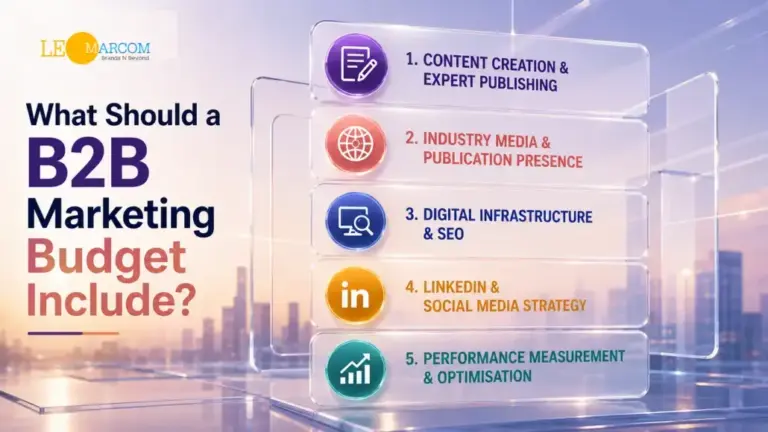
A B2B marketing budget is one of the most important strategic decisions a business makes each year, yet it is one of the most inconsistently planned. Many B2B companies allocate marketing spend reactively, responding to immediate sales pressure rather than investing in the long-term brand authority and lead generation infrastructure that delivers compounding commercial returns.
Consequently, businesses that plan their B2B marketing budget strategically from allocating across content, media presence, digital infrastructure to performance measurement consistently outperform those that treat marketing spend as a cost to minimise rather than an investment to optimise.
Content Creation and Expert Publishing
The foundation of any effective B2B marketing budget is investment in expert content creation. Blogs, whitepapers, case studies, industry reports, video content and thought leadership articles are the assets that build brand authority, generate organic search visibility and educate the professional audiences that eventually become clients.
Furthermore, content investment compounds over time in a way that advertising spend does not every expert article published continues generating organic traffic, building credibility and supporting AI recommendation long after it is written. Therefore, content creation should be treated as the anchor investment in any B2B marketing budget rather than a discretionary line item that gets cut when other costs rise.
Industry Media and Publication Presence
Owned content alone reaches only existing audiences. A well-planned B2B marketing budget must also include investment in industry media presence, the kind of expert visibility that reaches professional audiences beyond a brand’s existing network through trusted third-party platforms.
Moreover, being featured in or advertising within respected industry publications delivers third-party credibility that no owned channel can replicate and positions brands in front of the decision-makers actively researching their sector. World Pharma Today, HHM Global and Power Info Today provide exactly this giving pharmaceutical, healthcare and energy brands direct access to engaged professional audiences through expert-driven industry platforms that build brand authority and generate qualified inbound interest.
Digital Infrastructure and SEO
A B2B marketing budget must include investment in the digital infrastructure that makes everything else work, a professional website that communicates expertise clearly, technical SEO that ensures content is discoverable and analytics tools that measure performance accurately.
In addition, digital infrastructure investment includes the platforms and tools that support content distribution, email marketing, social media management and CRM integration, ensuring that every piece of content produced reaches the widest possible relevant professional audience and every lead generated is captured and nurtured effectively.
LinkedIn and Social Media Strategy
LinkedIn is the primary professional research platform for B2B decision-makers across every major industry. Therefore, a B2B marketing budget should include consistent investment in LinkedIn content strategy expert posts, thought leadership articles and targeted advertising that keeps a brand visible and credible with the professional audiences that drive its commercial pipeline.
Furthermore, organic LinkedIn activity supported by modest paid amplification delivers significantly stronger ROI for most B2B brands than broad digital advertising particularly when content is genuinely expert-driven and consistently published. Mining Frontier, World Construction Today and Packaging World Insights all extend brand reach through social distribution amplifying expert industry content to the professional communities their brand partners need to reach.
Performance Measurement and Optimisation
No B2B marketing budget should be allocated without a corresponding investment in measuring what it delivers. Performance measurement tools analytics platforms, CRM reporting, content performance tracking and lead attribution systems, provide the data needed to optimise spend continuously and demonstrate marketing ROI to business leadership.
Moreover, measurement investment ensures that budget allocation improves over time directing more resource toward the channels and content types that generate the strongest qualified pipeline and away from those that do not. World Finance Informs and Tele Info Today provide measurable advertising and content partnership products that allow B2B brands to track the professional audience reach and engagement their media investment delivers.
Conclusion
A B2B marketing budget should include expert content creation, industry media presence, digital infrastructure, LinkedIn strategy and performance measurement — allocated strategically across brand building and demand generation to deliver both immediate pipeline and long-term authority that compounds in commercial value over time.
At Leo MarCom, we help B2B brands across pharma, healthcare, energy, construction, mining and finance build and execute marketing strategies that make every budget pound and rupee work harder. Subscribe to our newsletter to get the latest industry updates.