
The search for reliable, carbon-free baseload power has led the global energy sector back to the world’s most vast and energetic resource: the ocean. While solar and wind have dominated the renewable transition over the last two decades, wave energy technology is now emerging as a critical third pillar of the marine renewable ecosystem. With a theoretical global potential estimated at over 30,000 TWh per year, ocean waves represent a massive, untapped reservoir of kinetic energy. For policymakers and energy engineers, the central question is no longer whether waves can provide power, but how to deploy wave energy converters (WECs) that are efficient, durable, and economically competitive with established technologies. The ocean’s consistency and high energy density make wave power an ideal candidate for providing the grid stability that more intermittent sources lack.
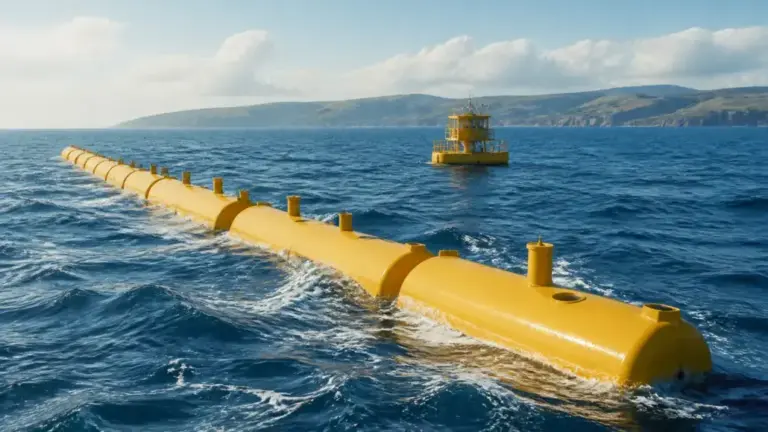
The technical complexity of wave energy technology stems from the diverse ways in which energy can be extracted from the water’s surface. Unlike wind turbines, which have largely converged on a single three-bladed design, WECs come in a variety of architectural archetypes, each optimized for different wave environments. Point absorbers, for example, are buoyant structures that harvest energy from omnidirectional heave and pitch motions. Attenuators are multi-segmented floating structures that flex at hinged joints as waves pass along their length, while oscillating water columns (OWCs) use trapped air to drive bidirectional pneumatic turbines. Each of these designs must solve the fundamental challenge of the marine environment: how to convert low-speed, high-force mechanical motion into high-quality grid-compliant electricity.
The Evolution of Power Take-Off (PTO) Systems
PowerGen Advancement notes that at the heart of any wave energy technology is the Power Take-Off (PTO) system. This is the mechanism that converts the mechanical energy of the wave into electrical power. Traditional PTO systems often rely on hydraulics, which are well-suited for the high forces and low frequencies of wave motion but can be complex and prone to fluid leaks in the sensitive marine environment. To address these issues, the industry is increasingly moving toward direct-drive linear generators and mechanical motion rectifiers (MMR). These advanced PTOs eliminate the need for intermediate fluid stages, improving overall system efficiency and reducing maintenance requirements. Furthermore, the integration of power electronics allows for precise control over the WEC’s impedance, enabling it to be “tuned” to the incoming wave frequency for maximum power capture.
A significant breakthrough in wave energy technology is the development of advanced phase control. Companies like CorPower Ocean have pioneered “WaveSpring” technology, which allows a point absorber to oscillate in resonance with the waves. By dynamically adjusting the phase of the buoy’s motion, these systems can amplify the response in small waves and mitigate the structural loads in large ones. This “negative damping” effect can increase energy capture by up to 300% compared to traditional passive systems, fundamentally changing the economic outlook for wave power. This level of active control is essential for making wave energy a viable and scalable component of the future renewable energy mix.
Survivability and the Harsh Marine Environment
Perhaps the greatest hurdle for wave energy technology is the sheer physical violence of the ocean during storm events. A WEC must not only perform efficiently in moderate seas but also survive 50-year and 100-year rogue waves that can deliver forces equivalent to hundreds of tons. Modern designs solve this through “storm protection” modes, where the device can be automatically submerged or its motion dampened to avoid structural damage. The use of advanced marine energy materials, such as non-corrosive carbon-fiber reinforced polymers (CFRP) and super-duplex stainless steels, is also critical for ensuring a 20- to 25-year service life in a highly saline and biofouling-prone environment.
Furthermore, the deployment of wave energy technology requires a sophisticated understanding of mooring and subsea cabling. High dynamic tension and multi-axis flexing place extreme stress on the dynamic umbilical cables that transport power from the floating device to the seabed collection hub. The industry is currently developing next-generation fatigue-resistant cables and wet-mateable subsea connectors that allow for easier installation and rapid maintenance. By utilizing shared mooring networks in large-scale arrays, operators can significantly reduce the “Balance of Plant” costs, bringing the Levelized Cost of Energy (LCOE) of wave power closer to that of offshore wind.
Hybrid Marine Infrastructure and Co-location
Wave energy technology is increasingly being explored for integration with other offshore infrastructures. Co-locating wave energy converters with floating offshore wind farms offers several strategic advantages. Shared anchor moorings and subsea export cables can reduce the total capital expenditure (CAPEX) of a project by 20% to 30%. More importantly, the power generation profiles of wind and wave are often complementary; waves continue to generate power long after the wind has died down, providing a smoother and more reliable combined output for the grid. This “hybrid offshore energy” model is a key trend in the development of future energy islands.
Beyond utility-scale power, wave energy technology is also finding niche applications in the “blue economy.” WECs can be used to power offshore aquaculture operations, autonomous oceanographic sensors, and subsea oil and gas decommissioning projects. In these scenarios, the ability to provide localized, zero-emission power eliminates the need for expensive diesel deliveries and reduces the risk of environmental contamination. As these niche markets mature, they provide the essential operational data and supply chain development needed to scale wave energy into the global power markets.
AI, Forecasting, and Grid Integration
The future of wave energy technology is also being shaped by digitalization and artificial intelligence. AI-driven predictive control algorithms now use real-time surface radar and LiDAR data to sense incoming individual wave profiles seconds before they hit the WEC. This allows the PTO system to adjust its damping and stiffness on a wave-by-wave basis, optimizing energy capture in real-time. Moreover, the inherent predictability of wave energy—which can be forecasted days in advance with high accuracy using numerical weather models—makes it an ideal partner for more intermittent sources like solar and wind. By providing a steadier and more predictable power flow, wave energy can reduce the need for large-scale battery storage and improve the overall stability of the grid.
In remote island communities and off-grid offshore operations, wave energy technology is already proving its worth. By displacing expensive and carbon-intensive diesel generation, wave power can enhance energy security and provide a sustainable source of electricity for seawater desalination and food production. As the technology moves from individual pilot projects to multi-megawatt commercial arrays, these niche applications will serve as the essential proving grounds for the large-scale utility deployments of the future. The transition to a marine-powered world requires not only technological innovation but also a long-term commitment to maritime engineering excellence.
Strategic Takeaways for Ocean Power Potential
The realization of wave energy technology as a major power source requires a coordinated global effort in engineering, financing, and policy. For the energy sector, the opportunity lies in harnessing the world’s most consistent and dense renewable resource.
Wave energy technology has the potential to provide a massive, predictable source of renewable power that complements existing wind and solar assets. By integrating advanced PTO systems, resonant phase control, and AI-driven forecasting, the industry is overcoming the technical hurdles that have historically limited the adoption of wave power. The success of this transition depends on the industry’s ability to demonstrate structural survivability in extreme storm conditions and to achieve significant reductions in LCOE through array-scale deployments and shared infrastructure models.
To lead in the ocean energy sector, stakeholders must prioritize the development of international standards (such as IEC TC 114) and the modernization of subsea infrastructure. The move toward a marine-powered future requires a holistic approach that includes not only the WECs themselves but also the dynamic cabling, mooring systems, and digital twins needed to manage them safely. PowerGen Advancement believes that by investing in these technologies today, the energy industry can unlock the full potential of the ocean as a sustainable, reliable, and powerful source of clean electricity for a carbon-constrained world.