
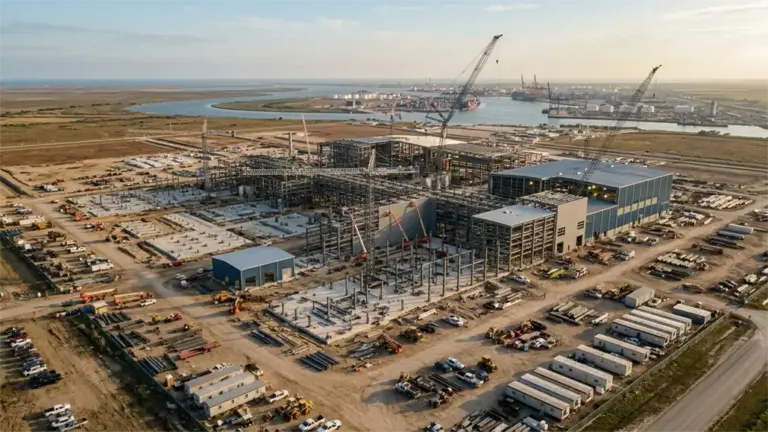
A major expansion by USG Corporation reflects steady growth within heavy industrial and construction materials manufacturing across Texas as suppliers locate nearer to expanding construction and infrastructure demand centers.
It is well to be noted that the USG is developing $1.18 billion manufacturing facility in Texas at Orange which will further develop its U.S. manufacturing network when it comes to gypsum-based building products utilised in commercial and residential as well as infrastructure projects.
This $1.18 billion Manufacturing Facility in Texas is projected to bring in almost 200 jobs and additionally expand USG’s footprint across the state, where the company already has multiple locations that support national construction supply chains.
From a construction perspective, the project is another significant industrial construction for the Gulf Coast pipeline, a space that keeps attracting materials production and energy-adjacent industry as well as logistics-driven development because of its proximity to ports as well as transportation corridors.
The site was a former industrial paper mill, a part of a movement to convert legacy industrial sites into modern production assets. Such renovations often involve substantial ecological clean-up, demolition, and alterations to utility facilities before vertical construction starts.
The Jobs, Energy, Technology and Innovation – JETI program of Texas supports the project, providing qualifying developments with short-term limitations on property tax valuations in return for commitments related to job generation and capital investments.
Local involvement calls for coordination with Little Cypress-Mauriceville Consolidated Independent School District, which is anticipated to play an important part in workforce development efforts linked to the project.
As far as the contractors are concerned, the investment points to ongoing strength within industrial manufacturing construction, especially in materials manufacturing plants that are supporting broader infrastructure and housing demand. These projects usually need specialised construction skills, such as heavy structural work, setup of process equipment and utility systems that have substantial capacity.
Building materials manufacturers across the industry have benefited from continued demand from infrastructure upgrades, housing demands and nonresidential construction activity. Specifically, Texas has grown into a hotbed for new manufacturing investment because of its regulatory environment, labour supply and accessibility to growing regional markets.
While the number of jobs created by the project may be small when compared to some of the large automotive or data center projects, the capital intensity of the project illustrates the scale of modern production infrastructure and its crucial function in stabilising domestic supply chains for construction inputs.
What does this imply for construction owners?
When it comes to the construction owners and contractors, the project represents a larger trend manufacturing industrial materials has grown into a major driver of long-duration construction projects, particularly in states battling for large-scale capital funding.