
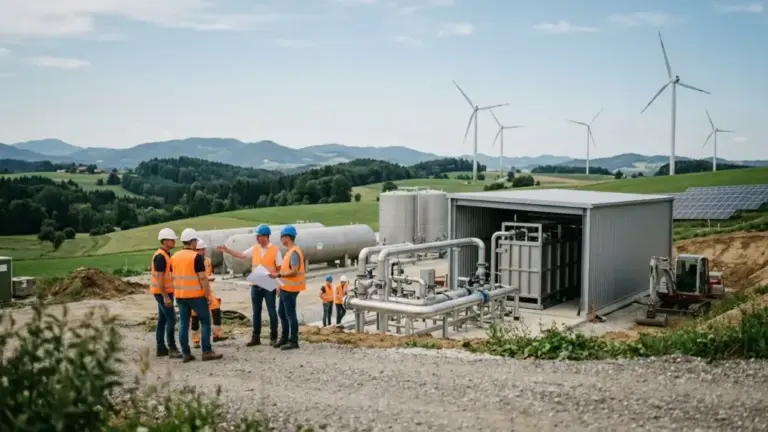
With the symbolic groundbreaking ceremony for the extra 12.5 MW water electrolysis plant, financed by its own resources, RAG Austria is executing the next step in the growth of the RAG Valley in Gampern, Upper Austria.
In this case green hydrogen is generated from renewable energy in summer and thereafter stored so it is accessible in large amounts at all times, which includes winter when there is a shortage of renewable electricity, and it can be utilised for heating and electricity generation to substitute for natural gas over time.
In this phase of scaling up, RAG Austria is partnering with Andritz AG, an established Austrian ally when it comes to industrial plant engineering.
A stronger domestic partnership for more green hydrogen
The largest green hydrogen production plant in Austria, scheduled to be online by the end of 2026, is projected to generate around 17 million m³ which is more than 1,500 tonnes of green hydrogen a year with solar as the main source of renewable energy. It will go on stream at the end of 2026 and be the largest green hydrogen production plant in Austria.
ANDRITZ will supply the plant and also take full accountability for the project execution and completion. The scope of supply – EPC – Engineering, Procurement, Construction goes on to include the whole plant for green hydrogen production and hydrogen purification along with compression systems.
The project strengthens the standing of ANDRITZ as a prominent EPC partner in terms of green hydrogen production plants and corresponds to the strategic focus of the company on technologies that facilitate the ecological transition.
A number of Austrian utilities, such as Energie AG, EVN AG, KELAG, LINZ AG as well as Salzburg AG, have already allocated electrolysis capacity.
Winter of 2025/26 showed that the country did not produce enough electricity
The challenging winter of 2025/26 characterised by its high demand for heating and electricity undoubtedly left its mark. In January and February 2026 renewable electricity generation had been low for several weeks – with barely any sunshine, low and unpredictable wind power, as well as limited hydroelectric power. Therefore, it is apparent that renewables by themselves cannot ensure a stable supply.
It is well to be noted that the high demand for electricity in winter, at the same time partially due to additional heat pumps, could only be met by adjustable natural gas-fired power stations as well as electricity imports from nearby nuclear, coal and gas-fired power plants.
This introduces a fundamental energy policy query back into the public awareness – how to guarantee a sufficient supply of energy in times of low renewable generation?
According to Markus Mitteregger, RAG CEO, “100 per cent renewable electricity on an annual basis does not guarantee a single week in winter. Last winter has shown who actually keeps the system running: our large-capacity gas storage facilities, into which the gas was stored a year earlier, and the adjustable, flexible gas-fired power stations. Thanks to early storage, our facilities were also independent of geopolitical circumstances. We can expect more ‘winters’ in the future, and we must be prepared for them. A resilient energy system must be able to guarantee supply at all times,”
Interestingly, short-term storage, in the form of batteries or pumped storage, is in fact important, but those are designed so as to balance supply and demand on an hour-to-hour or day-to-day basis. They are not in a position to offset generation shortfalls that last for weeks.
Commitments cannot ensure a winter supply – seasonal storage is an essential requirement for the energy transition
The fact is that the change of the energy system is essential and socially desired as well as politically necessary. Industrial companies are expected to have to shift gradually to low-carbon solutions, particularly domestic ones, like green hydrogen. But the increasing electrification of heating significantly boosts the need for electricity, particularly in the cold winter months, whereas the availability of renewable energy sources like solar, wind and hydro is severely constrained throughout this exact time.
The latest storage study by the Austrian government additionally demonstrates that action is required, as it points to a seasonal storage requirement of about 1.2 TWh in 2030 and approximately 7 TWh in 2040. Storage projects needed for this have been identified. There is now a critical need to make investments in these via projects that use electrolysis and hydrogen storage. Renewable energy can only be utilised when the sun and wind are not generating electricity and if there exists sufficient storage capacity.
Remarks Wolfgang Hattmannsdorfer, “We want to supply Austria with affordable renewable energy from within the country all year round. This is precisely where hydrogen comes in: electrolyzes convert domestic solar power into a storable energy carrier, which is why I wholeheartedly welcome the project in Gampern. This will make summer sunshine available in winter, strengthen domestic value creation and make Austria less dependent on energy imports. Projects such as this are a key building block for security of supply, competitiveness and a realistic roll-out of hydrogen in Austria.”