

Liability insurance is becoming harder to price as the cost of claims rises for reasons that go beyond ordinary economic inflation. Larger jury awards, changing attitudes toward corporate responsibility, broader litigation activity and growing legal costs are all adding pressure to the final cost of liability claims. Together, these forces are often described as social inflation, and they are becoming an increasingly important issue for insurers, businesses and the wider insurance market.
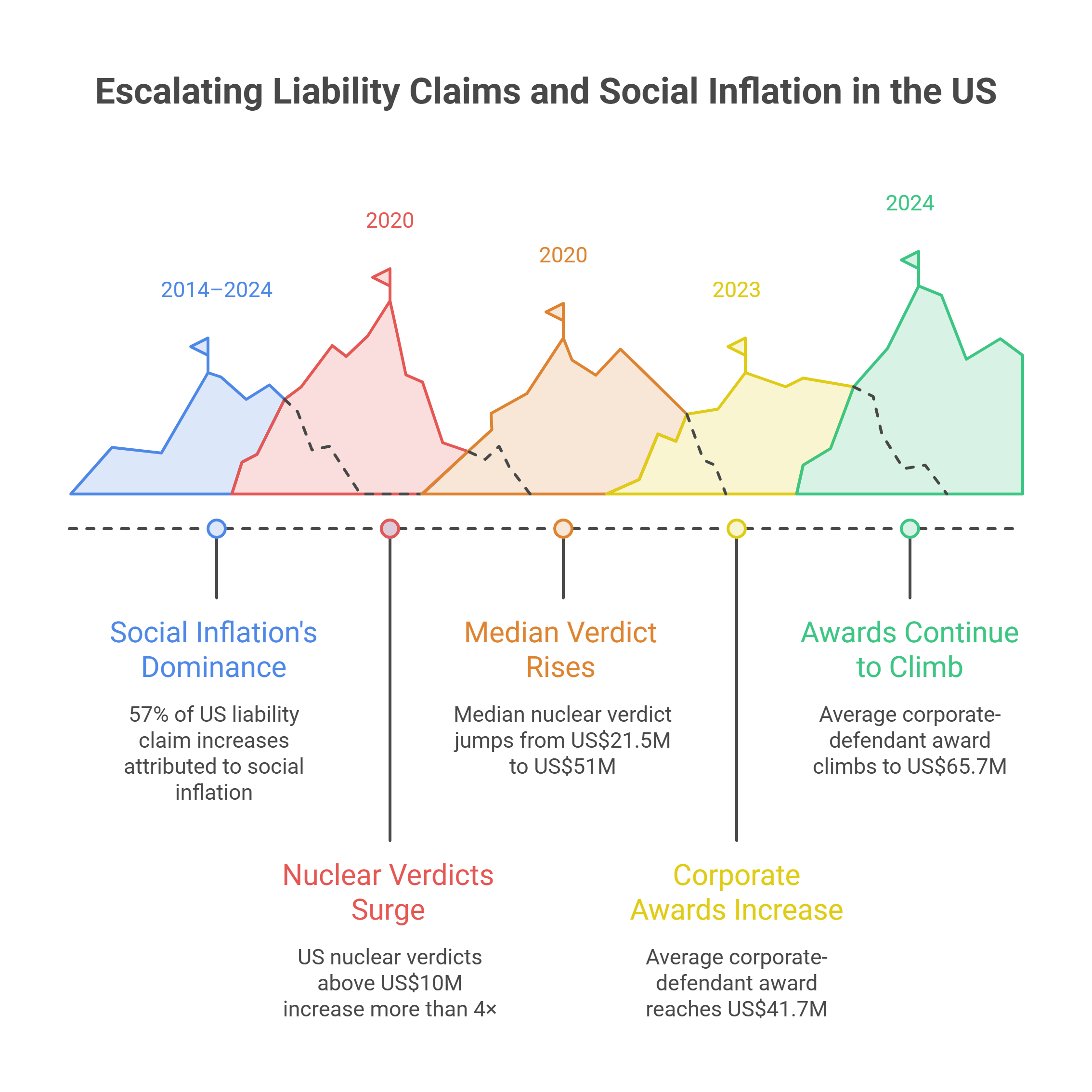
The change is most visible in the United States, where the number of so-called nuclear verdicts, generally awards above US$10 million, has more than quadrupled since 2020. Over the same period, the median value of those verdicts rose from US$21.5 million to US$51 million. In 2024, the average award in cases involving a corporate defendant reached US$65.7 million, compared with US$41.7 million a year earlier.
The financial impact is already reaching beyond individual claims. Recent industry analysis found that US insurers added US$16 billion to prior-year liability loss estimates during 2024 reviews. Across 2015 to 2024, commercial liability lines recorded US$62 billion in adverse reserve development, excluding medical professional liability.
This is why the verdict economy is becoming more than a courtroom issue. When claims become larger and harder to predict, insurers have to rethink the assumptions behind pricing, reserves, underwriting appetite and the amount of risk they are willing to take on.
Social Inflation Is Changing the Cost of Liability Claims
Economic inflation is relatively easy to understand. Medical treatment, wages, repairs and other costs rise, making claims more expensive. Social inflation is different because it describes liability claims costs rising beyond what can be explained by those economic factors alone. The drivers can include changes in attitudes toward corporate responsibility, litigation behaviour, jury decisions, legal marketing and the growing use of large monetary awards.
Recent research estimates that these social inflation factors accounted for 57% of the increase in US liability claims over the decade to 2024. In 2023 alone, social inflation contributed around seven percentage points to liability claims growth, making it a significant source of pressure alongside ordinary economic inflation.
The issue is not confined to one market. Research has identified social inflation pressures in the UK, Australia and Canada as well, although the scale differs significantly between jurisdictions. Legal systems, court structures, rules around collective actions and approaches to compensation all shape how quickly claims costs can rise. The US remains the most exposed market, while other common-law jurisdictions are also showing signs of growing pressure.
That difference matters for global insurers. A multinational business may operate across several legal systems, while an insurer may manage liability portfolios that include risks with exposure to US litigation. Rising claims severity in one jurisdiction can therefore affect the broader cost of international insurance programmes and the amount of capacity available for certain risks.
The financial consequences become clearer when these trends are viewed across an entire liability portfolio rather than through individual lawsuits. A single large verdict can affect one insurer, but sustained changes in claims severity can alter the assumptions used to price thousands of policies. That is where the verdict economy starts to influence the wider insurance business.