
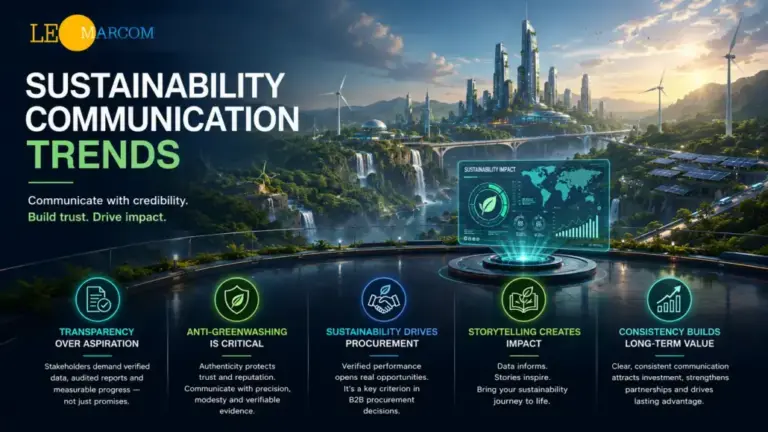
Sustainability communication trends are reshaping how B2B brands engage with investors, procurement partners, regulators and professional audiences across every major industrial sector. The era of vague environmental pledges and aspirational mission statements is over, replaced by a communication landscape that demands verified data, measurable impact and transparent reporting from every organisation that claims a sustainability commitment.
Consequently, brands that adapt their sustainability communication to reflect these emerging trends are building stronger stakeholder trust and more durable professional credibility than those still relying on outdated green messaging frameworks.
Transparency Has Replaced Aspiration
The most significant shift in sustainability communication trends is the move from aspirational to evidential. Stakeholders, investors, procurement teams, regulators and professional partners are no longer satisfied with sustainability pledges and ambition statements. They demand verified data, third-party audited reports and measurable progress against clearly defined targets.
Furthermore, the regulatory environment is reinforcing this shift. Mandatory sustainability disclosure requirements are being introduced across multiple jurisdictions, forcing businesses to communicate sustainability performance with the same rigour they apply to financial reporting. Therefore, brands that have already built transparent evidential sustainability communication frameworks are significantly better prepared for this regulatory transition than those still operating on aspirational messaging alone.
Anti-Greenwashing Is Now a Strategic Priority
Greenwashing is the communication of inflated or unsubstantiated environmental credentials has moved from a reputational risk to a legal one. Regulatory bodies across Europe, North America and increasingly Asia are actively investigating and penalising businesses that make misleading sustainability claims in their marketing and investor communications.
Moreover, professional audiences have become highly sophisticated at identifying greenwashing with procurement professionals, ESG investors and industry media actively scrutinising sustainability claims against available evidence. As a result, brands that communicate sustainability with precision, modesty and verifiable data are building far stronger stakeholder trust than those that overstate their environmental performance. Power Info Today and World Construction Today both cover sustainability developments across energy and construction providing brands with credible platforms to communicate genuine sustainability progress to professional audiences actively tracking sector-wide environmental performance.
Sustainability Is Becoming a Procurement Criterion
One of the most commercially significant sustainability communication trends of 2026 is the integration of sustainability performance into B2B procurement evaluation processes. Increasingly, large organisations are requiring supply chain partners to demonstrate verifiable sustainability credentials before shortlisting, making sustainability communication a direct driver of commercial opportunity rather than simply a reputational consideration.
Therefore, B2B brands that communicate sustainability performance clearly and credibly are not just building better reputations, they are qualifying for procurement opportunities that brands with weak or unverifiable sustainability communication are being excluded from. In addition, sustainability credentials communicated through trusted industry media platforms carry greater procurement credibility than those communicated exclusively through owned channels. HHM Global and World Pharma Today provide pharmaceutical and healthcare brands with exactly this credibility platform communicating sustainability commitments and progress to the professional procurement audiences that evaluate them.
Storytelling Brings Sustainability to Life
Data and reports are essential for credibility but storytelling is what makes sustainability communication resonate with professional audiences. The brands building the strongest sustainability narratives in 2026 are those combining verified impact data with human stories — the communities supported, the emissions reduced, the supply chains transformed and the innovations pioneered.
Furthermore, sustainability storytelling distributed through industry media platforms reaches the professional audiences most likely to respond to it investors, procurement decision-makers and strategic partners who are actively evaluating sustainability performance as part of their broader business relationships. Mining Frontier and Packaging World Insights serve brands in sectors where sustainability storytelling is particularly commercially significant providing credible editorial platforms for mining and packaging companies communicating genuine environmental progress to the professional audiences that shape their markets.
Conclusion
Sustainability communication trends in 2026 are clear transparency over aspiration, evidence over ambition and verified impact over vague pledges. The brands that communicate sustainability with rigour, consistency and genuine credibility are building stakeholder trust that translates directly into investment attraction, procurement qualification and long-term commercial advantage.
At Leo MarCom, we help B2B brands across pharma, healthcare, energy, construction, mining and packaging build sustainability communication strategies that meet the highest standards of professional credibility. Subscribe to our newsletter to get the latest industry updates.