
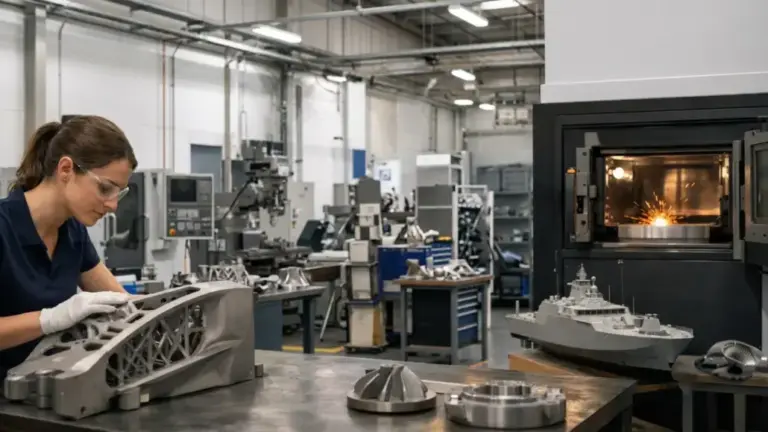
Austal, Curtin University, and the Additive Manufacturing Cooperative Research Center – AMCRC have gone on to announce a $600,000 joint research project that will unlock new additive manufacturing possibilities throughout the maritime and defence supply chain in Australia.
It is worth noting that the global investment in additive manufacturing is growing but one of the biggest barriers when it comes to its broader adoption is determining where the technology provides obvious commercial and supply chain benefit in terms of manufacturing, in-service assistance, as well as standard operations of naval vessels.
Over the course of the next 18 months, the project will create a realistic industry-ready structure to provide consistent procedures for evaluating possibly thousands of elements against commercial, operational, and technical as well as regulatory standards.
When it comes to Austal, the framework marks a transition from standalone additive manufacturing applications to a scalable, systematic method – leading to better-informed decisions in areas where additive manufacturing can minimise lead times, reinforce supply chains and encourage sovereign manufacturing capability.
Interestingly, the project will assist in integrating additive manufacturing possibilities more effectively throughout the business, said Sam Abbott, who is Austal’s Head of Research and Development.
He adds that “the challenge is no longer whether additive manufacturing works. The challenge is knowing where it delivers the greatest value. This framework will help us quantify the demand for additive manufacturing across maritime and defence programs, allowing industry to make better investment decisions, build more resilient supply chains, and accelerate the uplift of Australia’s advanced manufacturing capabilities.”
The fact is that the role as prime contractor that Austal plays for the United States Navy’s Additive Manufacturing Center of Excellence is going to contribute global perspectives and practical manufacturing data to the research.
It will be Curtin University, which will oversee the development and verification of the framework, collaborating closely together with industry and using real-world information from vessels and supply chains to ensure the results are practical and commercially acceptable.
As per Dr. Karl Davidson, Research Lead, the research will help establish a more straightforward path from identifying opportunities to standard execution. He further says that “By combining engineering, operational, and commercial considerations into a single framework, we can help manufacturers make faster, more informed decisions about where additive manufacturing can deliver measurable benefits.”
The project is part of a wider initiative to build advanced manufacturing capability in Australia and speed up industry acceptance as far as additive manufacturing is concerned.
Says Simon Marriott, AMCRC Managing Director Simon Marriott, that the project tackles a key barrier to the much-broader adoption of additive manufacturing by way of helping manufacturers identify as well as select components that are most appropriate for the technology and has the potential applications throughout both defence as well as civil supply chains.
He says that “many organizations understand the potential of additive manufacturing but struggle to determine where it makes commercial and operational sense. This project will deliver a practical solution that helps industry identify high-value opportunities, prioritize investment, and build confidence to scale adoption.”
The structure is anticipated to offer a repeatable model that can be adapted throughout other manufacturing sectors in order to enhance efficiency, resilience, and competitive edge when it comes to Australian businesses, as well as for defence along with maritime applications.