

Building genuine social understanding and authentic connection
Social communication and interaction are at the heart of autism. Most autistic people find social interaction challenging not because they don’t care about others, but because the unwritten rules, rapid processing, subtle cues, and constant shifting expectations of social life are genuinely difficult. Social skills training attempts to teach the skills involved in social interaction, working from the premise that these skills do not always develop naturally in autistic individuals, even when intelligence and motivation are present.
What Social Skills Training Is (and Isn’t)
 Traditional social skills training sometimes taught rigid rules: ‘Make eye contact.’ ‘Smile when people talk to you.’ ‘Take turns in conversation.’ These approaches treated social interaction as a set of rules to be memorised and followed, with little attention to the actual context, the other person’s perspective, or what the autistic person actually feels.
Modern social skills training is different. Rather than teaching rules, it teaches social understanding and flexible problem-solving. It helps autistic individuals develop genuine understanding of why people do what they do, how to interpret social situations accurately, and how to respond authentically given their own autistic perspective.
Core Skills in Effective Social Training
Understanding perspective-taking: recognising that other people have thoughts, beliefs, and feelings that may differ from your own.
Reading context: understanding how setting, social relationships, and unwritten rules shape appropriate behaviour.
Interpreting social cues: understanding facial expressions, tone of voice, body language — with recognition that this is effortful for many autistic people and may require explicit teaching.
Initiating and maintaining interaction: strategies for starting conversations, keeping interaction going, and knowing when to end it.
Managing social challenges: dealing with rejection, misunderstanding, bullying, or conflict.
Identifying areas of genuine interest for friendship: recognising that meaningful friendships are built on shared interests.
Who Benefits Most from Social Skills Training
Social skills training is most beneficial for autistic individuals who:
- Want to improve their social skills (not for those who don’t care about social connection)
- Have the cognitive ability to think about social thinking and problem-solving
- Are school-age or older (younger children learn social skills better through natural peer interaction)
- Are motivated by the specific goals of the training
Best Practices in Social Skills Training
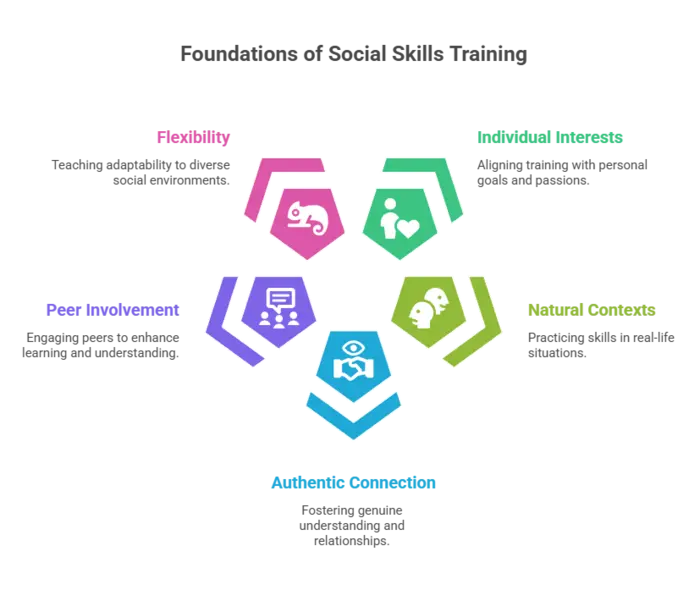
Start with the individual’s genuine interests and goals: If they want friends, teach friendship skills. If they want workplace social success, teach workplace social skills.
- Teach in natural contexts when possible: Learning about conversation in role-play is less powerful than practising conversation with real peers.
- Focus on authentic connection, not compliance: The goal is genuine understanding and authentic ways of connecting that work for the autistic person, not forcing neurotypical social
- Include peer involvement when possible: Training is more effective when actual peers are involved and understand the autistic person’s perspective.
- Teach flexibility, not rules: The goal is understanding so the person can adapt to different contexts, not memorising rules.
Critical insight: Many autistic people struggle with social skills not because they lack intelligence or empathy, but because social interpretation requires rapid, intuitive processing that is hard for the autistic brain. Teaching explicit strategies, frameworks, and problem-solving approaches can make social situations genuinely more manageable.
Key Takeaway
Social skills training, when focused on genuine understanding rather than rule-following and when honouring the autistic person’s authentic way of connecting, can enable more comfortable and meaningful social participation.