
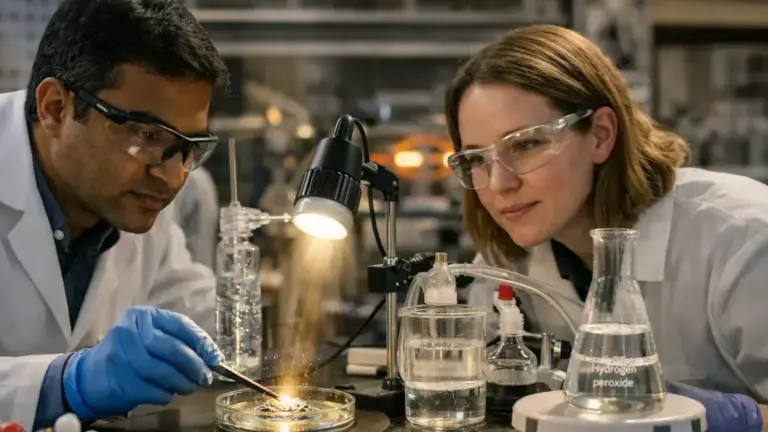
Scientists at the Argonne National Laboratory from the U.S. Department of Energy – DOE created a new material that integrates inorganic material with biological components so as to hydrogen peroxide more effective.
Hydrogen peroxide is widely used when it comes to disinfecting and bleaching as well as whitening everything, right from manufacturing to medicine cabinets. But it is costly to produce, and it is also energy intensive. The research, involving scientists at the Photon Science Innovation Center and Tohoku University in Japan, incorporated a technology called nanoarchitectonics to turn sunlight, air, water into Hydrogen Peroxide. The results were published in the Journal of the American Chemical Society.
21st-century technologies of nanoarchitectonics, artificial intelligence, and quantum information science are of equal importance. According to Jinhyeong Jang, the Argonne postdoctoral fellow, “Nanoarchitectonics is on par with artificial intelligence and quantum information science as one of the most important technologies of the 21st century. Our work demonstrates that we can use it to tune living systems for functional purposes.”
It is well to be noted that Nanoarchitectonics is the assembly of materials into functional architectures from the nanoscale building blocks mostly inspired by living systems.
The material that the researchers created is built from layered nanosheets that are 200 nanometers thick, around 500 times thinner compared to a human hair. The layers make up a hybrid system – bismuth oxychloride, a synthetic semiconducting material, is combined with sections of a purple membrane composed of a naturally occurring light-absorbing biological material obtained from salt-loving microorganisms known as archaea.
The purple membrane acts like a biological solar panel, absorbing the energy of the light when it hits the material. Then, it causes the motion of protons and electrons at the junction with bismuth oxychloride. This process, which sunlight, air, water into Hydrogen Peroxide, is carried out by the semiconductor. The hybrid material generated over five times the amount of hydrogen peroxide compared to the semiconductor alone.
According to scientists at the Center for Nanoscale Materials – CNM, a DOE Office of Science user facility at Argonne, Elena Rozhkova, “Our system operates at ambient conditions and uses only inexpensive, abundant materials,” said Elena Rozhkova, a scientist at the Center for Nanoscale Materials (CNM), a DOE Office of Science user facility at Argonne. “If we were to do the same reaction industrially, it would require high energy input and more complex catalytic systems. Our approach shows how carefully designed nano-bio interfaces can direct chemical reactions under mild conditions.”
The team produced the nanosheets at the CNM and used the advanced electron microscopy tools from CNM in order to study their properties.
Many semiconductors, such as the bismuth oxychloride utilized here, are known catalysts, and purple membranes of archaea are very sturdy, nice, organized biological devices.
Rozhkova added that “But simply combining these properties does not on its own create the catalysis we want. The key is designing their interface to guide how charge moves and to drive a specific chemical reaction.”
In the newest experiment, the researchers have devised a way to extract more value from several parts of the catalytic reaction. As well as producing hydrogen peroxide, the system also turns ethylene glycol, which is a low-cost industrial chemical, into higher-value substances such as glycolaldehyde, glyoxal, and formic acid.
Nanoarchitectonics is a flexible and intriguing technique that can be used for a variety of challenges such as producing fertilizer and fuel components, said Jang.
He further says that “Driven by a spirit of innovation, we will continue exploring this chemistry and seeking new applications across chemical and materials systems that address national priorities in manufacturing and advanced technologies.”
This research was supported by the DOE Office of Science. Authors include Yuzi Liu and Jianguo Wen of Argonne, Haruki Meguro of the Photon Science Innovation Center as well as Tetsuya Nakamura of the Photon Science Innovation Center and Tohoku University.