
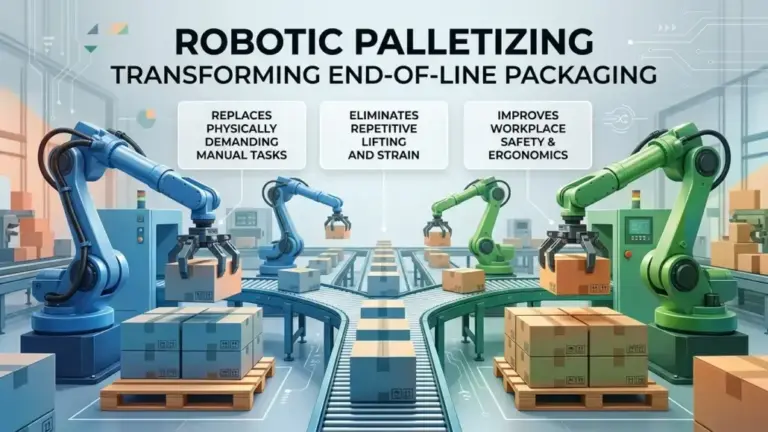
The final stage of the manufacturing process, where finished products are stacked and secured onto pallets for shipping, has traditionally been one of the most labor-intensive and physically demanding areas of the factory. For many years, this “end-of-line” task relied on human workers to lift, twist, and stack heavy boxes in repetitive motions, leading to a high rate of workplace injuries and chronic physical strain. However, the rise of advanced automation is fundamentally changing this dynamic. The adoption of mechanical assistance in the warehouse environment is no longer just an option for the largest firms; it is becoming a standard practice as robotic palletising transforming end-of-line operations provides a safer and more efficient alternative to manual labor.
Robotic palletizing involves the use of articulable robotic arms equipped with specialized grippers to move products from the conveyor line to the pallet. Unlike traditional mechanical palletizers, which are often large, rigid, and limited to a single product type, modern industrial robotics are highly flexible and can be programmed to handle a wide variety of box sizes, weights, and stacking patterns. This versatility is essential for modern facilities that must manage a diverse range of secondary packaging formats. By automating this final step, firms can ensure that their products are prepared for transit with a level of precision and speed that human workers cannot match.
Enhancing Labor Safety and Workplace Ergonomics
The primary driver for the adoption of robotic systems in the warehouse is the improvement of labor safety and the reduction of ergonomic risks. Palletizing is a physically punishing task that is often performed in a high-speed environment, which is a perfect recipe for musculoskeletal disorders and acute injuries. By replacing human workers with robots, firms can eliminate these risks and create a much safer work environment. This not only reduces the direct costs associated with workers’ compensation claims but also improves the overall morale and retention of the workforce.
The focus on workplace ergonomics is also a key part of the broader corporate social responsibility goals of many modern organizations. When robotic palletising transforming end-of-line tasks is implemented, the human workers can be transitioned to more engaging and less physically taxing roles, such as system monitoring or quality control. This shift in the labor force is a necessary response to the growing shortage of workers who are willing or able to perform repetitive heavy lifting. The investment in industrial robotics is therefore a strategic move that addresses both the ethical and the practical challenges of modern manufacturing.
Optimization of Pallet Configuration and Stability
The stability of a pallet during transit is a critical factor in preventing product damage and ensuring the safety of logistics personnel. A poorly stacked pallet can shift or collapse, leading to significant losses and potential accidents in the warehouse or on the road. Robotic systems utilize sophisticated software to calculate the optimal pallet configuration for every load, ensuring that the weight is distributed evenly and that the stack is as stable as possible. This level of precision is particularly important when dealing with mixed loads or irregularly shaped packages that are difficult to stack manually.
Modern robotic palletizers can also be integrated with stretch wrapping systems to secure the load as soon as it is built. This seamless coordination ensures that the pallet remains intact from the moment it leaves the robotic cell to the moment it arrives at its destination. The ability of robotic palletising transforming end-of-line workflows to provide this level of consistency is a major advantage for firms that are looking to reduce their shipping costs and improve their customer service. A perfectly built pallet is a hallmark of a professional and high-quality manufacturing operation.
Secondary Packaging and Material Handling Efficiency
The role of industrial robotics in the warehouse extends beyond the simple act of stacking boxes. Modern systems are designed to integrate with the broader material handling infrastructure, including automated guided vehicles (AGVs) and conveyor networks. This high degree of connectivity ensures that the flow of secondary packaging is never interrupted and that the final products are moved to the loading dock as quickly as possible. The efficiency gains from this level of automation are substantial, allowing the facility to maintain a high rate of production without the bottlenecks that often occur at the end of the line.
Robotic palletizing also allows for a more efficient use of floor space in the warehouse. Modern robotic cells have a smaller footprint than traditional mechanical palletizers, which can be a significant advantage for facilities with limited space. Furthermore, some systems can be mounted on rails or gantries to serve multiple production lines simultaneously, further increasing their utility and return on investment. The ability to handle complex and high-volume tasks in a compact area is a key feature of the modern end-of-line packaging environment.
Strategic Investment in Warehouse Automation
For firms looking to stay competitive in a global market, the investment in warehouse automation is a critical component of their long-term strategy. The benefits of robotic palletizing extend across the entire organization, from improved productivity and lower labor costs to enhanced safety and quality. As the technology continues to mature, it is becoming more accessible and easier to use, with intuitive interfaces that allow for rapid programming and troubleshooting. This democratization of industrial robotics is a major trend that is set to reshape the final stages of the manufacturing process for decades to come.
The data generated by these systems also provide a wealth of information for process optimization and warehouse management. By tracking the number of pallets built and the time taken for each task, managers can identify trends and anomalies that may indicate a need for adjustment. This data-driven approach allows for a level of operational oversight that was previously impossible in a manual environment. The success of any modern manufacturing operation depends on the seamless coordination of every step, and the end-of-line process is the final piece of the puzzle.
Conclusion
The transition toward a more automated and robotic-led end-of-line process is a fundamental shift in the packaging industry. By replacing traditional manual and mechanical methods with flexible, intelligent systems, firms can achieve a level of operational precision and safety that supports their long-term growth. The benefits of robotic palletising transforming end-of-line operations are visible in every aspect of the warehouse, from the physical well-being of the staff to the stability of the final shipments.
As the industry moves toward more customized production and smaller batch sizes, the need for flexible and responsive palletizing systems will only grow. The ability to handle a wide variety of packaging formats with minimal downtime will remain a key differentiator for successful firms. The ongoing commitment to warehouse automation and robotic innovation will continue to provide the foundation for a more efficient, safe, and profitable manufacturing sector.