
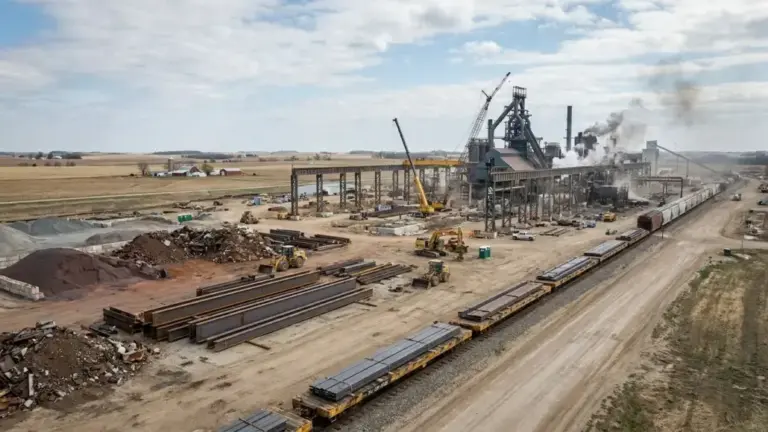
Donald Trump, the U.S. President, said on September 28, 2026, that a Minnesota company will build a multi-billion-dollar steel mill in Iowa, giving the administration a marquee manufacturing investment to demonstrate as Republicans advance into the November midterm elections.
Trump announced the project at the White House alongside leaders of Mesabi Metallics, which recently inaugurated Minnesota’s first new iron ore mine in 50 years. The White House said the investment would be $15 billion in the plant.
The announcement comes amid Trump’s push to highlight his economic record ahead of November elections, with his approval rating recently hitting all-time lows as the Republican Party struggles with voter concerns over inflation and the cost of living. Tariffs and a revival of US manufacturing have been the center-piece of Trump’s economic agenda, with higher barriers to imports argued to drive investment and jobs back to the US.
But Republicans have several competitive elections taking place in Iowa, a onetime swing state that has voted more reliably for Trump’s party in recent years. This cycle, polls show a tight race for both a seat in the US Senate and the state’s gubernatorial race, with most polls showing Democratic candidate Rob Sand leading.
It is well to be noted that the proposed $15 billion steel project gives Trump a high-profile investment he can cite as he makes that case to voters. It also comes as the administration faces pressure to show its policies of broad tariffs on US imports can deliver industrial gains without igniting inflation. This is a tremendous investment – Trump said from the Oval Office of the White House.
Our steel industry is coming back to life is what he added.
New Jobs Anticipated
Overcapacity, notably in China, and lacklustre demand have contributed to a softening of global steel markets in recent months. But in the US steel prices are higher because of trade barriers making domestic projects more attractive even if construction costs are high.
During his first term, Trump implemented a 25% tariff on most imported steel, a policy his successor, Democrat Joe Biden, has largely kept in place.
American steelmaker Cleveland-Cliffs idled some production at its Hamilton, Ontario, plant in Canada and will lay off hundreds of workers, citing damage from U.S. tariffs, CBC News reported on September 28, 2026.
revival of US manufacturing US began in 2025, with industrial production data from the Federal Reserve showing output rose at the fastest pace in nearly four years. Factory jobs, which fell by 113,000 in Trump’s first year back in the White House, also have bounced back a bit this year, increasing by 56,000 through August, as reported to the Bureau of Labour Statistics.
The new project will be completely vertically integrated, with Mesabi taking iron ore from its Minnesota mine to Iowa to make steel. In the first phase, it will produce 7.5 million tonnes of steel a year, with the plant projected to reach 10 million tonnes. It was hailed by the White House as the largest steel plant in US history.
Notably, the announcement was first reported by The Wall Street Journal.
The Mesabi steel project would utilize iron ore mined from the company’s operation in Nashwauk, Minnesota, approximately 250 miles from the Iowa border.
Mesabi is owned by India’s Essar Group, which has put over $2.5 billion into the Minnesota mine.
Earlier in September 2026, the US Export-Import Bank said it would fund $10 billion for the mine’s expansion, and the bank’s chairman, John Jovanovic, visited the site.
The White House said the Iowa steel plant will create a minimum of 1,750 permanent jobs. The first phase is also expected to support around 6,000 construction jobs.
It was not immediately apparent why Mesabi would want to build a steel mill in Iowa out of iron ore mined in Minnesota.
Commercial electricity is a little cheaper in Iowa than Minnesota, and power is a big cost for steel producers.
The White House says the first phase of the project will have an overall economic impact of $95 billion at the time of construction and the first 10 years of operation. The first steel production is anticipated by 2030.