
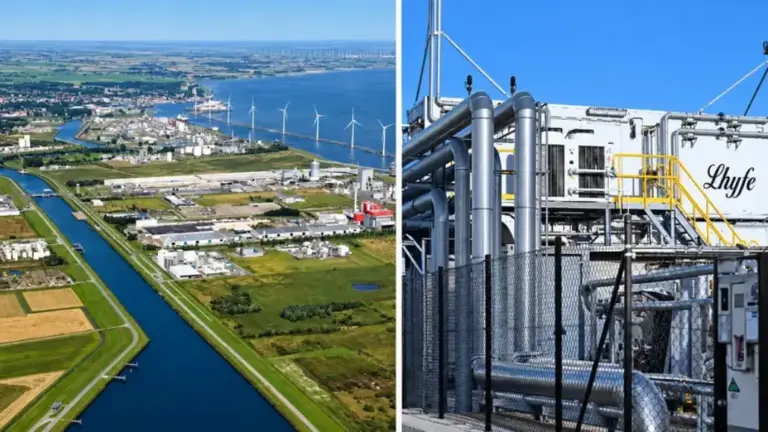
Perpetual Next, the sustainable raw materials producer and Lhyfe Delfzijl, a subsidiary of Lhyfe, one of the leading companies in green and renewable hydrogen production for decarbonizing industry and mobility in the world, have signed a Memorandum of Understanding – MoU so as to investigate the possibility for long-term supply of renewable hydrogen in DeltaNor biomethanol production plant by Perpetual Next located in Delfzijl, the Netherlands.
It is well to be noted that biomethanol is a viable pathway for decarbonization of difficult-to-electrify sectors such as the shipping sector and the chemical industry. Renewable hydrogen can boost the outputs of production by adding to the hydrogen in biomass-derived syngas to transform a greater amount of biogenic carbon into biomethanol.
Lhyfe has four production sites already set up in Europe, to be six by the end of 2026. The company advances in the development of large-scale on-site projects of upward of several hundred megawatts in scale. The fact is that the Netherlands is one of the most advanced green hydrogen markets in Europe, and Lhyfe is developing projects there, including this large 120 MW project in Delfzijl.
Perpetual Next is additionally constructing one of five biomethanol facilities at different stages of development within the same industrial cluster, DeltaNor, as a 220,000 tonne-per-year biomethanol production facility.
Lhyfe Delfzijl and Perpetual Next will, under the MoU, look at the prospect of integrating renewable hydrogen from the planned DelfzHyl renewable hydrogen production facility into Perpetual Next’s DeltaNor facility.
The partners are targeting an off-take of around 12,000 tonnes of renewable hydrogen a year. Any supply arrangement would be subject to additional technical and commercial assessment.
Notably, Delfzijl is already a big user of hydrogen as a chemical feedstock. Location is massive for the industrial and chemical industry. This need will increase significantly in the future as decarbonization will be inevitable in the long term. Particularly, under the revised Renewable Energy Directive – RED III, Member States ought to guarantee that renewable hydrogen – RFNBO makes up a minimal share of industrial consumption of hydrogen by 2030 and 2035.
The CEO of Perpetual Next, René Buwalda, said, “Access to competitively priced renewable hydrogen will be an important consideration in the continued development of DeltaNor. This MoU gives both companies a structured framework to evaluate how locally produced renewable hydrogen could support our biomethanol facility while strengthening the development case for both projects.”
Luc Graré, who is the Chief Strategy Officer at Lhyfe, said, “This agreement reflects the strong industrial complementarity between our renewable hydrogen project in Delfzijl and Perpetual Next’s biomethanol development. It illustrates the growing role of renewable hydrogen in decarbonizing hard-to-abate sectors. We look forward to working together to demonstrate the synergies between the two projects within the Delfzijl industrial cluster and to strengthen their respective industrial cases, including in the context of the public support schemes required to enable their development.”
The parties will now proceed with their technical and commercial negotiations, including an assessment of a renewable hydrogen supply arrangement, and support the further progress of their respective initiatives in Delfzijl.