
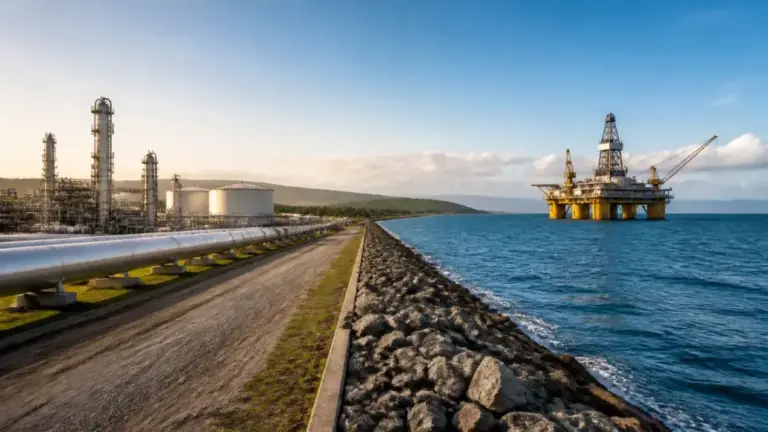
The global energy sector, spanning both traditional hydrocarbons and emerging renewables, is fundamentally defined by the choice between offshore and onshore development. While the objective remains the same—harvesting energy and transporting it to markets—the infrastructure required to achieve this goal differs dramatically. When comparing between offshore and onshore infrastructure, the decision-making process involves a complex trade-off between resource quality, capital intensity, environmental exposure, and operational risk. For energy companies and policymakers, understanding these fundamental differences is critical for long-term strategic planning and capital allocation in an increasingly resource-constrained world.
Onshore infrastructure is characterized by its relative accessibility and lower cost of entry. Capital expenditure (CAPEX) for onshore oil and gas facilities or wind farms is significantly lower than for their offshore counterparts. This is primarily due to the simpler engineering requirements for foundations, the ability to use standard heavy-duty construction equipment, and shorter, terrestrial supply chains. Onshore assets benefit from terrestrial logistics, where materials can be transported via road or rail, and labor is readily available. Furthermore, operational expenditure (OPEX) is typically much lower onshore, often representing only 10% to 15% of the total lifetime cost of the asset. Maintenance teams can easily access onshore sites for routine inspections, and repairs can be executed quickly without the need for specialized marine vessels.
However, onshore infrastructure faces its own set of challenges, particularly regarding land use and social license. Projects must navigate complex zoning laws, private property rights, and environmental impact assessments that can be stalled by local opposition and NIMBY (Not In My Backyard) sentiments. In many regions, the best onshore resource sites have already been developed, leading to a diminishing returns scenario where new projects must be located in increasingly remote or challenging terrains. Additionally, onshore wind resources are often more turbulent and less consistent than those found at sea, limiting the capacity factor of onshore renewable energy infrastructure and necessitating larger land footprints to achieve equivalent power outputs.
The High Stakes of Offshore Marine Engineering
In contrast, the debate between offshore and onshore infrastructure reveals that marine environments offer vastly superior resource potential at the cost of extreme technical complexity and financial risk. Offshore platforms and wind turbines can tap into much larger and more consistent energy flows. In the oil and gas sector, offshore fields often host massive reservoirs that far exceed the scale of onshore plays. In renewables, offshore wind speeds are typically higher and more stable, allowing for the deployment of 15MW to 18MW turbines that are simply too large to be transported overland or installed on terrestrial sites. However, capturing this energy requires a level of engineering that is more akin to aerospace design than traditional construction.
The CAPEX for offshore infrastructure is often two to three times higher than onshore. Foundations must be designed to withstand extreme hydrodynamic loads, including 100-year storm surges, constant wave slamming, and seabed scour. In shallow waters, fixed-bottom structures like monopiles or jackets are used, but as projects move into deeper waters beyond 60 meters, the industry is transitioning to floating offshore infrastructure. Technologies such as semi-submersibles, SPARs, and Tension Leg Platforms (TLPs) are being deployed to unlock energy in regions previously considered inaccessible. The cost of subsea power cables and offshore substations adds another layer of financial burden, particularly as projects move further from the coast, requiring High Voltage Direct Current (HVDC) transmission with Voltage Source Converters (VSC) to minimize energy losses over the vast distances involved.
Maintenance, Accessibility, and Operational Risks
One of the most defining differences between offshore and onshore infrastructure is the logistics of maintenance. Offshore assets are governed by the harsh reality of metocean conditions—the combined impact of meteorological and oceanographic factors. Maintenance accessibility is strictly limited by significant wave height (Hs) and wind speed windows. Routine operations often require specialized Crew Transfer Vessels (CTVs), while major interventions depend on multi-million dollar Service Operation Vessels (SOVs) equipped with motion-compensated Walk-to-Work (W2W) gangways. If a major component fails, such as a subsea export cable or a wind turbine gearbox, the cost of mobilizing a heavy-lift jack-up vessel or a Wind Turbine Installation Vessel (WTIV) can exceed $250,000 per day, leading to astronomical repair bills and significant operational downtime.
Corrosion management is another area where offshore and onshore infrastructure diverge significantly. Offshore assets are placed in the most corrosive environments on Earth, classified by ISO 12944 under the extreme Category CX. Preventing structural failure requires high-performance epoxy coatings, sacrificial zinc/aluminum anodes, and Impressed Current Cathodic Protection (ICCP) systems. The lack of physical accessibility means that operators are increasingly relying on digital technology, such as structural health monitoring sensors, Digital Twins, and autonomous underwater vehicles (AUVs), to track asset integrity without sending human crews into hazardous marine environments. This reliance on remote technology is a key driver of the digital transformation in the offshore sector.
Regulatory Landscape and Environmental Governance
The regulatory frameworks governing between offshore and onshore infrastructure also differ fundamentally. Onshore assets typically fall under the jurisdiction of municipal zoning boards, state environmental departments, and national agencies such as the EPA in the United States. In contrast, offshore assets must navigate a complex web of international and federal maritime law. This includes UNCLOS (United Nations Convention on the Law of the Sea), which defines Exclusive Economic Zones (EEZ) up to 200 nautical miles offshore. In the US, the Bureau of Ocean Energy Management (BOEM) and the Bureau of Safety and Environmental Enforcement (BSEE) oversee leasing and safety, while international environmental conventions like OSPAR govern the North Atlantic.
The environmental impact of offshore projects, particularly on marine biodiversity and subsea habitats, is subject to intense scrutiny. Marine Spatial Planning (MSP) is increasingly used to balance the needs of energy development with commercial fishing, maritime shipping, and conservation. Onshore, the focus is more on terrestrial biodiversity, groundwater protection, and noise pollution. For both environments, the ability to secure the necessary permits depends on a thorough and transparent Environmental Impact Statement (EIS), but the scope and complexity of these studies are often much greater for offshore developments due to the less-understood nature of deep-sea ecosystems.
Security, Geopolitics, and Decommissioning
The strategic risk profile of offshore and onshore infrastructure has shifted significantly in recent years due to heightened geopolitical tensions. Offshore assets, including pipelines, subsea telecommunication cables, and power interconnectors, are increasingly viewed as vulnerable points in national security. The vastness of the ocean makes these assets difficult to monitor and protect against grey-zone sabotage or accidental damage from commercial fishing and anchor drags. While onshore assets also face security risks, their relative accessibility allows for more rapid response and repair, whereas an incident at a deep-sea pipeline can take months to resolve.
Finally, the end-of-life phase presents a massive challenge for offshore infrastructure. Decommissioning a large offshore platform or a wind farm is a monumental task that must comply with strict international environmental mandates like the OSPAR Decision 98/3. Removing thousands of tons of steel and concrete from the seabed, while restoring the marine habitat, is an expensive and technically demanding process that must be planned for decades in advance. Onshore decommissioning, while still regulated, is generally far simpler and less costly, often involving the recycling of materials and the restoration of the land to its original state, which can often be returned to agricultural or commercial use.
Choosing the Right Strategy for Energy Assets
The choice between offshore and onshore infrastructure depends entirely on the specific goals of the project, the geographical context, and the risk appetite of the investor. Onshore projects offer faster returns, lower initial costs, and easier maintenance, but they are increasingly limited by resource quality and land availability. Offshore projects offer massive scale, superior energy consistency, and the potential to revolutionize the energy mix, but they require vast capital, specialized marine expertise, and a high tolerance for operational and environmental risk.
When evaluating between offshore and onshore infrastructure, it is clear that neither is a universal winner. Onshore remains the backbone of the global energy system due to its economic efficiency and logistical simplicity. However, the future of large-scale energy transition, particularly for countries with limited land but extensive coastlines, lies offshore. The move toward floating platforms, subsea processing technology, and green hydrogen production is narrowing the gap, but the fundamental challenges of the marine environment will always ensure that offshore assets remain the high-stakes, high-reward segment of the industry.
Operators must adopt a holistic lifecycle approach to both onshore and offshore infrastructure. This means integrating digital twins, predictive maintenance, and autonomous monitoring from the design phase to minimize the higher OPEX of offshore assets and navigating the social and regulatory hurdles of onshore developments with equal care. Oil & Gas Advancement believes that as technology continues to evolve and supply chains mature, the distinction between these two realms may blur, but the physical reality of the land and sea will continue to shape the global energy map for generations to come, requiring a diversified and resilient approach to energy development.