
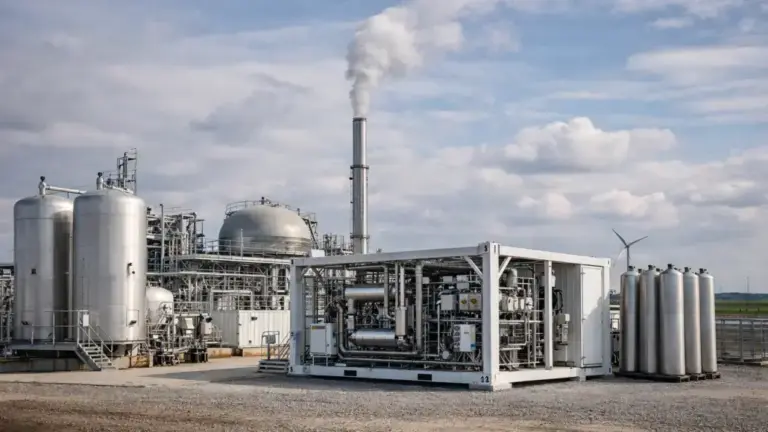
In a latest news, Nordenham Innovation Center commissions new hydrogen plant. Dieter Sichau, Managing Director of the INP, Dr. Stefanie Abke, Executive Director of the EWE Foundation, as well as the District Administrator, Stephan Siefken, jointly listed out the significance of the project, its funding, and its potential when it comes to the Wesermarsch region.
A joint project in energy transition
Apparently, the hydrogen project was launched in 2023. It started its operations as a joint venture, with finance applications being shared with NBank, the EWE Foundation, and the Wesermarsch district, as well as the city of Nordenham. As per Dieter Sichau, INP Managing Director, “NBank finances only technical components, but a project like this also requires personnel resources.
Via the mix of technical assistance along with personnel support, this project went on to become a regional joint venture, the work of which goes beyond the Wesermarsch region across the entire JadeBay region.
A funding of 450,000 euros for the hydrogen plant
Interestingly, the hydrogen plant by itself represented an investment of almost €450,000, with the funding being provided as 40% by NBank along with 60% by the shareholders of JadeBay. Additionally, the EWE Foundation is offering €210,000 funding over three years when it comes to both personnel and development costs to make sure that educational assistance along with technical training is adequately provided.
Dr. Stefanie Abke stated that “We only fund personnel if it is part of a professional overall concept – and that is the case here.”
Technical outcomes along with new research collaborations
It is worth noting that the plant has already been operated successfully and that too many times. Simultaneously, there are more research projects that are already underway, such as the WENDE project of Karlsruhe Institute of Technology – KIT that involves prominent German research institutions like DLR and DECHEMA, and investigations into which water types are appropriate for future hydrogen production. Notably, the German Aerospace Center – DLR in Oldenburg has conducted purity measurements of the produced hydrogen recently. The outcomes are most likely to be published soon.
What lies ahead – Expansion of INP and hydrogen as a building tech
As Nordenham Innovation Center commissions new hydrogen plant, it is looking forward to having an extension to meet the demand, which has risen pretty sharply. The center has been functioning at full capacity for 3 years. Plans for the extension go on to include geothermal supply of energy, equipping one of the floors with hydrogen heating technology, and also putting in place a hybrid system with a switchover alternative to the regular heating technology. As per Sichau, “We want to demonstrate how modern building technology can work with hydrogen.”
Digital learning setup – Over 3,000 students every year
One of the major elements of the project is its educational work. The digital learning of ILP teaches students technical as well as scientific skills, be it in hydrogen and 3D printing to drone tech. It is well to be noted that in the first year itself, 660 students visited the center, in the second year, that number rose to 2,015, and in 2026, it has touched 3,020. The INP is very much known among schools even beyond the district as a prominent digital learning place.
The EWE Foundation has offered more support to the learning center with €45,000 when it comes to a qualified educator, who has since joined permanently. Stephan Siefken, the District Administrator, stressed that, “In today’s world, a good idea is not enough – it also needs funding. We are grateful for the strong partners at our side.”
Regional significance for energy shift
The INP is indeed growing into a significant location when it comes to hydrogen technology as well as technical education across Northwest Germany. The integration of research and application along with education has made the center a flagship when it comes to regional energy shift.