
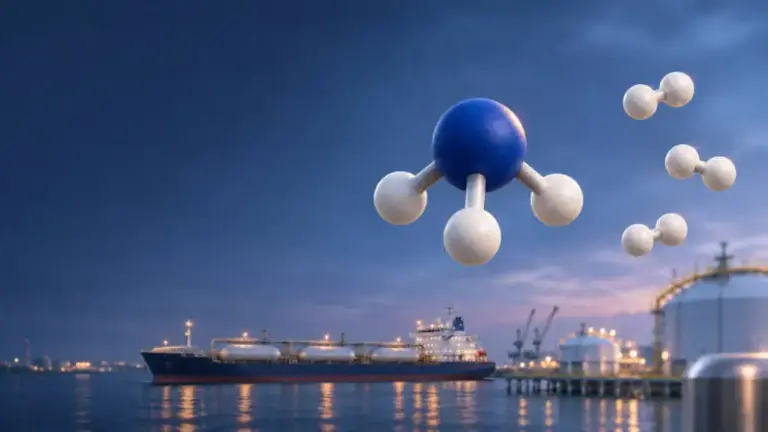
Researchers have gone ahead and made a nickel-based catalyst that efficiently pulls hydrogen from ammonia without making use of ruthenium, which is a costly precious metal. The breakthrough is expected to make breaking apart ammonia, a hydrogen carrier, cheaper and so thereby improve the financial feasibility of delivering hydrogen over long distances.
A team led by Professor Cho Seung-ho of the Department of Materials Science and Engineering at the Ulsan National Institute of Science and Technology went on to develop a highly efficient ammonia decomposition catalyst known as NiCrAl-RMMO, which integrates nickel, chromium, and aluminum, the institute said on November 16, 2026.
The process that pulls hydrogen from ammonia was done in collaboration with Kim Hong-dae, the senior researcher of the Korea Institute of Industrial Technology, along with a team led by Yeungnam University’s Professor Kim Min-kyu. The findings were published on October 7, 2026, in the international journal Advanced Science.
It is well to be noted that hydrogen has a low energy density per volume. This makes it costly to ship over extended distances or to store as gas. Ammonia, however, has a high hydrogen content and is easy to liquefy and, at the same time, can utilize standard transport and storage infrastructure, thereby making it a frontrunner when it comes to being a hydrogen carrier.
But cracking ammonia to nitrogen and hydrogen at the point of application is a highly endothermic reaction, which requires large amounts of energy. Ruthenium catalysts have been the preferred option due to their high reaction activity, but their high cost and scarce supply have been a constraint for mass production. The main alternative is nickel. It is cheap, but the particles tend to stick together at high temperatures, and the rate of surface reactions is slow.
In order to make the nickel more reactive and to stop the particles from sticking together, the team developed a method to control the electronic state and structural stability of the material. Making use of density functional theory calculations, the researchers determined that chromium is the metal that exchanges electrons with nickel most effectively among iron, cobalt, copper, manganese as well as chromium.
They then employed a layer-based double hydroxide as the base material, which enables different metals to be combined uniformly at the atomic level. They mixed nickel with chromium and aluminum and then heated the material in air at 600 degrees Celsius in order to oxidize it. Then they decreased the material in a pure ammonia setting. The final catalyst had uniformly dispersed active particles. The addition of chromium also reduced the temperature required to activate the catalyst.
Chromium and aluminum in the catalyst play different roles, one promoting the reaction while the other supporting the structure. And the nickel, which receives electrons from the chromium, has a higher electron density around it.
When ammonia adsorbs on Lewis acid sites on the catalyst surface, it tends to break down stepwise as it eliminates hydrogen atoms one at a time. The electron-rich nickel minimizes the energy barrier necessary to break nitrogen-hydrogen bonds. It also reduces the electronic energy state of nickel, the so-called d-band center, reducing the pressure that attaches to the nitrogen gas generated after the reaction to the surface. Nitrogen also leaves the surface faster, which allows more sites to be available for the next ammonia molecule to react. The aluminum is in oxide form and binds to the nickel particles and prevents them from colliding at high temperatures.
In the performance test, the catalyst reached a decomposition rate of 95.5% at 550 degrees Celsius with a feed rate of 20,000 milliliters of ammonia per gram per hour. Conversely, a control catalyst made with just nickel had a decomposition rate of less than 10% under the same conditions of use. The catalyst was able to produce 22.83 millimoles of hydrogen per gram per minute when the ammonia feed rate was increased to 30,000 milliliters per gram per hour at 500 degrees Celsius. In a 100-hour durability test at 525 degrees Celsius, its original achievement and its uniform particle structure were maintained. Conversely, a catalyst without aluminum demonstrated low activity due to particle aggregation, and a catalyst containing no chromium lost its electron-supply effect and decreased in performance over time.
We have surpassed the limits of non-precious-metal catalysts by uniformly distributing active particles while meticulously regulating the electronic state of the particles,” the research team said. “This may reduce the cost of producing hydrogen from ammonia and can be applied to the design of other energy and environmental catalyst systems.”
Co-first authors are Kim Dong-hyuk of UNIST, Kim Su-jin of the Korea Institute of Industrial Technology, and Kim Ga-young of Yeungnam University. This research was made possible by the National Research Foundation of Korea -under the Ministry of Science and ICT, the Ministry of Trade, Industry and Energy, the InnoCORE program, and UNIST.