
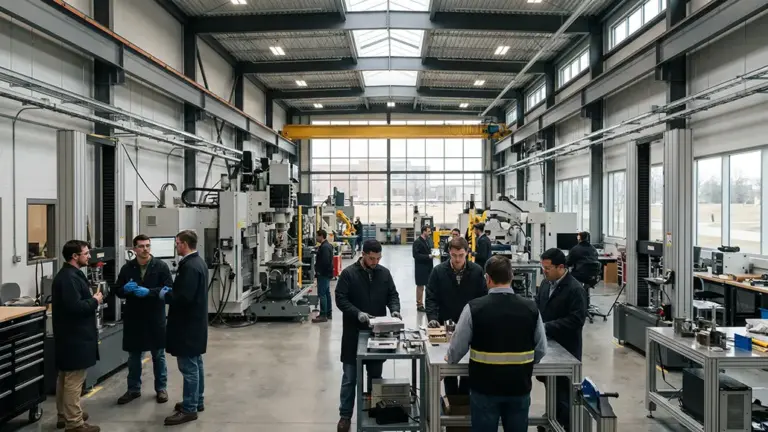
After a two-day grand opening ceremony that welcomed industry leaders, federal partners, Wichita State and NIAR employees along with the greater community, the National Institute for Aviation Research -NIAR of Wichita State University formally opens new Hub for Advanced Manufacturing and Research – HAMR.
Apparently, the 170,000-square-foot facility is now open to use for industry and government research, development, and training as well as collaboration. HAMR, which is located on Innovation Campus in Wichita State, combines applied research, novel technologies, cutting-edge materials, precision machining, digital engineering, and smart automation – all under one roof, continuing the legacy of NIAR as a global leader when it comes to innovation and workforce growth.
HAMR offers over 500 internship opportunities for WSU students.
Representatives from Deloitte, Boeing, Dassault Systèmes, General Atomics, GKN Aerospace, John Deere, Northrop Grumman, Novacoast, Rolls Royce, Siemens, Textron Aviation, the U.S. Army, the U.S. Air Force and many more attended the grand opening Industry Day of HAMR.
Notably, the attendees took part in the keynote speeches, guided tours and hands-on exhibits in six research zones, namely, the Digital Twin, Sustainment & Digital Transformation, Advanced Manufacturing & Materials Research, Process Automation, The Digital Factory and Customer Engagement: Co-Create the Future.
According to Wichita State senior vice president for industry and defence programmes and NIAR executive director John Tomblin, “The opening of HAMR represents a major step forward for Wichita State, NIAR and the aerospace, defence, and manufacturing industries. This facility was created to accelerate innovation, strengthen U.S. manufacturing competitiveness, and provide industry and government partners with the tools and talent needed to solve the challenges of tomorrow.”
The following day, Wichita State, as well as NIAR faculty, staff, students, and their families, participated in an open house event, taking self-guided tours through the new facility. Community leaders and invited industry guests took part in the celebration of advancement, collaboration, and possibilities.
During both events, over 1,000 visitors toured the new facility and engaged with NIAR engineers, witnessing first-hand how student technicians participate in paid applied learning positions offered via NIAR. The open house provided a rare glimpse into the HAMR facility, which will not be open to the public at large in the near future due to ITAR-restricted and proprietary industry and defence work.
The HAMR standard was developed with help from the Build Back Better Regional Challenge grant, which is a U.S. Economic Development Administration and South Kansas’ – Driving Adoption: Smart Manufacturing Technologies initiative, with a large joint investment from Wichita State University.
HAMR broadens the role of NIAR as a national resource when it comes to advanced manufacturing research, sustainment, digital engineering, and prototyping as well as production. The facility is designed to support both commercial and defence customers by offering access to a top-notch production ecosystem and next-generation workforce.
Tomblin opines that HAMR is more than a building. He adds that “It’s an investment in the future of American manufacturing a place where industry, government, and academia can co-create the technologies that will define the next century.”
Now formally open, HAMR has the potential to drive partnership, speed up technology adoption and bolster regional and national competitiveness throughout the critical technology sectors.
Notably, the Innovation Campus is a tangible extension of the main Wichita State University campus and is one of the largest as well as fastest-growing research or innovation parks in the nation, spanning more than 120 acres and catering to a number of global organizations and businesses.
Interestingly, the new Hub for Advanced Manufacturing and Research aims to bring together industry, researchers and students when it comes to applied research and workforce development. It is crafted to spark innovation quickly and offer real-world learning experiences, with labs, business collaborations, and mixed-use spaces.