
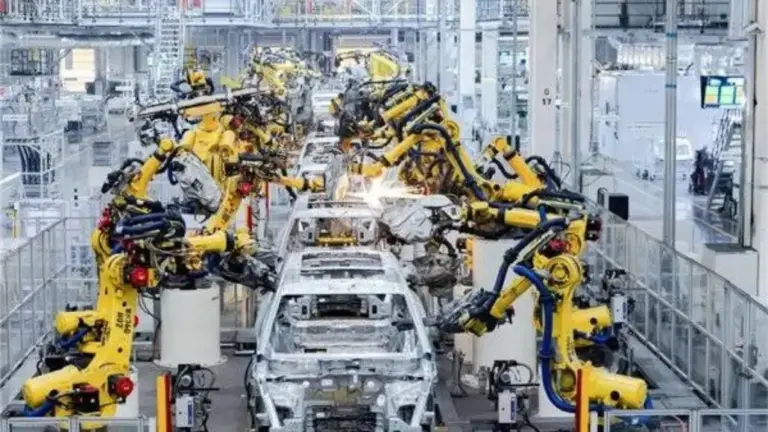
China extended the initiative to further consumer-facing sectors, rolling out 34 flagship smart factories in 20 provincial-level regions on November 19, as the country intensifies efforts to incorporate AI technology into manufacturing, improve productivity, and speed up the digital transformation when it comes to its industrial sector.
The Ministry of Industry and Information Technology – MIIT along with five other departments, published the 2026 flagship smart factory cultivation list, with leading manufacturers like Xiaomi Auto on the list. For the very first time, manufacturers of pharmaceuticals and clothing were included, reflecting the growing industry scope of the effort.
They are the second generation of flagship smart factories and have demonstrated an average 34.4% increase in labor productivity and a 19.3% boost to production efficiency while assisting almost 4,000 enterprises to implement digital and intelligent change in a coordinated manner.
Particularly, the industry coverage range has further broadened compared with the preceding batch. The list published by the MIIT comprised pharmaceutical and apparel enterprises in the consumer goods industry for the very first time, as well as steel, electronic information, and various other fields of equipment manufacturing.
The list includes smart factory projects of leading Chinese manufacturers when it comes to vehicle, power tools, and shipbuilding segments, such as Harbin Electric Machinery, Xiaomi Auto, FAW-Volkswagen as well as Hudong-Zhonghua Shipbuilding.
The announcement made by the six departments outlines a plan for promoting support for leading smart factories in terms of building high-quality industrial standards, creating industrial AI agents, researching advanced manufacturing models, and building intelligent supply chains. The requirements point to a broader change in smart factory development, from equipment automation to greater incorporation of AI and industrial data along with supply chain coordination.
On Nov. 24, 2025, the MIIT announced 15 candidate factories, increasing the total number to 49.
Li Changan, a professor at the School of Public Administration of the University of International Business and Economics, told the Global Times on November 19, 2026, that the combination of AI with manufacturing is a major technological force that is driving the advancement of modern manufacturing.
The presence of pharmaceutical and apparel manufacturers on the latest list, Li said, indicates artificial intelligence – AI technologies are moving beyond a handful of industries into more traditional manufacturing sectors.
The expert also said that the compilation is not only a reflection of the advancement of AI applications when it comes to the manufacturing industry but also a benchmark and a model for the sector as a whole, which encourages more traditional manufacturers to speed up technological upgrading and change. This trend is projected to boost China’s manufacturing capacity, upgrade the quality of its products, and increase the international competitiveness of its manufacturing industry.
China is accelerating the development of smart manufacturing. Data released in October 2026 revealed the country had over 56,000 basic, 9,000 advanced, and 500 excellence-level smart factories by the end of June 2026, demonstrating the growing scale of its manufacturing digitization push.
China is accelerating its attempts to incorporate AI into industrial production. The country plans to create 1,000 high-level industrial AI agents and 100 high-quality industrial datasets by 2027 and promote AI applications in manufacturing, an action plan that was published in January stated.
Apparently, flagship smart factories are anticipated to assist in attempting to turn innovations in technology into practical industrial applications and boost productivity improvements throughout supply chains.