
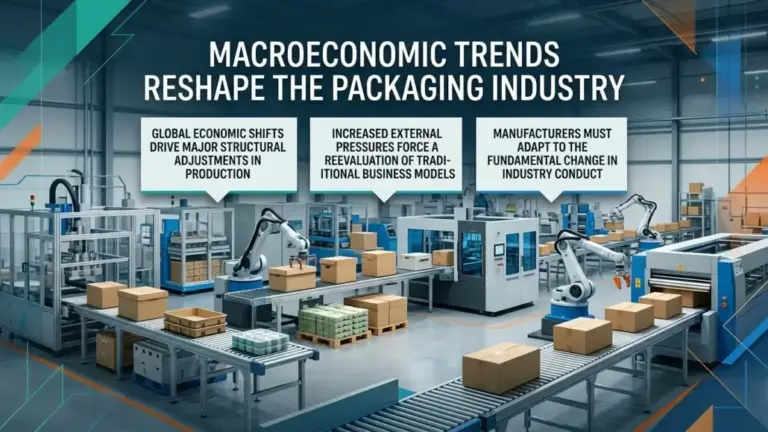
The global industrial environment is currently undergoing a period of intense structural adjustment as a variety of external pressures converge on the manufacturing sector. For organizations operating within the production of containers and protective materials, these shifts are not merely cyclical fluctuations but represent a fundamental change in how business is conducted. It is increasingly clear that macroeconomic trends reshape the packaging industry by forcing a reevaluation of traditional cost structures and operational priorities. Leaders in this sector must now account for a more volatile set of variables than at any point in the last several decades.
Inflationary pressures have become a dominant concern for executives who are attempting to maintain margins while facing rising prices for energy and raw materials. The cost of polymers, aluminum, and fiber-based products has seen significant volatility, driven by both energy market instability and shifting trade policies. In response, many firms are moving away from fixed-price long-term contracts in favor of more flexible pricing models that can adapt to rapid changes in the global economy. This shift requires a high degree of transparency with customers and a sophisticated approach to financial forecasting that can account for sudden spikes in input costs.
The Financial Impact of Global Inflation
The persistence of high interest rates in major markets has also altered the capital expenditure strategies of many industrial manufacturing firms. When the cost of borrowing increases, the threshold for a return on investment for new machinery or facility expansions becomes much higher. This environment has led to a more cautious approach to expansion, with many companies focusing on optimizing existing assets rather than building new capacity. The reality of how macroeconomic trends reshape the packaging industry is visible in the way that firms are prioritizing efficiency over raw growth in their strategic planning.
Material costs are no longer a stable line item but a strategic variable that must be managed with precision. Companies are investing in procurement technologies that provide real-time visibility into commodity markets, allowing them to hedge against future price increases. This proactive stance is essential for maintaining a competitive edge in a market where even small fluctuations in the price of resin or pulp can have a massive impact on the bottom line. The ability to manage these costs effectively is now a core competency for any successful leadership team in this sector.
Supply Chain Resilience and Strategic Reshoring
The fragility of global logistics networks was exposed during recent years, leading to a widespread movement toward reshoring and nearshoring operations. Many packaging firms are moving their production facilities closer to their end markets to reduce the risks associated with long-distance shipping and geopolitical instability. This trend toward regionalization is a direct result of how macroeconomic trends reshape the packaging industry, as the cost and reliability of trans-oceanic freight become more unpredictable. By shortening the physical distance between the factory and the customer, firms can provide faster lead times and reduce their exposure to external shocks.
Supply chain management is also being refined through the adoption of more sophisticated inventory strategies. The traditional “just-in-time” model is being replaced by a “just-in-case” approach that prioritizes the availability of critical components and raw materials. While this requires a higher level of working capital, the cost of a production stoppage is often much greater than the expense of maintaining additional safety stock. This shift reflects a broader priority for resilience and reliability in an increasingly uncertain global economy, ensuring that commitments to customers are met regardless of external disruptions.
Shifts in Consumer Behavior and Market Demand
The purchasing habits of both industrial and retail consumers are undergoing a significant transformation as disposable income is squeezed by rising costs of living. In the retail sector, there is a clear move toward value-based purchasing and smaller pack sizes, which requires a corresponding adjustment in packaging design and production. For manufacturers, this means that their lines must be more flexible and capable of handling a wider variety of formats without lengthy downtime. The way that macroeconomic trends reshape the packaging industry is evident in this demand for agility and responsiveness to a rapidly changing consumer environment.
Industrial manufacturing firms are also seeing a change in how their corporate clients evaluate packaging solutions. There is an increasing focus on the total cost of ownership rather than just the initial price per unit. Clients are looking for materials that can reduce shipping costs through better dimensional weight optimization or provide enhanced protection to minimize product damage and returns. This focus on functional efficiency is a rational response to the economic pressures facing all businesses, driving a more collaborative and technical relationship between packaging providers and their clients.
Capital Investment and Technological Adaptation
Despite the high cost of capital, the need for increased productivity is driving targeted investments in automation and data analytics. When labor costs rise and the availability of skilled workers decreases, the case for industrial automation becomes much stronger. Many firms are focusing their investments on technologies that can reduce the human element in repetitive tasks, such as palletizing and quality inspection. These investments are not just about cost reduction but about ensuring operational continuity in an environment where the labor market remains tight and unpredictable.
The adoption of digital tools for process monitoring is also helping firms to identify and eliminate waste in their operations. By utilizing sensors and machine learning algorithms, manufacturers can optimize the use of energy and raw materials, leading to both financial and environmental benefits. This data-driven approach is a key part of how macroeconomic trends reshape the packaging industry, as it allows for a level of operational precision that was previously unattainable. Companies that can leverage this data effectively are better positioned to weather the current economic challenges and emerge stronger in the future.
Conclusion
The packaging sector must continue to adapt to a global environment where stability is no longer the default state. The ability to anticipate and respond to macroeconomic shifts will remain a defining characteristic of market leaders. This requires a commitment to innovation, both in terms of material science and business processes, ensuring that the industry can meet the needs of a modern economy while managing the constraints of a high-cost environment.
In the coming years, the focus will likely remain on the integration of technology and strategic flexibility. Those who view these economic pressures as a catalyst for positive change rather than a mere obstacle will find opportunities for differentiation. The successful navigation of this complex environment will depend on a balanced approach that prioritizes both short-term resilience and long-term strategic vision, solidifying the industry as a vital pillar of the global manufacturing sector.