
When copying others doesn’t come naturally
Imitation the drive to watch what others do and replicate it is one of the most fundamental mechanisms of human learning. Babies begin imitating facial expressions within hours of birth. Toddlers learn to clap, wave, use a spoon, and speak primarily through imitation. When imitation is significantly reduced or absent, it does not just affect a handful of skills it affects the entire architecture of social and cognitive development. In autism spectrum disorder, limited imitation is an early and diagnostically meaningful sign that appears across the first years of life.
Imitation as a Foundation for Development
 Developmental psychologists have described imitation as the engine of early learning. Through imitation, infants learn about faces, objects, cause and effect, social rules, and language. Through imitation, toddlers acquire pretend play, self-care skills, and an understanding of other people’s actions as intentional and meaningful.
Imitation is also a social act. When a baby opens their mouth wide because a parent did the same, they are not just learning a motor pattern they are participating in a shared moment, demonstrating that they are attending to another person and find their actions interesting and worth replicating.
How Imitation Difficulties Present in Autism
In autism, imitation may be reduced, delayed, or qualitatively different. Research using standardised assessments has consistently found that autistic toddlers imitate less frequently and less spontaneously than neurotypical peers, even when they are capable of the underlying motor actions.
Signs to watch for in infancy and toddlerhood:
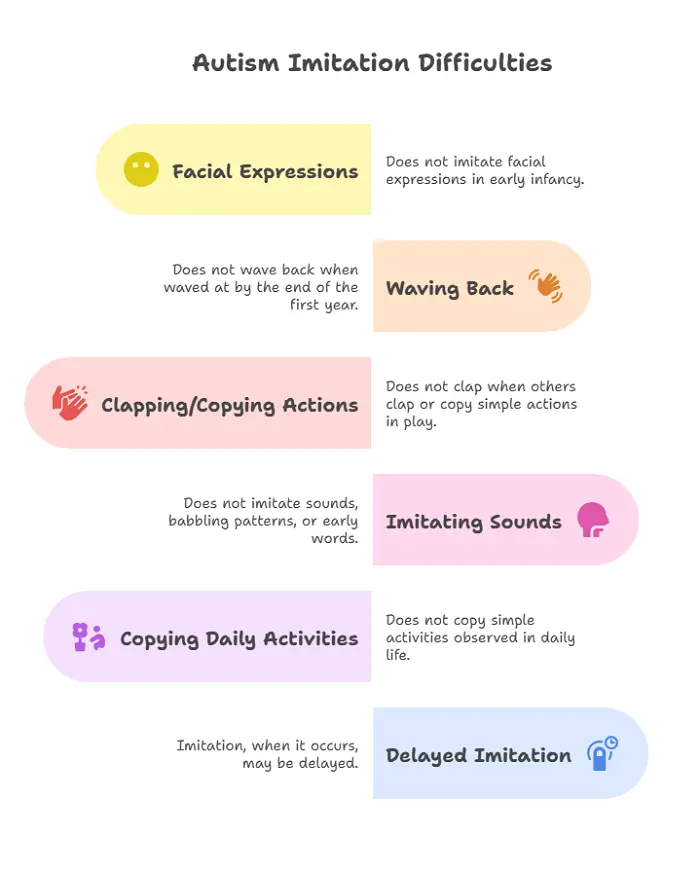
- Does not imitate facial expressions (opening mouth, sticking out tongue) in early infancy
- Does not wave back when waved at by the end of the first year
- Does not clap when others clap or copy simple actions in play
- Does not imitate sounds, babbling patterns, or early words
- Does not copy simple activities observed in daily life (pretend to talk on the phone, stir a bowl)
- Imitation, when it occurs, may be delayed the child imitates the action later, not in the immediate social moment
Imitation and Social Motivation
One of the key insights from autism research is that imitation difficulties in autism are not simply motor or perceptual they are closely tied to social motivation. Typically developing children imitate because they find other people’s actions interesting and want to participate in shared experience. When social motivation is reduced when other people’s actions are less inherently compelling the drive to imitate is also reduced.
This links imitation difficulties to the broader social communication profile of autism: reduced social orientation, reduced joint attention, and reduced social referencing all operate together to create a different relationship with social learning.
Impact on Broader Development
Limited imitation has downstream effects across multiple developmental domains:
Language: much of early word learning happens through imitating the sounds and words of caregivers in shared contexts.
Play: pretend play is largely learned through imitating adults and peers reduced imitation directly affects the development of imaginative and symbolic play.
Self-care: dressing, feeding, and hygiene skills are substantially acquired through watching and imitating others.
Social skills: wave-goodbye, turn-taking, clapping games these early social rituals are all learned through imitation.
Conclusion
Limited imitation is not a trivial finding. It sits at the intersection of social motivation, learning capacity, and relationship formation three of the domains most significantly affected by autism. Identifying it early, understanding why it occurs, and building interventions that gently scaffold imitation within social play can make a meaningful difference to the trajectory of an autistic child’s development.