
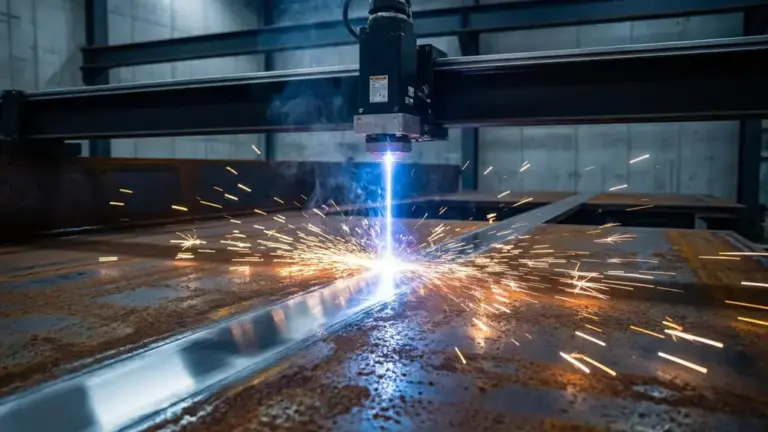
Innovation is continuously transforming the manufacturing landscape with rapid automation, enhanced production efficiency and new sustainability priorities. No matter the industry, every company is looking to achieve their goals cleaner, faster, and with less energy consumption. Laser cleaning systems are one method to accomplish these goals.
Laser cleaning is a versatile surface preparation technique that drives the automation of factories in the 21st century across any industry. Based on the fundamental principles of Industry 4.0, companies are being forced to rethink their processes and use advanced laser systems like the HANTENCNC 300w laser cleaning machine for maintenance, material prep and industrial cleaning.
Traditional industrial cleaning methods use chemicals, are abrasive and are labour intensive. There are a lot of disadvantages to these old systems. New restrictions on the impact of business operations on the environment, labour costs and chemical waste are forcing industry to find better alternatives.
Laser cleaning tech changing smart manufacturing future is a reality and is disrupting older techniques of cleaning industry surfaces. Cleaning of metal surfaces of rust, oil, paint and coatings with great precision with less effort using focused laser energy instead of an abrasively rough substance.
Businesses can’t afford to ignore operational sustainability and running a clean business while keeping productivity levels with investor backing and government and customer expectations.
The rapid evolution of automation, robotics and the ability to collect and interpret data have led to the design of advanced manufacturing systems. The evolution of manufacturing systems has been followed by the need for highly efficient maintenance strategies.
Not only does laser cleaning tech changing smart manufacturing is a known phenomenon, it also helps to prevent the build-up of contaminants on sensitive mechanical parts of factory equipment, helps to support a factory’s predictive maintenance model, and can be used to automate cleaning. Integrated laser systems will make robotic manufacturing cells more efficient by reducing unplanned interventions.
So, maintenance systems have to change accordingly to assist automated systems of smart factories. The old systems that relied on inefficient maintenance and added costs to the bottom line are being replaced with systems that incorporate advanced manufacturing technologies and support automation.
Laser cleaning systems are a good match due to their combination of precision, flexibility, automation and low operational costs.
Environmental Value of Laser Cleaning
Laser cleaning is one of the most remarkable of all the innovations that are changing the face of industry. Governments are imposing new restrictions on the environmental sustainability of manufacturers, and companies are creating Environmental, Social and Governance (ESG) initiatives to remain compliant.
The laser cleaning systems can be expensive to maintain. The traditional cleaning methods will leave residues and airborne contaminants which create secondary pollution. Traditional cleaning also has ongoing costs related to disposal and compliance.
Laser cleaning systems minimise consumables, secondary waste and clogging residue. This is where laser cleaning has an advantage over other systems, giving manufacturers and industries with a focus on sustainability an edge over the competition.
Countries are adopting more ambitious carbon budgets and emission pledges to address climate change. “Businesses that have invested in the sustainability of their manufacturing systems are more likely to maintain a competitive advantage in the long term.”
Integration of robots and automation
This union of laser systems and robotics is perhaps the greatest leap forward in industrial technologies to date. Automated laser cleaning stations are being used more and more in advanced manufacturing environments where speed and consistency are two key requirements.
Laser cleaning tools can be used in combination with robotic arms for autonomous cleaning tasks. This advantage reduces the labour burden and enhances the safety of the industrial environments, which are often the most dangerous of working environments.
The application of industrial robotics, automation software and AI monitoring systems is creating more opportunities for both the entrepreneur and the manufacturing startups.
In the future, laser cleaning systems in factories could be interconnected and linked with sensors and production management systems in real time. That will make the whole system of the factory more productive by automatically doing maintenance on the equipment before it breaks down.
With the development of autonomous manufacturing systems, integrated smart control systems are being developed to provide efficient manufacturing services. Laser cleaning technology is rapidly becoming a part of this movement.
Development and Implementation in Different Industries
Laser cleaning technology is quickly moving out from its niche industrial fields.
Weld cleaning and surface preparation in automotive manufacturing are performed by laser systems. Precision cleaning is used for sensitive parts in the aerospace industry. Laser cleaning technology for corrosion control in shipbuilding is developing laser solutions for rust removal. “We are developing laser cleaning techniques for use in cleaning turbines and everything in the infrastructure of industrial and even renewable energy.
The expanded application uses of laser cleaning technology are providing plenty of opportunity for the specialised industries that have manufacturing concerns. There’s a demand for industrial automation, equipment servicing, and smart manufacturing systems, which is creating opportunities for startups in this area.
As the hardware becomes more cost-effective and the performance of the systems increases, we may see laser cleaning technology being adopted by mid-sized manufacturers.
Innovation Beyond the Clean
The potential of laser technology is much wider than cleaning and maintenance of rust. One day, lasers with advanced setups may be able to integrate with artificial intelligence, digital twins, quality control systems and smart analytics.
One potential application is a laser cleaning tool with machine vision to identify the properties of the cleaning surface and then modulate the laser power accordingly. In factories analytics can be used to clean less often, saving the energy and even possibly predicting equipment failure before it occurs.
AI, lasers and robotics are their own system. They are a sign of the current trend which is happening in the manufacturing industry. The emphasis is moving away from machines, with a connected set of tools and technologies that improve efficiency becoming the main focus of investment.
The progress of integrated and intelligent tools in the manufacturing industry is reflected in the development of equipment such as the HANTENCNC 300w laser cleaning machine.
The Industrial Innovation Startup Opportunity
Many entrepreneurs are drawn to consumer products, fintech and software, but the most valuable industries are emerging in the cutting-edge ecosystems around industrial technology.
The intersection of sustainable manufacturing and innovative technologies will drive new tools and systems that will be a worthy investment. Investors are drawn to industrial innovation that is specifically tailored around sustainability and the reduction of the carbon footprint of a specific industry because of the anticipated impact on the environment and climate.
The Future
The manufacturing sector is constantly changing, with industries adapting to the regulators and to digital transformation and new global players. The next era of industrial growth will be characterised by tools that make on-demand, efficient and sustainable production.
Laser cleaning technology is not only a maintenance tool but also a step in the right direction for smarter, cleaner and connected manufacturing networks.
Sustainable innovations are paving their way towards the next industrial revolution, and the laser rust removal machine is an example of how the existing factory model will be more transformed by automation than manufacturing.