

Banking is moving toward a model in which payments are expected to work continuously rather than within the operating windows of traditional clearing systems. Fast-payment infrastructure now allows funds to become available almost immediately, including outside conventional banking hours. The World Bank’s global fast-payments dataset shows that people and businesses in 137 countries had access to instant payment services on a 24/7 basis as of June 2026, illustrating how broadly the infrastructure has spread across different banking markets.
This expansion is giving instant payment banking a broader significance than simply processing transfers more quickly. The underlying infrastructure is increasingly becoming part of how banks deliver everyday payments, account services and digital financial products. The BIS has also found that fast payments are gaining ground globally and are increasingly being used for small-value payments in both advanced and emerging economies.
Instant Payments are Moving Beyond Faster Transfers
The distinction between conventional electronic transfers and instant payments is increasingly about the underlying operating model. Traditional systems can depend on clearing cycles and processing windows, whereas fast-payment systems are designed to make funds available to beneficiaries on a 24/7/365 basis. The World Bank defines these systems as infrastructure that can support banks and non-bank providers, multiple payment channels, domestic and cross-border use cases and overlay services such as request-to-pay.
That creates opportunities beyond person-to-person transfers. Businesses can use faster payments for collections, supplier payments and disbursements, while financial institutions can build digital products around immediate movement of funds. The BIS has found that fast-payment infrastructure can also contribute to wider digital-finance adoption, with its research linking the expansion of fast payments to increased use of finance applications.
For instant payment banking, the significance is therefore not simply that money moves within seconds. The capability can change when financial services can operate, how quickly funds become usable and how digital products are designed around payment infrastructure.
Payment Availability is Becoming a Core Banking Expectation
The shift is also being reinforced by regulation and market expectations. Europe’s Instant Payments Regulation provides one of the clearest examples. Euro-area payment service providers have been required to support the receipt of instant euro payments since January 2025 and the sending of instant payments since October 2025. The rules also require charges for instant transfers to be no higher than those for corresponding regular transfers and introduce verification-of-payee requirements.
Other markets are following different paths, but the direction is increasingly similar: payment infrastructure is expected to operate continuously and integrate more closely with digital banking experiences. Large-scale systems such as India’s UPI, Brazil’s Pix and US real-time payment networks demonstrate that instant payments can move from specialist infrastructure into high-volume everyday use.
The global picture is not uniform. Adoption varies according to system design, participation, pricing, use cases and cross-border connectivity. BIS research finds that fast-payment adoption tends to be stronger where systems allow broader participation, including non-bank providers, and where more use cases and connections are available.
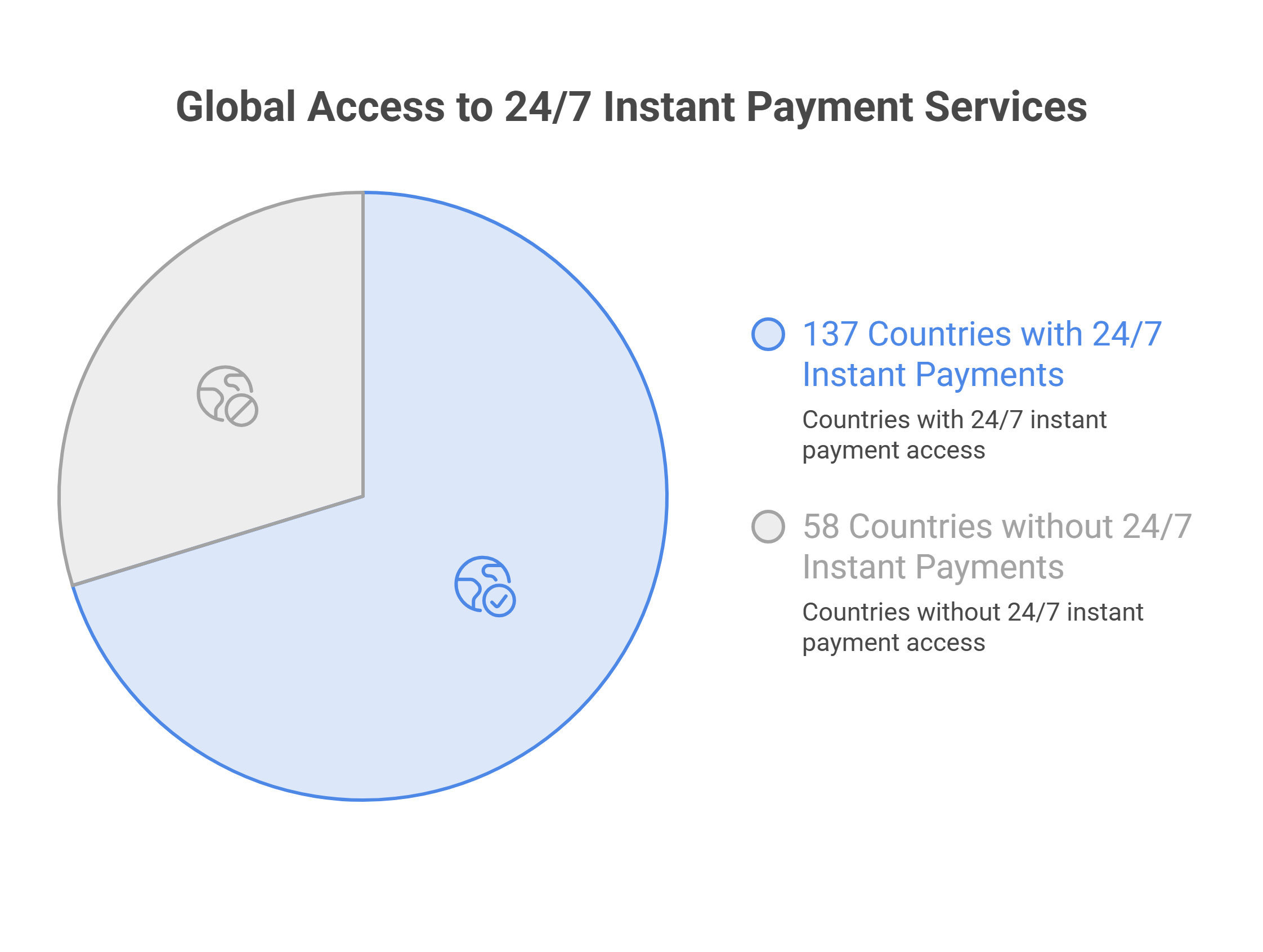
Key Takeaway: Instant-payment infrastructure has moved beyond a limited number of early-adopter markets, with 24/7 services now available across a broad global set of banking jurisdictions.
The transition is therefore becoming structural. Instant payment banking is moving toward a model in which immediate payment availability is increasingly treated as part of the core digital banking proposition rather than a separate premium capability.