
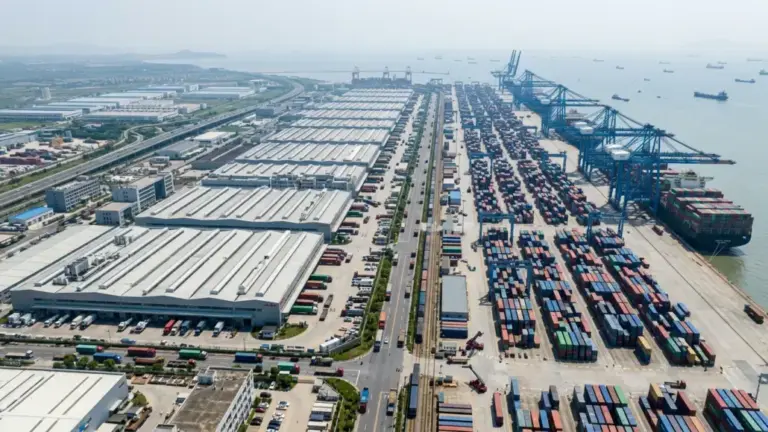
The rise of China’s industry is an important external force that affects euro area trade, production and prices via its cost-lowering and competitive pressure effects for euro area producers. The recent rise in Chinese exports illustrates productivity and technological gains that are enhancing China’s role in higher-value manufacturing, but other factors, such as decreased Chinese demand for imports, are also at the forefront. For producers in the euro area, import penetration by Chinese competitors can have expansionary effects via lower input costs and prices but can also displace production by means of stronger competition.
The growing presence of Chinese companies poses serious competitiveness challenges for the euro area, which are becoming more and more apparent in its economic performance both at home and abroad. Since 2020, European producers have been shedding market share to China, especially in areas where they are in competition. China’s import penetration in the European market has gone up significantly, particularly in the medium- and high-tech sectors, creating a strain on European producers.
Today’s challenges are somewhat different from those that occurred during the first China shock in the early 2000s. Compared with the beginning of the 2000s, euro area trade, especially imports from China have grown faster in advanced industries than in conventional manufacturing sectors, e.g., the electronics and automotive sectors compared with the textile and furniture sectors in the recent years. Also, the structure of imports from China has changed to intermediate products. In addition, the recent pick-up in Chinese exports to the euro area has not been coupled with a pick-up in euro area exports to China, with Chinese imports from the euro area declining since 2021, unlike in the 2000s.
Alterations in the import penetration of intermediate and final goods from China have varied considerably among various sectors in recent years, indicating that the impact on production will vary across sectors. Competition in final goods primarily impacts sectors like furniture and metal products, but other sectors, such as electronics, experience both large cost cuts and fierce product market competition.
Econometric analysis indicates an obvious asymmetry between an input cost channel and a competition channel when it comes to import penetration from China. Using a country-sector panel for 2000-22, we relate modifications to China’s sectoral import shares with industrial production growth in the EU, separating between the imports of final goods and the imports of intermediate goods. The results suggest that, among sectors that experienced an average yearly rise in imports, the increase in reliance on imports of intermediate goods from China was associated with a 0.6 percentage point increase in industrial production growth. On the other hand, an average annual rise in imports of final goods was linked to a drag on production of roughly one percentage point.
To measure the general effect of China’s productivity gains on the EU, we use a multi-country, multi-sector dynamic stochastic general equilibrium – DSGE model with trade linkages along with global production networks. Model-based simulations of the rise in competitive pressure from China are carried out by separate sector-specific productivity shocks that occur to China’s traditional and advanced manufacturing sectors that naturally decrease Chinese marginal costs as well as export prices. The principal distinction between the two sectors is that traditional manufacturing imports are mainly final goods, whereas advanced manufacturing imports are more extensively utilised as intermediate inputs.
Positive productivity shocks in China have an advantageous impact on the EU GDP via income effects and cheaper imported inputs, but the impact differs across sectors. From an EU perspective, the primary impact of shocks in China’s traditional manufacturing sector or in its advanced manufacturing sector is a corresponding drop in prices of imports from the sector concerned and an increase in imports from China. The use of imported goods varies from sector to sector, as does the influence on EU production. Like in the advanced manufacturing sector, imports of intermediate goods minimise costs and support domestic production. When imports are primarily final goods, as in the traditional manufacturing sector, European consumers readily shift consumption to comparatively cheaper Chinese imports, and, thus, EU producers face increased competition and a fall in demand for their goods that reduces EU sectoral output.
But cheaper imports mean households have more to spend, which raises total consumption and eventually helps EU GDP.
The impact of cheaper Chinese imports in the EU is disinflationary via different channels across sectors. The jolt in China’s traditional or advanced manufacturing sectors leads to the import of comparatively cheaper Chinese goods that exert a large disinflationary impact on the EU. The disinflationary pressure is bigger when the shock hits China’s advanced manufacturing sector, the effect being mostly indirect through cost-pull effects through production linkages. In the event of a shock to China’s traditional manufacturing sector, imports go more directly into the consumption basket of European households, and the disinflationary effect is comparatively more driven by the direct effect of lower Chinese import prices.
Subsidies for production would have a comparable impact on the economy of the EU through improvement in the competitiveness of China in international markets. We consider an alternative scenario where a growing competitiveness of Chinese firms in world markets is driven due to production subsidies in China as opposed to by productivity shocks. We present sectoral production subsidies which decrease mark-ups and reduce producer prices. The driver of China’s competitiveness is distinct, but the consequences for Europe’s economy are generally similar. Again, cheaper imports of advanced manufacturing products are beneficial for advanced manufacturing production in the EU and for the total EU GDP. In the EU traditional manufacturing sector, production continues to decline, but gains in GDP are a bit modest as income impacts do not completely compensate for production losses.
The broader evaluation of the effects of China’s industrial rise on the euro area is more complex and goes beyond the model-based analysis. China’s current industrial rise may have positive short-term aggregate effects on the EU economy, but it has taken place against the backdrop of weak demand for imports in China and a decline of market shares for EU exporters. In addition, the positive impact on EU GDP only represents short-run channels and does not consider longer-run risks, like possible scarring effects from the displacement of production or structural risks as well as strategic susceptibilities.