
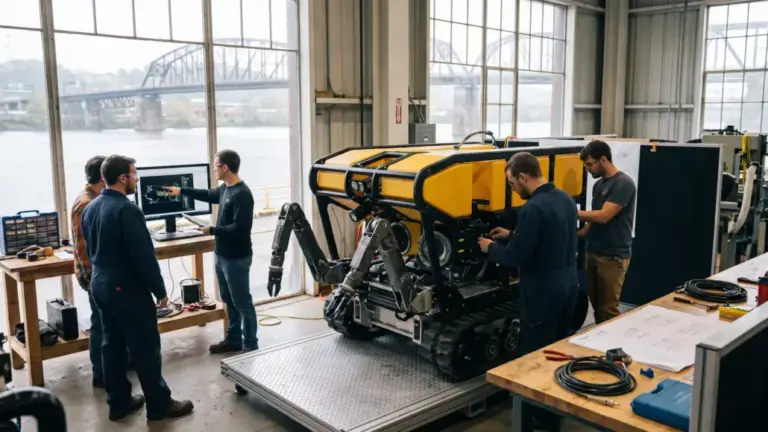
Impossible Metals, which is a Nevada-based private marine technology and deep-sea mining company, recently revealed plans to establish a new Advanced Marine Robotics Hub in Pittsburgh to operate as a center for the development of advanced American mineral robotics technology.
The Advanced Marine Robotics Hub will accommodate roboticists and autonomy engineers as well as marine systems experts, creating over a dozen high-paying science and engineering jobs in the Commonwealth with the potential to expand as the company prospers.
At the hub, teams of experts will push forward new ocean science and dual-purpose naval and critical mineral capacities based on Eureka from Impossible Metals, which is a fully autonomous underwater platform and its smart launch and recovery systems.
Impossible Metals claims that it plans to bring its most advanced and ambitious engineering to the city that created modern robotics.
The company says that it wants America to be the pioneer in autonomous marine and ocean-science systems to safeguard the critical minerals that China presently regulates.
It is well to be noted that Pittsburgh is the home base of over 140 robotics companies and the university ecosystem that established the industry. For context, it is rapidly becoming a national centre for defence autonomy and physical AI.
The executive chairperson Steve Curnutte says that “On the ocean floor lie potato-sized rocks called polymetallic nodules, and they hold the critical metals the modern economy and our national defence need most, in quantities surpassing every mine on land, combined, many times over. This isn’t one machine picking up rocks. It’s swarms of autonomous robots, precision-harvesting in parallel while leaving the ecosystem intact, producing the lowest-cost critical metals on Earth.”
It is worth noting that the Eureka system from Impossible Metals is designed to stockpile supplies of nickel, cobalt, and copper as well as manganese in the cheapest and least impactful way possible. The AI-guided robotics of the company recover individual polymetallic nodules without dredging or affecting the ocean floor in an attempt to provide the dependable, safe, and domestic critical mineral supplies that the American economy and industrial base need.
The company is committed to the region and intends to establish partnerships along with local colleges and universities, including collaborative research with faculty, hands-on training for students, and maybe even a yearly robotics competition designed to encourage young engineers to address actual issues in autonomy, marine systems, and ethical resource collection.