
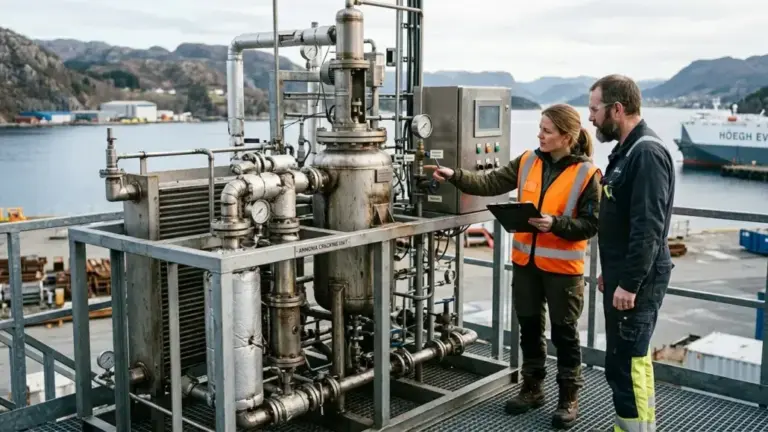
Höegh Evi, the floating gas infrastructure firm, and Norway’s Nord Gas Solutions said they have demonstrated the point of their ammonia-to-hydrogen cracking technology in advance of plans in order to develop floating import terminals.
The pilot cracker in Stord, Norway, reportedly demonstrated high performance in efficiency, conversion rate, and hydrogen yield as well as operational flexibility, even though no data points were disclosed.
It transforms hydrogen into hydrogen at 99.5% purity through a single process, with catalysts from chemical firm BASF. The modular system could be installed in floating terminals, with Höegh Evi aiming to create floating storage and regasification systems that are capable of delivering as much as 210,000 tonnes of hydrogen annually.
According to Vice-President Technology, Nord Gas Solutions (previously Wärtsilä Gas Solutions), Taro Mukae, “The results confirm both the efficiency and operational robustness of our technology, supporting its readiness for deployment in industrial-scale applications.”
Interestingly, the project was funded with €5.9m or $6.7m from the Norwegian government and backed by the University of South-East Norway, Sustainable Energy, as well as the Norwegian Institute for Energy Technology.
Nils Jakob, the Höegh Evi’s head of clean energy, said validation established the argument for floating hydrogen terminals.
He said that “we look forward to seeing these results validated further in long-term testing.”
The company plans to start by installing a floating cracker unit at the German port of Lubmin that could inject into Germany’s 9,000 km hydrogen core network.
The terminal, which was initially intended to be ready in 2023, can produce 30,000 tonnes of hydrogen every year. There is no update in terms of development as yet.
Höegh Evi has also entered into an early-stage agreement to create a 210,000-tonne terminal at Port-La Nouvelle in France.