
The integration of advanced robotic systems into the clinical environment represents one of the most significant shifts in the history of modern medicine. For decades, the concept of a robot in a hospital was confined to the realms of science fiction, yet today, these sophisticated machines are the silent partners of surgeons, nurses, and therapists. The fundamental promise of healthcare robotics supporting precision medical care lies in their ability to transcend human limitations offering a level of stability, accuracy, and endurance that the human hand and mind, however skilled, cannot consistently maintain over long periods. This evolution is not about replacing the human element in medicine but rather augmenting it, allowing for a fusion of biological intuition and mechanical precision that results in superior patient outcomes and more efficient healthcare delivery.
At the core of this transformation is the surgical suite, where robotic medical systems have redefined what it means to perform minimally invasive procedures. Traditional laparoscopy, while revolutionary, often forced surgeons to work with restricted degrees of freedom and a flattened perspective. In contrast, modern robotic platforms provide a three-dimensional, high-definition view of the surgical field, paired with instruments that can rotate with greater flexibility than the human wrist. This capability is essential for delicate operations where even a millimeter of deviation could mean the difference between a successful nerve-sparing surgery and a permanent loss of function. By filtering out natural hand tremors and scaling movements, these systems ensure that healthcare robotics supporting precision medical care is a tangible reality for patients undergoing complex urological, gynecological, and cardiothoracic procedures.
Advancements in Surgical Precision and Accuracy
The true measure of a robotic system’s value in surgery is its contribution to precision. In the context of an operating room, precision translates to smaller incisions, less trauma to surrounding tissues, and a significantly reduced risk of post-operative complications. When surgeons utilize healthcare robotics supporting precision medical care, they are able to navigate the intricate landscape of the human body with a map that is clearer and more detailed than ever before. This is particularly evident in neurosurgery and orthopedic surgery, where robotics assist in the placement of implants or the resection of tumors with sub-millimeter accuracy. The ability to pre-plan a surgery using patient-specific imaging and then execute that plan with robotic guidance ensures that the one-size-fits-all approach is replaced by a tailored, data-driven methodology.
Beyond the immediate mechanics of the surgery, the use of robotic medical systems contributes to a faster recovery profile for the patient. Smaller incisions mean less blood loss and a reduced need for pain medication, which in turn leads to shorter hospital stays and a quicker return to daily activities. From a systemic perspective, this efficiency is vital for hospitals facing rising costs and bed shortages. By optimizing the surgical process through healthcare robotics supporting precision medical care, institutions can treat more patients with better results, effectively maximizing the utility of their most skilled personnel and most expensive facilities.
Robotic Rehabilitation and Long-term Patient Recovery
While surgery often grabs the headlines, the role of robotic rehabilitation devices is equally transformative in the journey toward full patient recovery. Neurological injuries, such as strokes or spinal cord trauma, often require repetitive, intensive physical therapy to retrain the brain and body. Human therapists, while highly skilled, can find it physically taxing to provide the hundreds of repetitions needed for neuroplasticity to take effect. This is where robotic systems step in. Exoskeletons and robotic gait trainers can provide consistent, tireless support, guiding a patient’s limbs through the correct motions with perfect form every time. This consistent feedback is a cornerstone of healthcare robotics supporting precision medical care, as it allows for a highly measurable and adjustable recovery path.
These rehabilitation devices are equipped with sensors that track a patient’s progress in real-time, allowing clinicians to adjust the level of assistance as the patient regains strength. This data-driven approach removes much of the guesswork from physical therapy. Instead of relying solely on qualitative observations, therapists can look at precise metrics of force, range of motion, and symmetry. This level of detail ensures that the rehabilitation process is as targeted as the surgery that preceded it. By integrating healthcare robotics supporting precision medical care into the recovery phase, we bridge the gap between clinical intervention and functional independence, giving patients a better chance at reclaiming their quality of life.
Hospital Logistics and Clinical Workflow Support
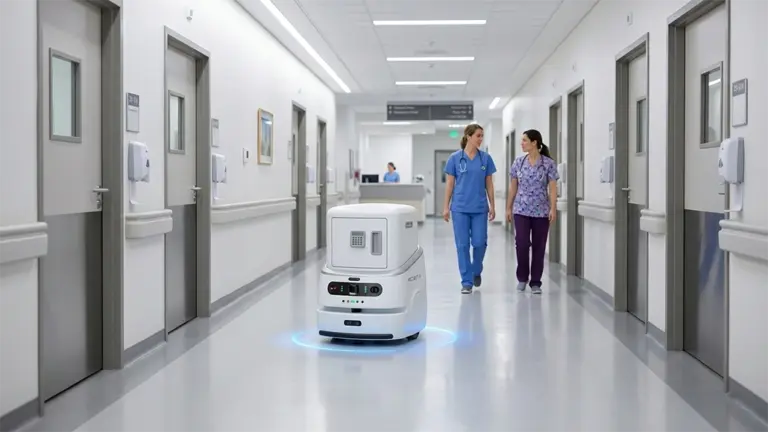
The impact of robotics extends far beyond the direct interaction with the patient’s body it also encompasses the very infrastructure of the modern hospital. Hospital robotics technology is increasingly being deployed to handle the behind-the-scenes logistics that keep a medical facility running. Autonomous mobile robots (AMRs) now navigate hospital corridors to deliver medications, laboratory samples, linens, and meals. By automating this routine but essential tasks, healthcare robotics supporting precision medical care frees up nursing and support staff to focus on high-value patient care. Every minute a nurse spends walking to the pharmacy for a forgotten prescription is a minute they are not at the bedside, and robotics are closing that gap.
Furthermore, these logistical robots contribute to a safer environment by reducing the risk of cross-contamination and human error. In the sterile processing department, robots can assist in the cleaning and sorting of surgical instruments, ensuring that every tool meets the rigorous standards required for precision medical robotics to function safely. This systemic integration of hospital robotics technology creates a smart environment where data flows seamlessly between the robotic hardware and the hospital’s management systems. The result is a more resilient clinical workflow that can adapt to the high pressures of a modern healthcare environment without compromising the safety or precision of care provided to the individual patient.
The Future of Precision Medical Robotics
Looking ahead, the trajectory of healthcare robotics supporting precision medical care is pointed toward even greater levels of autonomy and integration. We are moving toward a future where smart instruments can detect tissue types in real-time, providing haptic feedback to the surgeon or even preventing the instrument from cutting near a critical blood vessel. Artificial intelligence will play an increasing role in analyzing intraoperative data, offering best-practice suggestions based on thousands of similar cases. This synergy between AI and robotics will further solidify the role of healthcare robotics supporting precision medical care as the gold standard in global health.
The democratization of this technology is also a critical frontier. As robotic systems become more modular and cost-effective, they will find their way into smaller community hospitals and developing regions, bringing the benefits of precision surgery and rehabilitation to a much broader demographic. The ultimate goal is a healthcare system where precision is not a luxury but a baseline expectation. Through the continued development of robotic medical systems, we are not just building machines we are building a more precise, compassionate, and effective way to care for the human condition.