
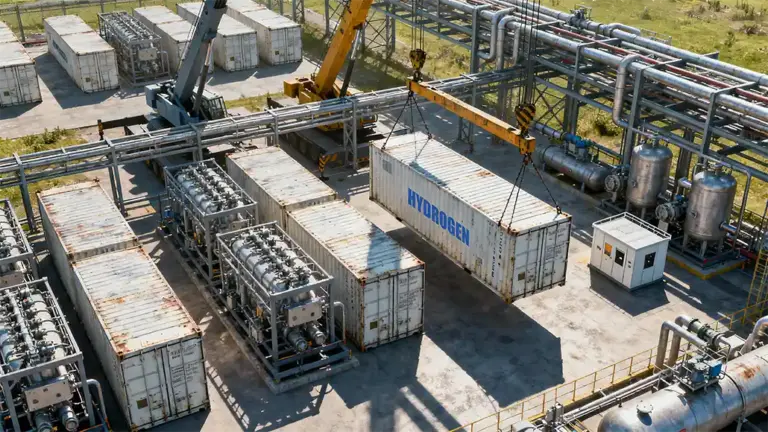
The clean hydrogen sector has gone on to reach a major milestone, with US$110 billion in investment, which happens to be now committed across over 500 projects throughout the world that are past final investment decision (FID), in construction, or are already functional; a US$35 billion increase since 2024. Since 2020, the sector has averaged a 50% year-over-year committed investment growth rate, as per September 2025 Hydrogen Council’s inaugural Global Hydrogen Compass report, co-authored by McKinsey & Company.
This progress happens to be accompanied by natural attrition, as projects having the strongest business cases advance, and then there are the less viable ones that are withdrawn, demonstrating consistent maturation throughout the industry. Since 2020, over 1,700 hydrogen projects have been announced across the world, a 7.5-fold increase, while almost 50 projects have been publicly cancelled in the last 18 months, thereby representing 3% of the overall pipeline; most of them happen to be the early-stage renewable hydrogen ventures. Structural challenges, which include the likes of persistently high interest rates and also delayed policy execution in some regions, are also putting pressure on the selection process.
When it comes to the supply side, total committed capacity now goes beyond 6 million tonnes per year (mtpa), which includes 1 mtpa that’s already in operation. Post accounting for delays and anticipated attrition, the present project pipeline could very well support almost 9-14 mtpa of clean hydrogen capacity by the end of the decade; however, it needs demand to materialize, and the fact is that unlocking it remains the next big challenge. When it comes to the demand side, around 3.6 mtpa of binding offtake has been secured. As policy clarity crops up across the key markets like the EU, US, Japan, and Korea, almost 8 mtpa of clean hydrogen demand could thereby materialize by 2030.
It is well to be noted that China happens to be leading the world when it comes to total committed investments of $33 billion and renewable hydrogen production of well over 50% of the global renewable capacity, which is followed by North America at $23 billion, also home to 85% of the worldwide low-carbon hydrogen production. Europe happens to rank third in terms of committed investment with $19 billion, while accounting for almost two-thirds of the anticipated 2030 global demand.
The Global Hydrogen Compass happens to build on the Hydrogen Insights series of the Hydrogen Council that was first launched in 2021 in order to offer a clear and fact-based view pertaining to the state of the global hydrogen industry. For the very first time, the publication happens to blend comprehensive industry data along with the direct perspectives coming from the global CEOs and the lessons learned from some of the most significant hydrogen projects in the world. It does send a message of confidence and clarity as well as urgency from industry leaders – in spite of a challenging environment, the majority of the surveyed CEOs went on to report stable or increased investment appetite through the last two years – 74% to be precise, believe that hydrogen is going to be a critical decarbonization solution for the hard-to-abate sectors across the global hydrogen industry along with the broader economy and anticipate the industry growth to continue.