
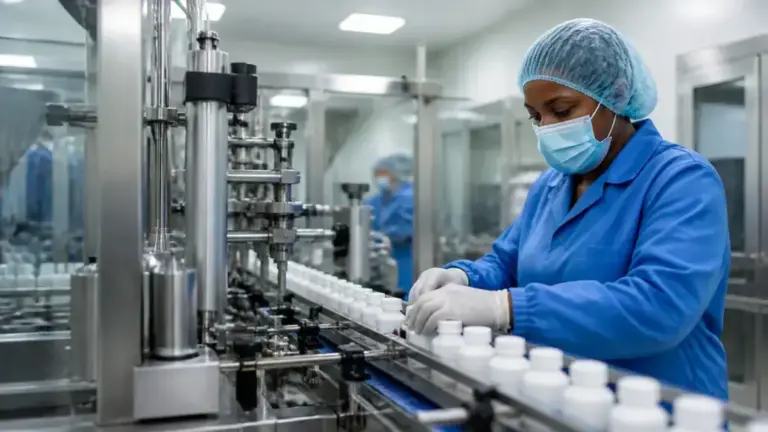
Ghana is moving ahead with plans to establish a pharmaceutical industrial park designed to attract both local and international manufacturers while strengthening domestic production of medicines, medical devices and other health-related products. The project is being developed under the government’s 24-Hour Economy initiative and is intended to create an integrated ecosystem covering pharmaceutical manufacturing, medical device production, herbal medicine, research and development, and associated industries.
Kafui Linda Abbah-Foli, Head of Project Development at the 24-Hour Economy Secretariat, announced the initiative during the opening of the 2026 China–West Africa Medical and Health Industry Expo and AI Deployment and Project Cooperation Summit in Accra. She said the development is intended to tackle key challenges affecting manufacturers, particularly difficulties related to access to land and dependable infrastructure.
“We are not just building a factory; we are building an ecosystem,” she said, noting that the pharmaceutical industrial park will include roads, electricity, water, wastewater and effluent treatment facilities needed for pharmaceutical production.
Land Secured and Investor Interest
According to Ms Abbah-Foli, 2,000 acres of land have been identified in the Shai-Osudoku District, while pre-feasibility studies have already been completed. The development already has an anchor investor, alongside a pipeline of potential tenants that includes established Ghanaian pharmaceutical companies and international manufacturers from India, China and the United States. Ghanaian health professionals in the diaspora have also shown interest in the project.
Project development activities are expected to be completed by the end of 2026. Following that stage, full feasibility studies, detailed design and master planning will commence. Plans for the pharmaceutical industrial park also include a township and housing facilities for workers. These facilities are expected to have the capacity to support up to 20,000 people during the project’s first five years.
Reducing Pharmaceutical Import Dependence
The development is also intended to address Ghana’s reliance on imported pharmaceutical products. Ms Abbah-Foli said Ghana currently imports about 70% of its pharmaceutical needs, including most active pharmaceutical ingredients and excipients.
“The goal is to ensure that we build a park that will cater for the whole value chain,” she said, explaining that the project is expected to support greater self-sufficiency in the production of essential medicines and health products.
The initiative could also strengthen the country’s resilience during future health emergencies such as the COVID-19 pandemic. Ms Abbah-Foli pointed to Ghana’s changing disease burden, including increasing cases of non-communicable diseases such as stroke and diabetes, as another reason for strengthening domestic pharmaceutical production. Local manufacturing of medicines for these conditions would reduce dependence on imports and, over time, help ease pressure on the national health bill.
Participatory Land Acquisition and Health Manufacturing
Ms Abbah-Foli identified land acquisition as a potential challenge but said the 24-Hour Economy programme had introduced a participatory land acquisition model. Under this approach, traditional authorities and land-owning communities would become shareholders in the project and receive benefits through dividends and rental income. She said the model is intended to make host communities active participants in the development while allowing them to benefit directly from the economic opportunities generated by the project.
Beyond healthcare delivery, Ms Abbah-Foli said Ghana needs to focus on the wider health value chain, including domestic production of medicines, medical equipment, supplies and health technologies. She said the country presents opportunities for investors, manufacturers, medical technology companies and research institutions looking for a base for production, innovation and technology transfer. She urged stakeholders to view Ghana not simply as a market for health products but as a centre for manufacturing, research, innovation and technology development.
The summit brought together stakeholders from Ghana, China and across West Africa to examine medical and health industry development, artificial intelligence, technology transfer, investment and project cooperation. Speakers highlighted the importance of collaboration between government, industry, academia, research institutions and international investors in developing a competitive health manufacturing sector capable of creating jobs, generating economic value and improving Ghana’s health security.