
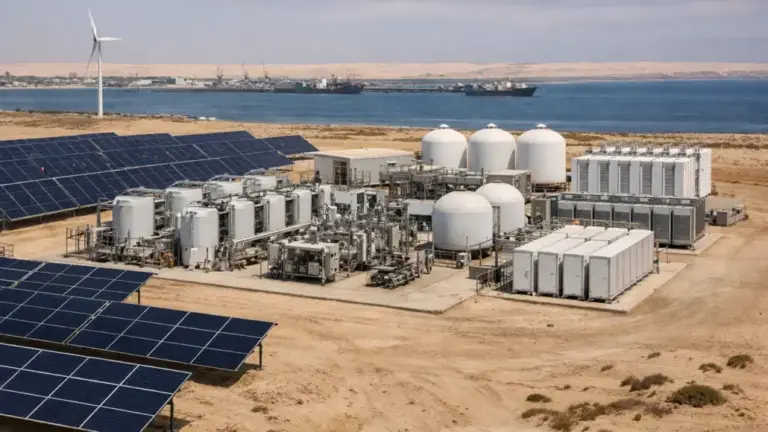
Walvis Bay facility from CMB.TECH, which is the first fully integrated green hydrogen hub in Africa, and in the past a joint venture with Namibia’s Ohlthaver & List Group is now fully owned by CMB.TECH following its acquisition of the O&L stake in October 2025.
The facility, which is a single off-grid ecosystem comprising a 5 MWp solar park and a 5 MW PEM electrolyser as well as 5.9 MWh battery storage, was inaugurated in September 2025.
CMB.TECH has become its own first client, using the hydrogen for dual-fuel trucks, generators and the first hydrogen-powered freight locomotive of Namibia, with goals to expand to 250 MW and then 500 MW of solar capacity and thereafter eventually export ammonia to Europe.
It is well to be noted that the hydrogen projects which are getting headlines in Africa tend to be massive, years away and packed with caveats. There is nothing which will match it, especially when we talk of CMB.TECH facility at Farm 58 in Walvis Bay, as the facility is small, it is running, and it is making green hydrogen as of now.
The facility and what it does
The site integrates three systems – a 5 MWp solar park that covers 6.5 hectares and contains approximately 7,000 panels, along with a 5 MW proton exchange membrane electrolyzer which uses only solar electricity in order to split water into hydrogen and oxygen, along with a 5.9 MWh battery energy storage system that enables electrolyzer to operate when the sun is not at its peak.
The entire facility is off-grid, therefore it does not require being connected to the national electricity network in Namibia.
Walvis Bay boasts some of the best solar resources on the continent, with around 300 days of sun every year. Hydrogen is generated on site, then compressed and then stored on site for use right away.
Apparently, the facility is a living lab when it comes to integrated hydrogen economy, the Chief Technology Officer at CMB.TECH, Roy Campe, said. He added that “the facility includes a solar-powered off-grid electrolyser for renewable hydrogen production, a refuelling station for hydrogen-powered vehicles and industrial applications, and an on-site Hydrogen Academy for local talent development.”
A hub that makes use of what it makes
The key structural characteristic of the Walvis Bay project, the first fully integrated green hydrogen hub in Africa is that CMB.TECH itself is its first customer. Green hydrogen produced on site powers dual-fuel trucks and generators, as well as off-road equipment, and Namibia’s first hydrogen-powered freight locomotive program is indeed part of the bigger plan. A hydrogen-powered harbour vessel under construction in the Netherlands is also going to be operating at Walvis Bay.
This is significant since the graveyard when it comes to global green hydrogen projects is mostly filled with facilities that spent big on production without an offtaker. CMB.TECH addressed that issue by being their own buyer from day one.
The longer-term strategy includes an ammonia terminal at the North Port in Walvis Bay that produces marine fuel by mixing hydrogen with nitrogen taken from the air, along with a gigawatt-scale solar hydrogen and ammonia plant located at Arandis, further into the Namib desert where the energy level of the sun is even higher. The total estimated investment throughout every stage is $3.5 billion.
Siemens as an integration layer
It is worth noting that Siemens supplied the integrated electrical, automation and safety infrastructure in order to coordinate the solar, electrolyzer, battery and refuelling systems. The CEO of Siemens Sub-Saharan Africa, Sabine Dall’Omo, was blunt about what this project shows. He says that “Africa’s first fully integrated green hydrogen facility demonstrates that large-scale clean energy production is not a future ambition but a present-day reality.” She further added that “The CMB.TECH plant can only deliver on its promise if all technologies operate seamlessly as one. That is where Siemens makes the decisive difference.”
The human story
Of the 25 employees, 24 are Namibian and have been trained using the on-site Hydrogen Academy, which works with local universities as well as the Namibia Institute for Mining Technology. According to Johannes Shimbilinga, the Walvis Bay Mayor, “the training programme is creating a sustainable pipeline of local expertise, positioning Namibia as an exporter of not just green molecules, but also the technical knowledge required to operate and maintain a hydrogen economy.”
Next steps
Campe is straightforward about the goal. He opines that the next step is to increase capacity to 250 MW, then to 500. We want to turn Namibia into a global energy hub and export energy to Europe and the rest of the world. Today we have 7,000 solar panels. In the future, there could be millions.”