
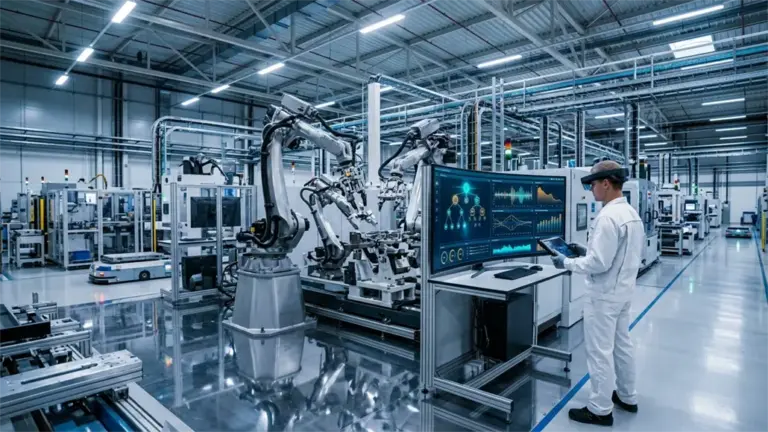
China has built a four-level smart factory system and expanded its implementation in the manufacturing industry, CCTV said. The present framework comprises over 8,200 advanced-level factories, 35,000 basic-level factories, and more than 500 excellence-level factories, as well as 15 companies selected for the Leading Smart Factory Cultivation Program.
The Four-Level Smart Factory System aims to take manufacturers from digitalization as well as connectivity to higher standards of automation and intelligent manufacturing. The MIIT data shows that collaborating factories have decreased average product defect rates by 47% and also average product development cycles by 38%.
Interestingly, the four-tier structure also offers a means to assess increasingly advanced industrial technologies. AI capability usage is currently being added to the evaluation standards for excellence and leading factories, and the limits are likely to increase over time.
Industrial AI agents are now emerging in manufacturing equipment.
The recent deployments indicated a transition from traditional factory automation to a standardized system that is capable of analyzing and supporting decision-making autonomously.
It is well to be noted that at a TBEA Shenyang Transformer Group factory rated at an excellence level, a digital integration platform connects virtual reality, production planning, execution, and tracking. The facility reported a 21% decrease in product development cycles along with a 40% boost in production efficiency.
They have developed algorithms to continuously assess transformer health utilizing real-time operating data. Maintenance teams can be given an alert eight to twelve hours before the occurrence of problems. The system itself can issue status warnings.
Notably, there is another trend visible in shipbuilding. At Hengli Shipbuilding in Dalian, digital systems integrate design, preparation, procurement, supply chains, and production as well as finance. AI software can now mostly do work that used to take two planners over two weeks to finish in about half an hour, with people checking and making alterations.
In the future, development will focus on industrial foundation models and sector-specific AI models as well as high-quality industrial datasets, said the MIIT officials.
It also aims to speed up the development of robots and machine tools as well as industrial control systems in the direction of more independent intelligent agent functions.
New energy vehicles in priority sectors
New energy vehicles are one of the sectors selected for future leading factories as well as large-scale industrial AI deployment.
The auto industry of China is currently serving as a showcase for advanced manufacturing. In 2025, it was reported that Avatr’s 5G AI-enabled factory will be able to churn out one vehicle every 60 seconds using advanced and automated manufacturing processes. The EV factory from Xiaomi has also drawn public attention, with factory visits becoming an attraction for those who want to see fully automated vehicle manufacturing on a massive scale.
All these projects show the increasing use of AI, digital twins, industrial internet platforms, and connected production systems within vehicle manufacturing.
Beyond the automotive production, the roadmap by MIIT also includes rail transit equipment, high-tech shipbuilding, aerospace, steel, and petrochemicals.
Official data show intelligent manufacturing equipment of China, along with industrial software and system solutions, has topped 4.5 trillion yuan, which is equivalent to 665 billion USD, whereas the system integration services market has exceeded 770 billion yuan, or 114 billion USD. Apparently, intelligent manufacturing is one of the largest industrial technology sectors in the country.