

Interoperability is Where the Balance Gets Complicated
The case for greater collaboration becomes clearer when the focus shifts from individual infrastructure providers to the connections between them. Europe has already invested heavily in shared market infrastructure, but common platforms do not automatically eliminate fragmentation. TARGET2-Securities (T2S), for example, provides a single securities settlement platform for Europe, yet most settlement activity still takes place within individual CSDs rather than directly between them. In 2025, T2S processed a record 235.2 million transactions worth €280.9 trillion, while settlement efficiency remained high at 93.5% by volume and 98.0% by value.
Direct Cross CSD Activity Remains Limited
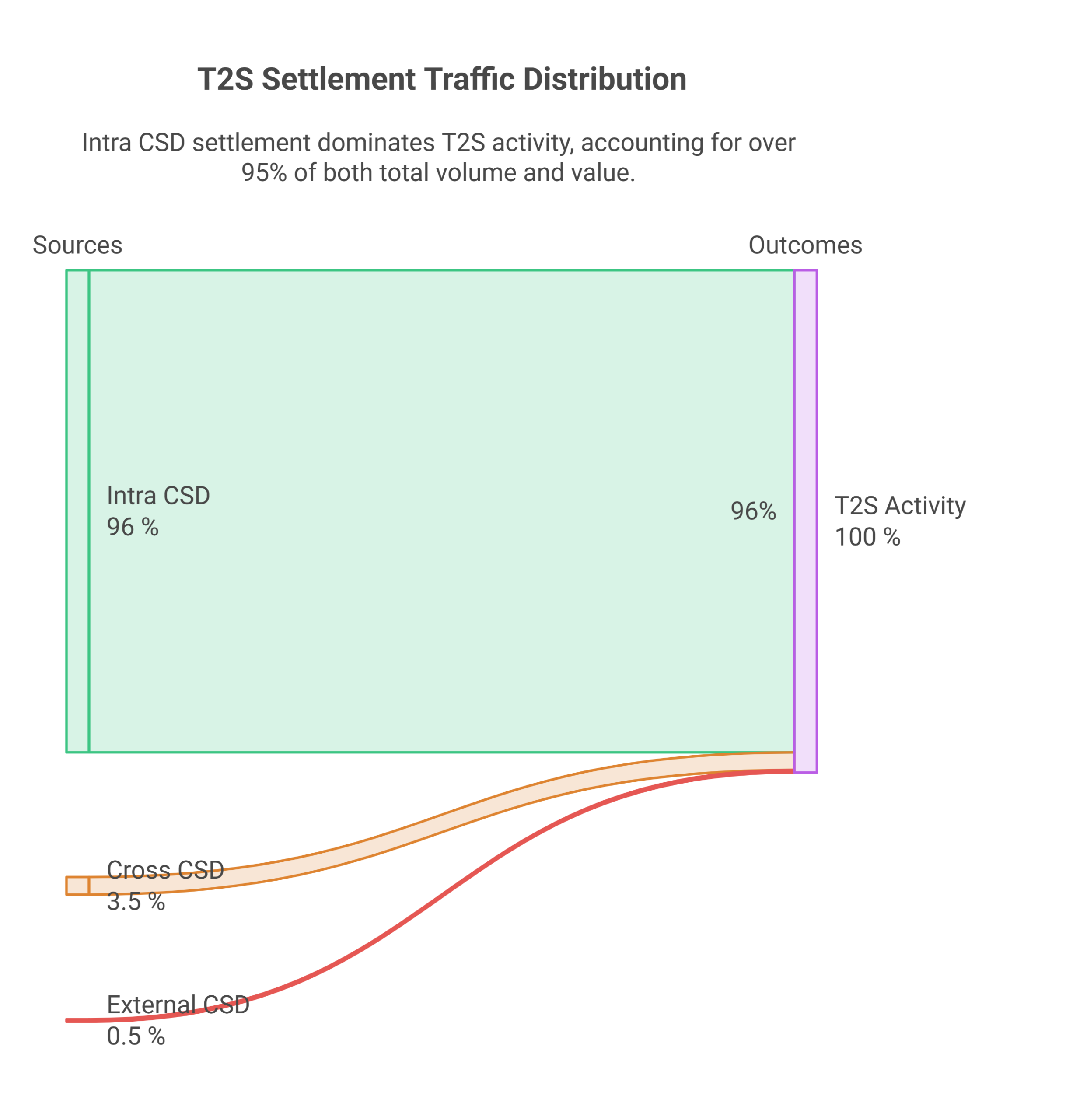
Key Takeaway: Direct cross CSD settlement remains a small share of T2S activity, showing that shared settlement infrastructure has not by itself removed the barriers to deeper European market integration.
The figures need some qualification. Cross-CSD activity does not capture every cross-border settlement transaction because CSDs can participate directly in one another’s systems, with those transactions recorded as intra-CSD activity in T2S. Even so, the data demonstrates that technical connectivity and actual cross-infrastructure usage are not the same thing. The ECB also notes that new functionality introduced in 2025 expanded options for cross-CSD settlement but had not yet produced a notable increase in activity.
The reason extends beyond technology. National legal frameworks, tax arrangements and market practices continue to shape how securities are issued, traded and settled. That means infrastructure can be technically connected while the underlying processes remain different. The European Commission’s market-integration package therefore goes beyond connectivity, proposing measures to simplify cross-border CSD processes and improve connections between EU settlement systems.
The same principle applies to trading infrastructure. Europe does not necessarily need fewer trading venues to create a more integrated market. It needs market participants to be able to compare and access liquidity across those venues more effectively. Consolidated market data is one example of this model: competition remains between execution venues, while common information mechanisms can make that competition more transparent and usable across the market.
Collaboration, however, introduces another consideration: interdependence. The closer infrastructures become, the greater the need to understand what happens when one part of the network experiences financial or operational stress. This is especially relevant to clearing. Under the EU’s EMIR framework, CCPs involved in interoperability arrangements must identify and manage credit and liquidity risks, as well as interdependencies that could affect clearing-member concentrations and pooled financial resources.
ESMA is also strengthening the regulatory assessment of interoperability arrangements, with guidance intended to make national authorities’ assessments more consistent and effective.
This makes interoperability a structural issue rather than simply a technical one. The objective is not to connect every system to every other system regardless of cost or risk. It is to remove unnecessary barriers while maintaining the safeguards that allow different infrastructures to coexist. For European capital markets, that distinction matters because financial market infrastructures must become more connected without sacrificing the competition, resilience and choice that multiple providers can bring.