
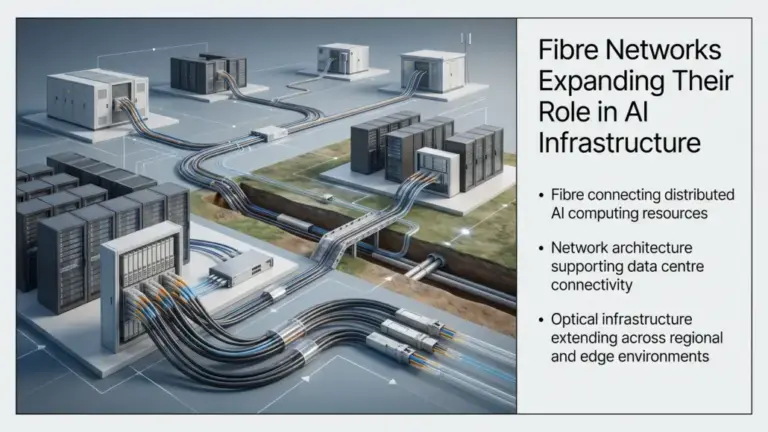
Fibre Networks Expanding Their Role in AI Infrastructure

0
Fibre Networks Expanding Their Role in AI Infrastructure

AI infrastructure is becoming increasingly distributed across data centres, regions and edge locations, changing the role that connectivity plays in computing architecture. Fibre networks are moving beyond their traditional role of connecting users to digital services and are increasingly being used to connect the computing resources that support AI workloads. As AI applications require substantial data exchange between computing locations, network performance is becoming more closely linked to moving information between facilities. ITU T Recommendation Y.2352 identifies bandwidth, latency and reliability as key requirements for networking distributed AI computing centres, highlighting how connectivity is becoming part of the wider AI infrastructure layer.

Google’s network architecture provides one example of this shift. Its global infrastructure spans more than 10 million kilometres of terrestrial and subsea fibre and connects multiple cloud regions and edge locations. The company has also described its Virgo architecture as a means of expanding AI compute across multiple data centres. These developments illustrate how fibre networks can support connectivity across different layers of an AI environment, from individual facilities to geographically separated compute resources.

Distributed Compute Increasing Importance of Optical Connectivity

The changing geography of AI is creating requirements that extend across intra data centre, inter data centre, regional and international connectivity. ITU T’s ION 2030 framework identifies optical networking as an important foundation for distributed AI training, inference and data exchange, while operators are expanding fibre infrastructure around new AI and cloud facilities. Microsoft, Meta, Bell and Ooredoo provide examples of infrastructure investments linking AI data centres with regional and international fibre systems.

This development also connects with network power efficiency, because scaling distributed compute increases the importance of efficient network infrastructure alongside capacity. The central change is that fibre networks are increasingly being planned not only around access demand, but also around the geographic distribution of computing resources.
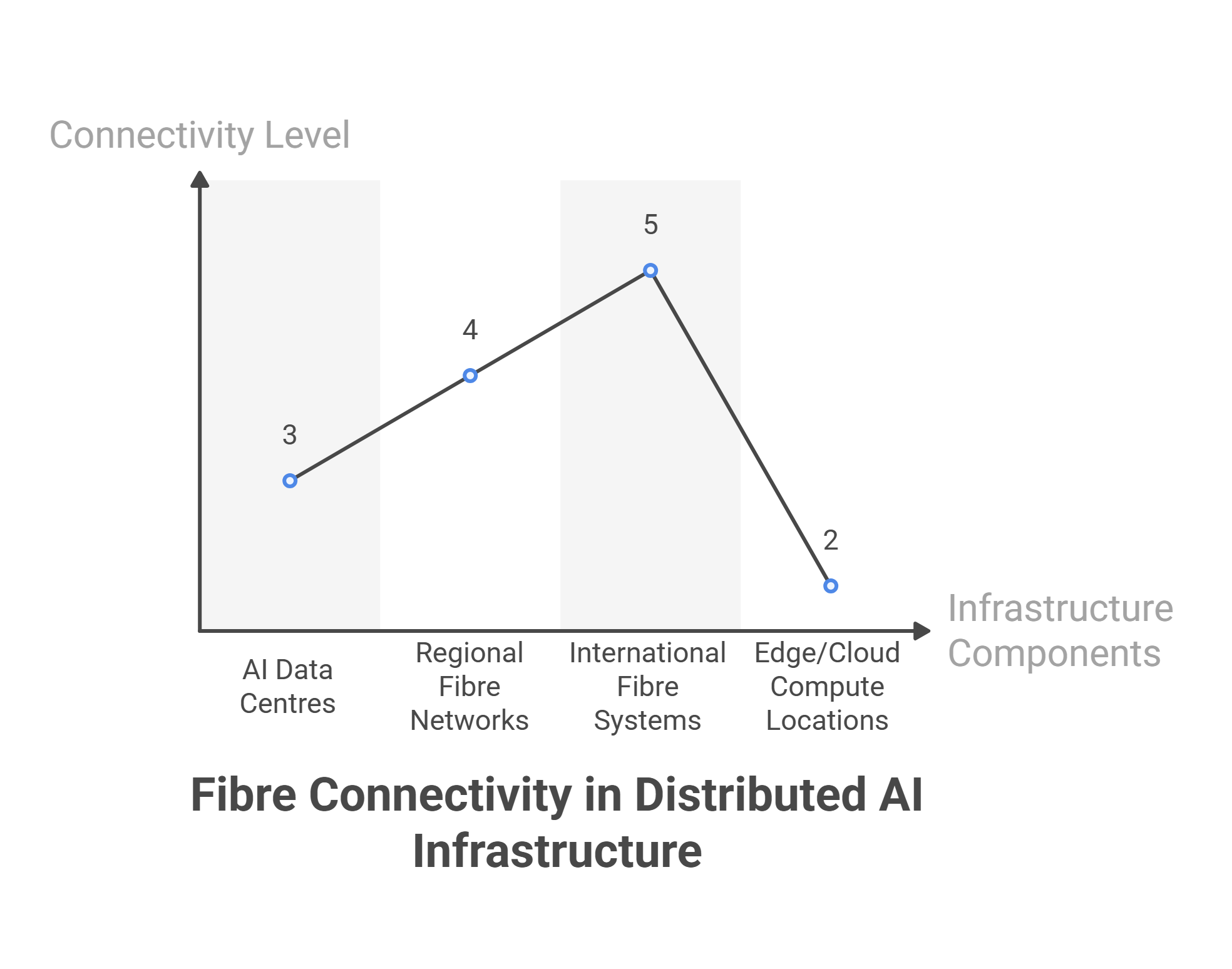
Distributed AI computing is expanding the role of fibre from user connectivity toward high capacity links connecting computing resources across locations.

Fibre Infrastructure Connecting Distributed AI Compute

The expansion of AI infrastructure is increasing the need for connectivity between data centres that may be separated by metropolitan, regional or international distances. Fibre networks can provide the transport layer for these connections, linking compute facilities with shared storage, cloud environments and other processing locations. Google has described its network architecture as supporting AI workloads across multiple data centres, while Bell is developing AI infrastructure linked to its national fibre backbone in Canada. These examples show how network operators and technology companies are increasingly considering fibre as part of the infrastructure required to distribute computing resources.

The requirements extend beyond moving large volumes of data. Distributed AI workloads can depend on consistent communication between computing locations, making latency and reliability important alongside bandwidth. ITU T Recommendation Y.2352 identifies all three as network requirements for distributed AI computing centres. This places greater emphasis on the quality and architecture of the connecting network, particularly where workloads are distributed across several facilities rather than concentrated within one site.

Regional and International Networks Adapting to AI Requirements

The changing location of AI infrastructure is also influencing regional and international network investment. Microsoft’s planned I 2SEA submarine cable system is intended to connect India, Malaysia and Singapore while supporting high capacity AI and cloud infrastructure across the region. Ooredoo is developing fibre infrastructure across the Gulf with capacity aimed at hyperscalers, cloud providers, AI platforms and data centre operators. These projects show how fibre networks can connect AI infrastructure across national boundaries as compute capacity expands into multiple markets.

The same development is visible in North America, where Bell is integrating AI data centre projects with its wider fibre footprint, and in Europe, where operators are experimenting with distributed edge environments that allow computing resources to operate across multiple network domains. Meta’s investment in fibre supply for its expanding data centre infrastructure further illustrates how AI expansion is affecting requirements beyond compute hardware and buildings.

This creates a broader infrastructure chain in which fibre networks connect data centre clusters to regional backbones and international routes. The resulting requirements can influence route planning, fibre capacity, interconnection availability and network resilience. For operators, the challenge is therefore not simply to provide connectivity to an AI facility, but to support the movement of data between distributed compute resources while maintaining the performance characteristics required by the workloads they support.