
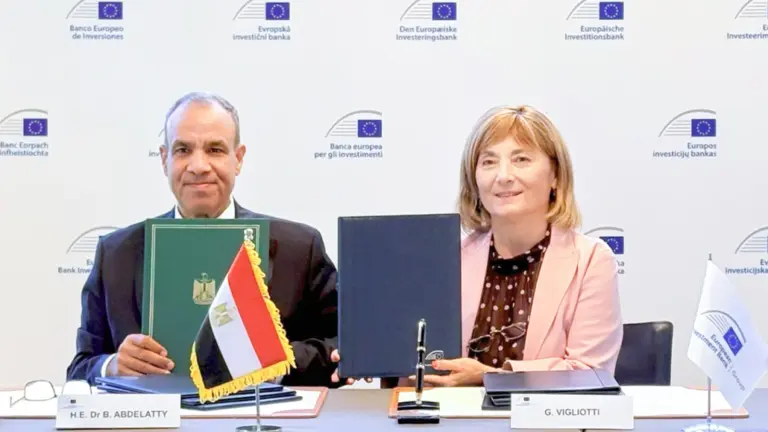
EIB Global supports with vaccine production in Egypt with technical assistance for the Vacsera project.
The European Investment Bank – EIB has gone ahead and signed a €750,000 technical assistance cooperation contract to help prepare a new multi-product vaccine plant at Vacsera in Egypt.
Interestingly, this project supports the ambition of Egypt to fortify local vaccine production and provides the African Union objective of boosting vaccine manufacturing in Africa as part of the EU Global Gateway initiative.
The technical assistance is indeed going to support a feasibility report and market analysis for a project estimated to be around €50 million that might clear the way for possible future EIB financing.
EIB Global, which is the development arm of the European Investment Bank, concluded a €750,000 technical assistance collaboration contract in Luxembourg on 15 June 2026 in order to assist with the development of the Vaccine Production Capacity Increase Project of Vacsera in Egypt. The agreement will promote a new multi-product vaccine facility, which is anticipated to increase domestic as well as regional manufacturing capacity with some of the new production designated for export to different countries in Africa.
It is well to be noted that Vacsera is national vaccine manufacturer from Egypt and one of the oldest vaccine producers in Africa with many years of experience when it comes to manufacturing vaccines as well as biological products.
The planned investment is intended to increase vaccine production capacity in Egypt and help achieve the goal of the African Union to raise the share of vaccines manufactured domestically in Africa from the current level of approximately 1% to 60% by 2040.
As EIB Global Supports with Vaccine Production in Egypt, its technical assistance cooperation agreement is backed by the Facility for Euro-Mediterranean Investment and Partnership – FEMIP Trust Fund and is in line with the Global Gateway strategy of the EU, which aims at strengthening health systems, promoting equal access to health products, and encouraging local production capacity in partner nations. It is also part of broader efforts to enhance prevention, readiness, response time, and early identification of health threats around the world.
Notably, the cooperation agreement from the Egyptian side was signed in Luxembourg on 15 June 2026 by H.E. Abdelatty, minister of Foreign Affairs, International Cooperation, and Egyptian Expatriates, and EIB vice president Gelsomina Vigliotti. The agreement was also signed by Vacsera, the Holding Company for Biological Products and Vaccines.
According to H.E. Badr Abdelatty, minister of foreign affairs, international cooperation, and Egyptian expatriates, “Egypt’s commitment to expanding local vaccine production and advancing national health priorities is at the heart of this cooperation with the European Investment Bank. Strengthened manufacturing capacity at Vacsera will contribute to meeting domestic demand, supporting regional supply and reinforcing Africa’s ability to respond to future health challenges through stronger local production.”
Says Vice President of EIB, Gelsomina Vigliotti, “This technical assistance agreement marks an important step in supporting Egypt’s efforts to strengthen vaccine manufacturing capacity and improve health security. By helping prepare this strategic investment, we aim to back local production, widen access to essential health products, and contribute to more resilient health systems in Egypt, across the region, and on the African continent.”
As per Executive Managing Director of Vacsera, Dr. Sherif Elfeel, “Expanding Vacsera’s production capacity reinforces Vacsera’s role as Egypt’s national vaccine manufacturer and supports our vision of becoming a regional hub for vaccine manufacturing and technology transfer, contributing to health security and sustainable access to vaccines across Africa. Through this partnership with the European Investment Bank, we are enhancing our manufacturing capabilities, improving quality standards and positioning Egypt as a key supplier for the region and the continent.”
The technical assistance, funded through the FEMIP Trust Fund, is expected to include a feasibility study and market analysis for the project. The studies are expected to support possible future EIB funding, the sum of which will be known when the studies are finished. Apparently, the total cost of the project is estimated to be around €50 million.