
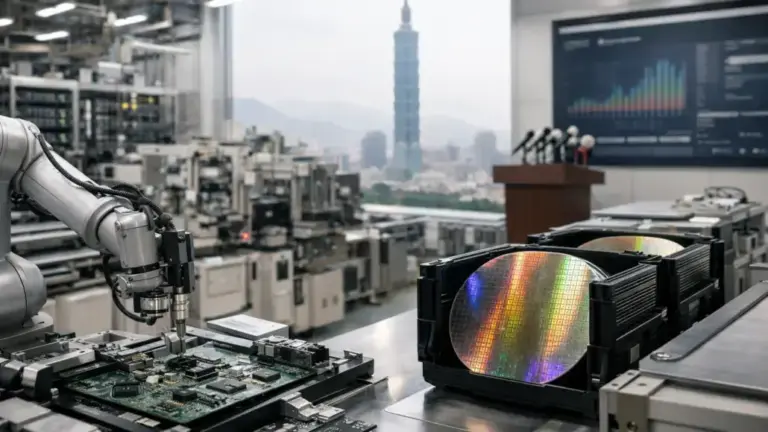
The industrial production in Taiwan surges 25.61% in July 2026 from a year earlier to 145.24, driven by steady demand for AI as well as high-performance computing applications to increase production in the information technology and electronics segments, the Ministry of Economic Affairs of Taiwan confirmed the same in a news conference in Taipei.
The fact is that the manufacturing production index of Taiwan, which makes up 93.72% of the total industrial output, increased by 26.89% year-on-year to 147.65, marking the 29th consecutive month of growth, and exceeded the projected growth that was made by the ministry in the range of 22-25.5%.
The report of industrial production in Taiwan surges 25.61% is indeed a stronger-than-expected performance and was predominantly caused by electronic components, electronics, and computers, as well as optical products, which had more traction than predicted, Chen Yu-fang, the Department of Statistics Deputy Director-General, told a Taipei news conference.
The output of computers and electronics, as well as optical products, jumped 95.62%, with demand for servers driving the surge as leading designers of graphics processing units and application-specific integrated circuits rolled out novel platforms in the current quarter, Chen stated.
She said switches and semiconductor inspection equipment, as well as solid-state drives utilized in cloud and data center applications, also helped boost output.
This was followed by a jump of 22.72% in the output of electronic components, driven by high demand for 12-inch wafers and DRAM chips, as well as IC packaging and testing services, Chen remarked.
As per Chen, the production of flat-panel displays saw a dip of 18.43% from a month earlier, marking the 3rd consecutive monthly drop, as rebounding demand for small panels utilized in medical and automotive sectors was countered by slow buying of large panels.
Machinery output when it comes to conventional industries increased by 19.75%, which is the fifth consecutive month of growth, on investment in chipmaking, automation, as well as power transmission equipment and reclaiming machine tool orders.
As far as the output of base metals is concerned, it saw a surge of 13.24%, helped by rising demand in terms of metals that are used in semiconductors, electronic components along with power batteries, she said.
Output of chemical materials saw a fall of 5.88%, thereby reflecting low demand, excess capacity in China, and maintenance closures, Chen said. Auto and auto parts output fell 5.03% as some of the automakers went on to cut production so as to minimize inventories.
When there is a mention of traditional industries, especially machinery, they are known to be gaining steadily since March 2026 and could remain year-on-year gainers for this year, driven by demand when it comes to equipment from fab expansions, she said.
Apparently, the base metal production could also continue a favorable trajectory, driven by appetite for semiconductor materials, but a slower turnaround in traditional steel demand might persist to put pressure on the sector, Chen said.
The manufacturing production index in Taiwan was expected to grow 25.5 to 28.9% year-on-year in August 2026, Chen said.
Since the second half is typically the peak season when it comes to the information and communications sector, the production of consumer electronics like AI PCs is projected to grow and improve manufacturing output.
High-performance computing along with AI-related products will be in high demand, with manufacturing output anticipated to rise in double digits for the full year, Chen stated.