
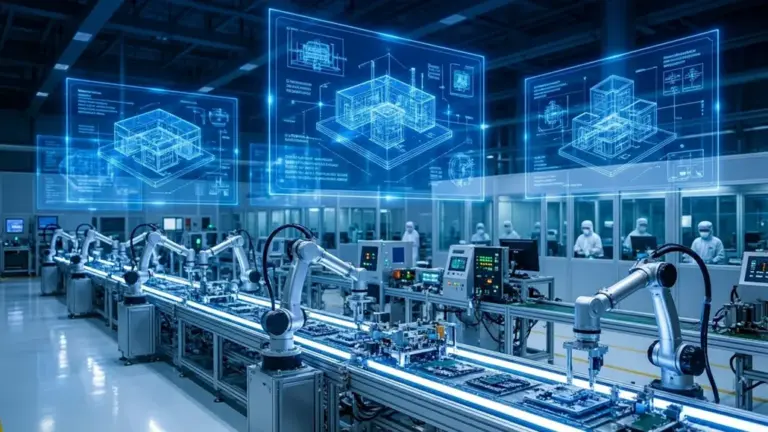
With the increased connectivity along with technological advancement of international semiconductor and mobility supply chains, digital twin and smart manufacturing in Malaysia have gained increasing importance in building up the industrial landscape.
According to Ts Norhizam Ibrahim, the Director of manufacturing development at the non-resource Malaysian Investment Development Authority – MIDA smart manufacturing has indeed gone on to become an entry ticket for companies who are looking out to remain competitive in the global supply chain landscape.
He adds that customer expectations have changed and are no longer based solely on traditional measures like ISO certification and on-time delivery. The expectation now is that manufacturers go ahead and offer live machine data, predictive defect alerts, real-time traceability as well as secure factory networks that can be directly integrated into customer systems.
He added that both customers and financiers are ramping up pressure to implement digital twin and smart manufacturing in Malaysia, as companies that can demonstrate reliable operational and sustainability data are regarded as lower risk and more investment prepared.
He further said that at the same time, competitive pressures are intensifying. The entry of high-quality, lower-cost manufacturers is challenging traditional operating models.
To remain relevant, companies must move beyond low-complexity assembly into higher-value activities such as design, research and development and innovation-led manufacturing, supported by a step change in productivity and efficiency through automation and smart manufacturing.”
Vehicles are becoming software-defined “computers on wheels”, and the link between the semiconductor and automotive sectors is growing more foundational, said Norhizam, resulting in greater demand for semiconductors, power management systems, sensors, as well as advanced driver assistance systems.
Hence, Malaysia needs to move away from incentives and emphasise building a complete and operational ecosystem backed up by the development of talent, advanced cybersecurity standards, system integrators, as well as Industry 4.0 acceptance.
Meanwhile, Noor Suziyanti Saad, MIDA’s director of transport technology division, said a closer integration between semiconductor and automotive industries is becoming more vital as chips now make up a rapidly increasing portion of modern vehicle costs, especially with the shift towards electric vehicles.
She said Malaysia already has solid foundations in the semiconductor and automotive sectors, and tapping the advantages of both industries could assist the country in enhancing its competitive edge when it comes to the regional EV ecosystem.
Apparently local vendors who have decades of experience providing components to OEMs are well-positioned to further develop their capabilities and be part of next-generation EV supply chains.
Smart manufacturing technologies, which include advanced sensors, semiconductor integration and intelligent systems, would be key to facilitating safer, more energy-efficient and connected vehicles, she said.
She added that the government is additionally collaborating closely with universities, industry players as well as technical agencies to fill talent gaps in the area of integrated software engineering, automotive electronics, and system architecture in order to support long-term growth of the industry.