
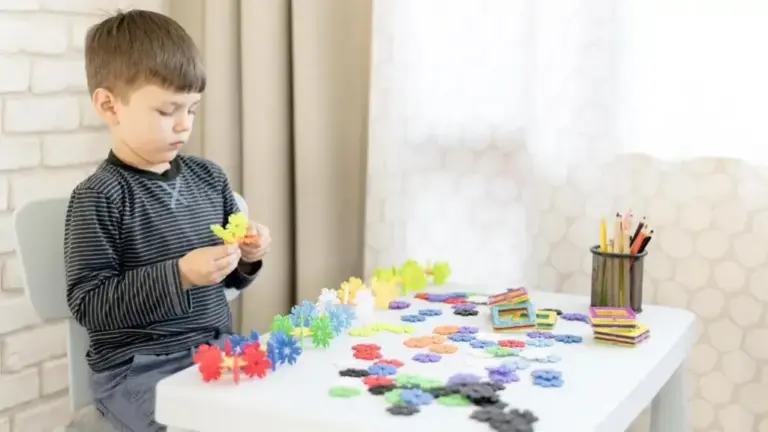
When imagination takes a different shape
Watch a neurotypical three-year-old and you will see the world transformed. A cardboard box becomes a spaceship. A stick is a magic wand. A row of cushions is a river that must not be stepped in. Pretend play the ability to use objects symbolically, to adopt roles, to create imaginary scenarios is one of the hallmarks of typical preschool development. It is also one of the developmental domains most commonly affected in autism, where pretend play may be absent, minimal, or qualitatively different in ways that offer important diagnostic information.
What Pretend Play Is and Why It Matters
 Pretend play (also called symbolic or imaginative play) requires the child to hold a mental representation of something that is different from what is physically present to treat a banana as a phone, or to act as if a doll is a real baby who needs feeding. This capacity for representational thinking is closely linked to language (which also involves using symbols words to stand in for real things), to theory of mind (understanding that other minds can represent the world differently), and to narrative thinking.
Pretend play also serves as the primary context for peer social interaction in the preschool years. Children who cannot or do not engage in pretend play are at a significant disadvantage in the social world of preschool, where play is the currency of friendship.
How Play Differences Present in Autism
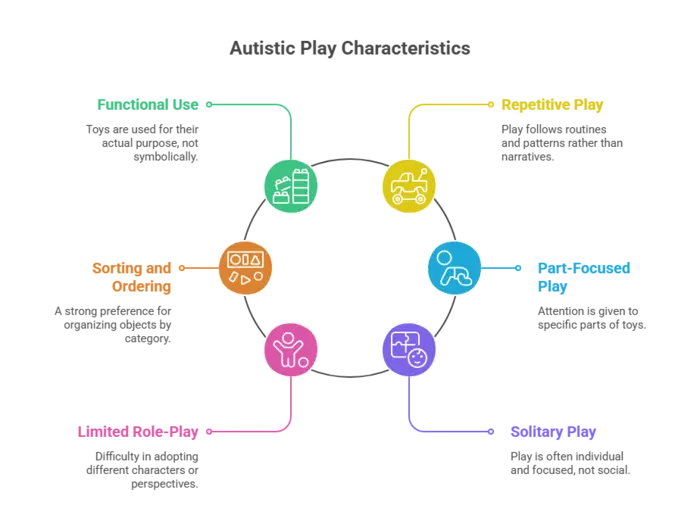
Autistic children’s play is often characterised by:
- Functional but not symbolic use of objects the child uses toys for their actual purpose but does not use them symbolically
- Repetitive, routine-based play rather than inventive, narrative play
- Strong preference for sorting, categorising, or ordering objects
- Spinning wheels, lining up objects, or focusing on parts of toys rather than whole-toy play
- Limited role-play or adoption of character perspectives
- Play that is solitary and focused, rather than inviting others to join
It is important to note that autistic children can and do play and some develop rich, elaborate systems of rule-based or fact-based play. The difference is in the nature of the play, not its presence or absence.
The Link to Theory of Mind
One influential explanation for reduced pretend play in autism draws on theory of mind the ability to understand that other people have beliefs, desires, and perspectives that may differ from one’s own. Pretend play, particularly role-play and character play, requires the child to take on a different perspective and act from within it.
The same cognitive capacity that makes it difficult to understand that someone might think differently than you do may also make it more difficult to pretend to be a different person, or to invest in the imaginary perspectives of doll characters. Theory of mind development and symbolic play are closely linked, and delays in one often accompany delays in the other.
What Play Does Look Like in Autistic Children
It is a mistake to assume that autistic children do not play or do not have rich inner imaginative lives. Many autistic children have intensely elaborate systems of interest-based play in-depth engagement with trains, planets, maps, or specific fictional universes. The play may be more rule-based, more expert, and less socially inviting but it is not absent.
Supporting autistic children’s play means meeting them in their interests, gently expanding the play in ways that invite reciprocity and imagination, and using their interests as a doorway into interaction rather than trying to impose a different kind of play.
Conclusion
Delayed or absent pretend play is one of the preschool-stage markers of autism that speaks directly to some of the deepest aspects of the autistic cognitive profile symbolic thinking, theory of mind, and social imagination. Understanding it accurately, without dismissing the very real creativity and imaginative richness that many autistic children possess, is essential for parents, educators, and clinicians who want to support rather than diminish the full range of what autistic children bring to the world.