
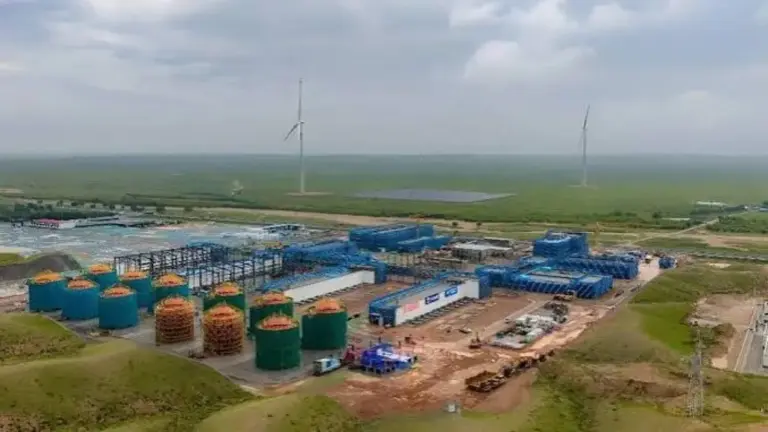
Sinopec, the Chinese state-owned energy giant, has formally begun construction on pure hydrogen pipeline which is 805-kilometres, equivalent to 500-mile. It is the first large-scale, long-distance project in China to carry the environmentally friendly fuel through various provinces.
The trunk pipeline was announced on November 16, 2026, at an industry conference held in Beijing, with the pipeline originating at the Shangdu station located in Ulanqab, Inner Mongolia.
The route will cut through 21 counties as well as districts in Inner Mongolia, Hebei, and Tianjin, along with Beijing, linking the wind- and solar-rich western interior of China with its heavy industrial hubs on the eastern coast.
Specialised materials and engineering controls are needed to transport pure hydrogen, which is apparently a process that degrades standard steel through hydrogen rather than standard natural gas lines.
Sinopec is expanding this infrastructure based on operational expertise from its current 42-kilometre or 26-mile Baling-Changling exclusive hydrogen pipeline.
The Ulanqab initiative combines manufacturing, storage, and transportation as well as end-use into one unified value chain. In the first phase, wind and solar capacity of 2.45 million kilowatts will power about 1 gigawatt of electrolyzers to generate 100,000 metric tonnes of green hydrogen per year.
The second phase will take production to 200,000 metric tonnes, and the pipeline has been designed to eventually increase capacity to 500,000 metric tonnes per year.
The construction on pure hydrogen pipeline will directly serve the Yanshan petrochemical complex of Sinopec in Beijing and the Tianjin refinery.
The project provides immediate and enormous industrial demand to displace carbon-intensive gray hydrogen from fossil fuels for processes in refining, such as sulphur removal, where commercial risk is lower.
Net carbon dioxide emissions are expected to fall by 1.73 million metric tonnes per year in the initial stage of operations.
In addition to the purification, the pipeline network is envisioned to ultimately facilitate natural gas blending, regional hydrogen trading, and green metallurgy, as well as fuel-cell transportation, providing a practical template for the more widespread energy shift in China.