
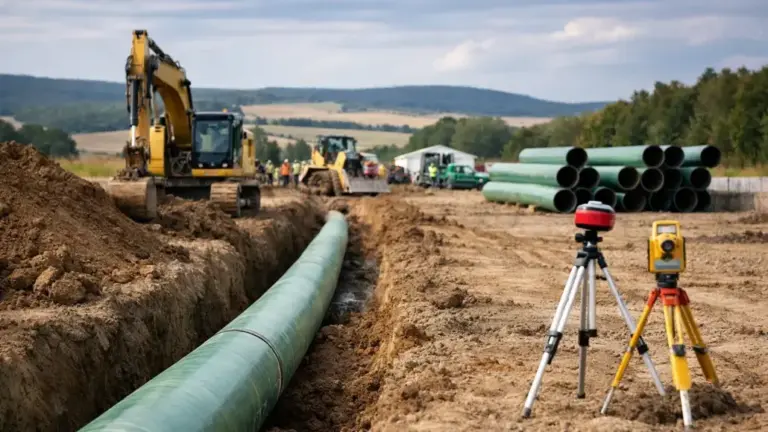
At the end of August 2026, the construction of the first hydrogen pipeline in Saarland officially got underway in Wallerfangen, a key milestone for green energy infrastructure within the Greater Region.
The project was inaugurated by a groundbreaking ceremony by grid operator Creos Deutschland GmbH in the district of Oberlimberg.
German, French and Luxembourgish political and business leaders joined the joint launch event for the project launch.
The 17-kilometre German part of the pipeline, which will link Leidingen and Dillingen, is part of a larger cross-border project called MosaHYc, short for Moselle-Saar Hydrogen Conversion. The ceremony was a visible sign of a new chapter for the industrial state, said Saarland’s Minister-President Anke Rehlinger, stressing the importance of building up hydrogen infrastructure to keep local industry competitive and meet climate goals.
The cross-border network is based on global collaboration between Germany and France.
Creos handles the German segment, while French network operator NaTran France is transforming 20 kilometres of existing pipelines and laying 5 kilometres of new pipe running from Bouzonville toward Leidingen.
The German part is funded by the federal and state governments as an Important Project of Common European Interest – IPCEI.
Rafael Sierra Garrido, the Creos Managing Director, said the project had been a great collaboration and that such cross-border projects were a powerful symbol of hope in difficult geopolitical times.
The switch to hydrogen is the second major evolution for Creos’s network, after the historical transition from coke oven gas to natural gas in the 1970s, Managing Director Frank Gawantka said. The pipe laying and civil engineering works are planned to take place over a period of roughly 18 months following formal planning approval in July 2026.
The first hydrogen pipeline in Saarland will be a key building block of an integrated European hydrogen network when completed.
Finally, the system will transport imported hydrogen from northern Germany, the Iberian Peninsula, Luxembourg and Belgium by linking to the German hydrogen core network and regional projects such as HY4LINK and HYFEN.
According to the Minister for the Economy, Luxembourg, Lex Delles, more hydrogen infrastructure means a more secure supply and a more resilient industry across the region.
Once fully operational, the system is going to transport hydrogen straight from France to the industrial heartland of the Saarland.