
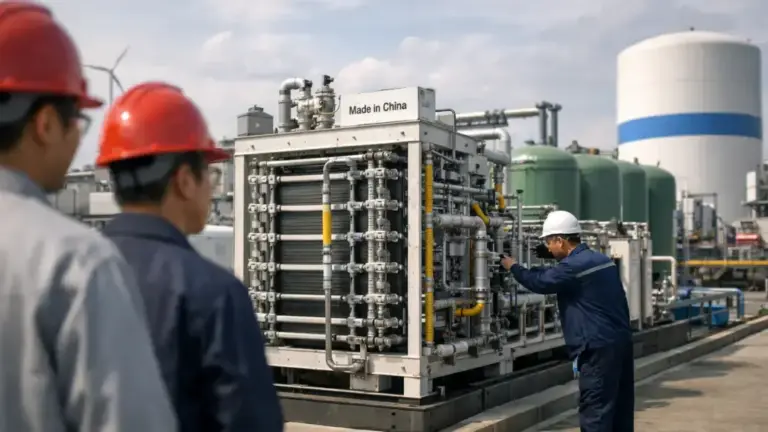
Chinese manufacturers shipped over 320 megawatts of electrolyzers to Europe, Asia, and Africa, as well as North America, in H1 of 2026, demonstrating the dominant role of China when it comes to the global hydrogen equipment market.
- Chinese electrolyzer makers have gone on to ship a minimum of 321.25 MW globally in the first half of 2026, which is a rise from 18.5 MW that was witnessed in 2025. This is a 17-fold jump, or more than 1,600%, throughout Europe, Asia, Africa, and North America.
- Chinese domestic bidding also jumped 35.74% to 1,121 MW, and Norway’s HydrogenPro just closed its own 500 MW China plant to produce on rival LONGi’s lines – just as electrolyzer sector of Europe basically surrendered the manufacturing race.
It is worth noting that the electrolyzer story of China has moved under the radar from growing exports to global takeover. Publicly available shipment data shows that overseas shipments of Chinese-made electrolyzers from the Chinese electrolyzer makers hit no less than 321.25 MW in the H1 of 2026, which is a rise from only 18.5 MW in the same period in 2025. This represents an approximate 17-fold leap, or more than 1,600%, year on year, throughout Europe, Asia, Africa, and North America.
Apparently, the domestic Chinese market is also booming. Publicly announced electrolyzer bids were for 46 projects having an overall installed capacity of around 1,188.05 MW in H1 2026, which is a 35.74% year-on-year growth.
Winning bids, which include the direct signings, were 1,121.05 MW. Alkaline electrolyzers – ALK took a total dominant 92.6% of the order scale, PEM 2.46%, and AEM 0.13%. Chinese hydrogen equipment is growing on the very technology where it has the greatest price advantage.
This is not some hypothetical pipeline. By the end of March 2026, the renewable hydrogen production capacity of China under construction was over 1 million tonnes/year, with over 250,000 tonnes/year of finished and operational projects, which is more than double the end-2024 figure – as well as more than 900,000 tonnes/year, which is still under construction, according to the National Energy Administration.
Deal that helps anchor the trend
H1 2026 export book looks like an atlas of everywhere that hydrogen is attempting to take place –
- Middle East – Sungrow Hydrogen – Sunshine Hydrogen has signed a 2025 agreement with the ACME Group from India so as to supply multiple 1,000 Nm³/h ALK units for a 320 MW green ammonia project in Oman. In March 2026, Shuangliang Energy Saving provided 16 hydrogen production systems to ACME Oman for its 300-tonne green ammonia project. In 2025, Power China Hydrogen signed 18 projects, of which foreign business represented 60%.
- Europe – 160 MW of cooperation with Spain when it comes to Trimogen Hydrogen. LONGi Hydrogen inked a 1 GW strategic OEM agreement with HydrogenPro Envision Energy from Norway and shipped its three MW-class units in a bulk shipment to Europe.
- South Asia – Guofu Hydrogen has signed a contract worth US$5.1m with Advait of India, and the joint-venture plant of the duo has produced its first 5 MW electrolyzer.
With these deals, Chinese electrolyzers are no longer a Chinese product but a global one. In parallel, the Uzbekistan project marks the first international deployment of a 1,000 Nm³/h “Four-in-One” system from LONGI, supplying ACWA Power’s 3,000-tonne-a-year pilot with PowerChina Huadong.
The Turbocharged Standard Policy
Two Chinese policy moves in 2025 and 2026 strengthened the domestic base despite the export push. In May 2025, the National Development and Reform Commission as well as the National Energy Administration issued the Notice on Matters Related to the Orderly Promotion of the Direct Development of Green Power, which allows the direct supply of green power to hydrogen consumers via direct lines, which is a mechanism that offers resource-rich areas a major cost advantage as far as green hydrogen is concerned.
In March 2026, MIIT, the Ministry of Finance, as well as NDRC, jointly conducted an extensive hydrogen application test in 5 urban agglomerations, which included green ammonia, fuel cell vehicles, methanol, hydrogen chemical feedstocks, and hydrogen metallurgy, as well as hydrogen-doped combustion.
Then, on June 25, 2026, the NDRC and NEA released the 15th Five-Year Plan for the Construction of a New Energy System, which targeted a renewable hydrogen production volume of 2 million tonnes/year by 2030, which is about 7 times the end-of-Q1 2026 number. This is the demand curve under everything above.
As per Changjiang Securities, the hydrogen industry enters the period of technology-cost to scale-cost reduction in the 15th Five-Year Plan between 2026 and 2030, and deep green hydrogen will penetrate the industrial demand side. Their triggering point is when green hydrogen drops to ¥8-10/kg or US$1.10-1.40 and carbon prices climb to ¥100/tonne or US$13.70, making hydrogen metallurgy and green ammonia locally economic, transforming the entire sector from being policy-driven to economics-based.
The Deal That Speaks the Quiet Part Pretty Loud
The most interesting transaction in H1 2026 cannot be found in the export figures. This was the case at HydrogenPro.
On 13 May 2026, the Norwegian electrolyzer maker said it was putting its own 500 MW factory in Tianjin on ice, which is a plant it took full ownership of in November 2025 in a $650,000 deal and would instead make on the Chinese lines of LONGi in a joint OEM agreement giving HydrogenPro immediate accessibility when it comes to 1 GW of capacity.
CFO Martin Holtet flagged that the move is expected to deliver over NOK 20m, or $2.2m, in terms of annual savings, on top of European salary freezes, management reductions in wages, and short-term job cuts.
A Norwegian electrolyzer maker abandoned a planned China plant to make on the assembly line of a Chinese rival. HydrogenPro will continue to utilize its proprietary technology, and is going to put together European-bound systems in Germany with Andritz, the EPC partner bu the metal, the manufacturing, and the volume are sourced from LONGi. Access to a more computerized facility with fewer operators per electrolyzer was the way CEO Jarle Dragvik described it. This is diplomatic for – we are unable to construct these things as well as they are capable of, and we have quit pretending that we can.
Notably, in 2024, LONGi had already invested NOK 70m or $7.62m in HydrogenPro.