
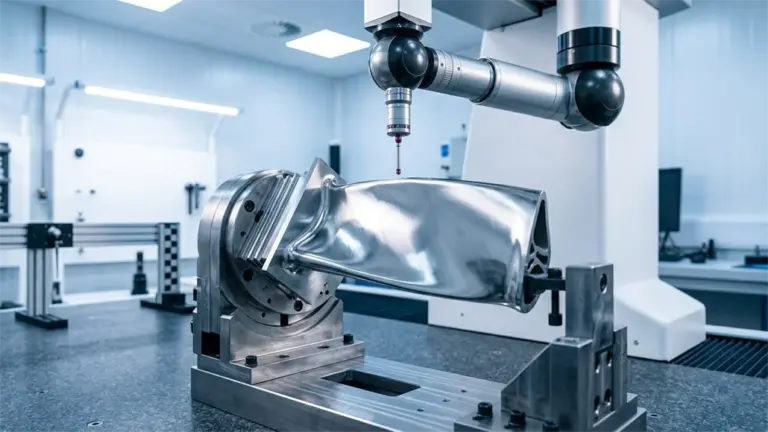
If the aero-engine is the pearl in the crown of modern industry, then the single-crystal turbine blade should indeed be considered the diamond set upon that pearl.
Currently, only the US, the UK, Russia, and France, as well as China, have autonomously mastered the entire technological chain when it comes to single-crystal turbine blades, from the whole range of materials research and development and precision casting to engineering application, China Media Group – CMG went on to report on May 26, 2026.
The fundamental component of an aero turbine engine is the energy conversion device. It transforms the chemical energy of aviation fuel into high temperature along with high-pressure thermal energy by means of combustion, which in turn propels the turbine to rotate and turns it into mechanical energy and subsequently breaks down into the kinetic energy of the aircraft.
It is well to be noted that the higher the temperature that the engine hot-section components can endure, the higher the energy efficiency of conversion will be, which will result in increased thrust, reduced fuel consumption and improved overall performance. Consequently, single-crystal turbine blades are subjected to very severe conditions. They are a key factor in determining the engine’s reliability and performance, as well as service life, in addition to being a key standard to measure the aviation manufacturing capability of the country, added CMG.
The chief engineer of the AECC Beijing Institute of Aeronautical Materials, Li Jiarong, along with his team, has developed a single-crystal superalloy with separate intellectual property rights – IP which reaches the global advanced level.
The report quoted Li as saying that “we have achieved the independent development of single-crystal turbine blade materials in China. Our second-generation single-crystal superalloy, DD6, offers performance that is superior to or equivalent to the second-generation single-crystal superalloys widely used in Europe and the US.”
On top of that, the superalloy is less expensive to make. DD6 has grown into the most commonly utilised single-crystal superalloy in China and has saved the nation a large number of strategic resources, Li said.
Li said the institute has created and provided single-crystal turbine blades over the years, and these are being utilised in a variety of advanced aero-engines, ensuring strong material backing for military and civil aircraft, such as advanced fighter jets as well as helicopters.
CMG said the main goal of single-crystal turbine blades is to work safely, steadily and effectively for an extended period in extreme conditions of ultra-high temperature, extreme pressure, excessive rotation speed and corrosive gas erosion. Single-crystal turbine blades already function at temperatures higher than normal steel, even close to the melting point of their particular alloy – so how can they be used in long-term stable operation?
Nickel-based single-crystal superalloys are built on metallic nickel, said a researcher at the institute, Yue Xiaodai, as per the report. Based on a variety of performance requirements such as high-temperature power, creep tolerance, and high-temperature resistance to corrosion, researchers scientifically develop and accurately add a range of alloying elements.
These elements have distinct chemical and physical characteristics. But via repeated experiments and consistent efforts, the research team accomplished a consistent melting and fusion of all elements and managed impurities effectively, said Yue.
The institute has been leading the development of single-crystal superalloys with IP rights since the 1980s and has developed the first single-crystal turbine blade, the first single-crystal hollow turbine blade and so forth in China. According to CMG, these accomplishments have filled several technological gaps in China.
The manufacturing procedure of single-crystal turbine blades includes over 10 core processes, such as alloy smelting and preparation and shipment of the final product. And each of these fundamental procedures is then subdivided into dozens of highly precise, comprehensive sub-steps. China has become one of the five nations that can autonomously master the full technology chain,” remarked CMG.