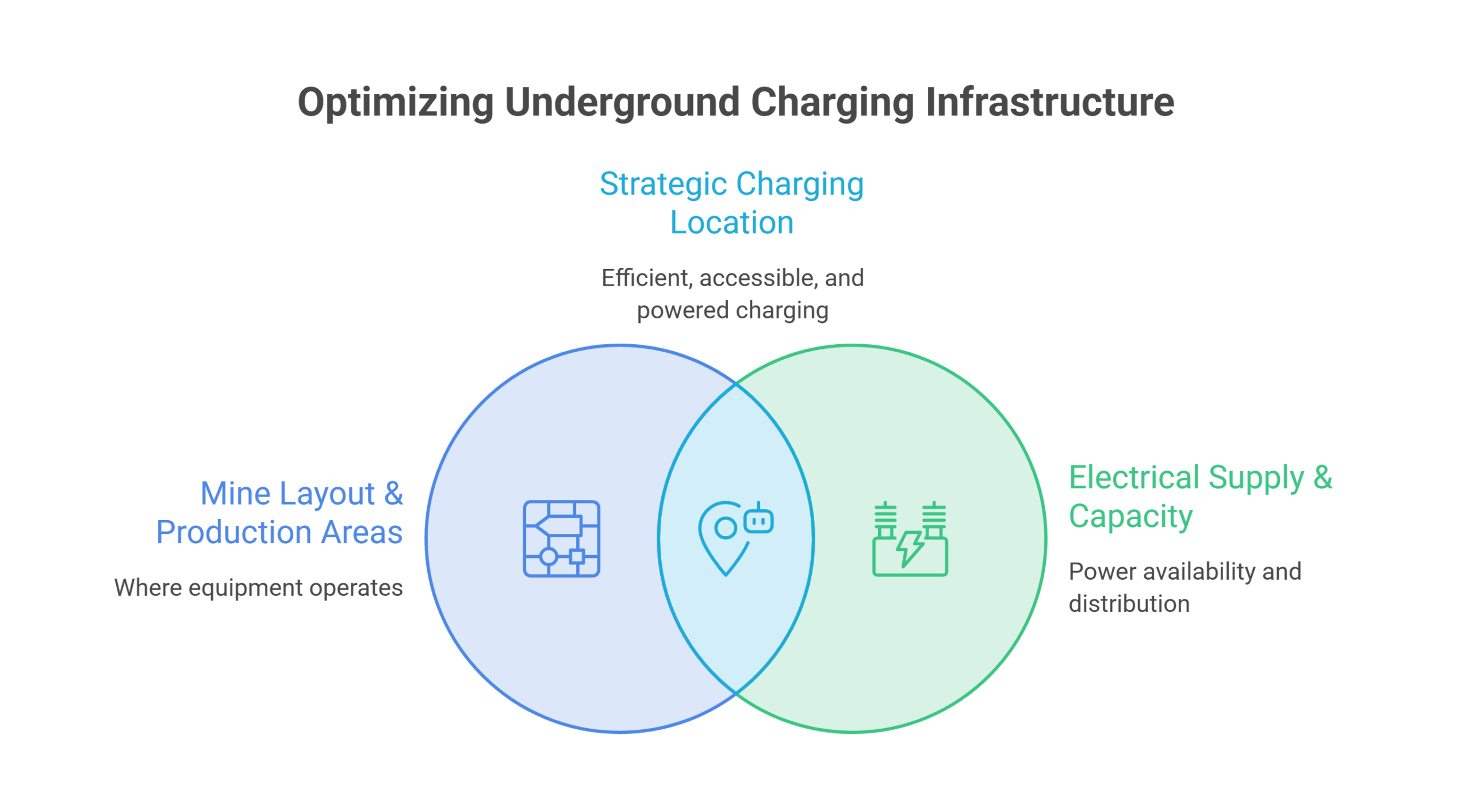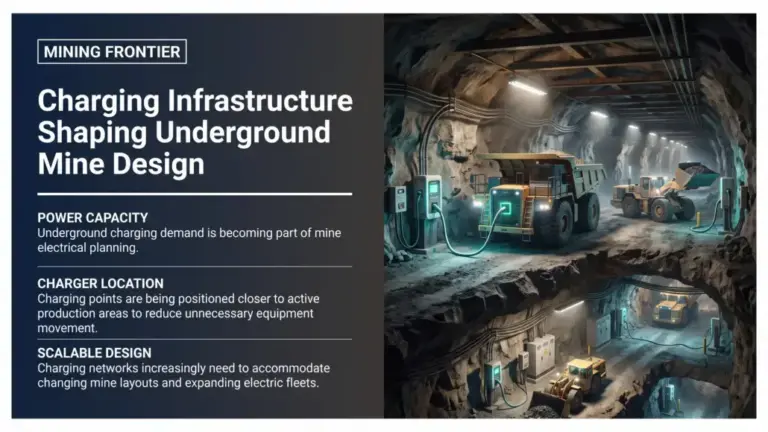
The expansion of charging infrastructure is changing how underground mines approach electric equipment deployment. Chargers can no longer be treated simply as support equipment installed after vehicles are selected. Their location, electrical capacity and connection to the mine power network can influence equipment movement, operating schedules and the amount of electric equipment that can be supported at a particular level.
The Global Mining Guidelines Group (GMG) identifies charging arrangements as part of underground battery-electric vehicle planning, alongside mine layout, equipment utilisation, power supply and operational controls. This means mine planners increasingly need to consider the charging system while developing the broader mine design rather than treating it as a separate procurement decision.
Several factors can influence where charging points are positioned:
- Distance between charging areas and active production zones
- Available electrical capacity at different mine levels
- Expected charging demand from the planned fleet
- Space and access requirements for charging equipment
- Future changes in mine development and fleet size
The relationship between charging locations and equipment travel is particularly important underground. A machine that has to leave its operating area and travel a significant distance to recharge can lose productive time, while concentrated charging demand can create queues when several machines require energy at the same time. ABB notes that strategically positioned charging points can reduce unnecessary tramming and should be considered alongside changes to mine design over the operating life of a site.
Distributed Charging Bringing Power Closer to Production
Recent equipment developments show greater attention to distributed charging. In 2026, Epiroc introduced an underground charging system using remote charge posts that can be positioned separately from a central charging cabinet. The company states that the arrangement is intended to bring charging closer to working areas, reduce unnecessary machine movement and distribute available power across multiple charging points.
This approach is significant because underground production areas change as development advances. A fixed charging location that works at one stage of a mine may become less practical as working faces move deeper or production shifts to another level. Charging infrastructure therefore needs to accommodate not only the fleet operating today but also how the mine is expected to develop.
The same principle applies to brownfield and greenfield operations. Existing mines may need to work within established electrical systems and underground layouts, while new mines have more scope to design power distribution and charging locations around electric equipment from the outset. In both cases, charging infrastructure becomes increasingly connected to the physical and electrical design of the mine.