
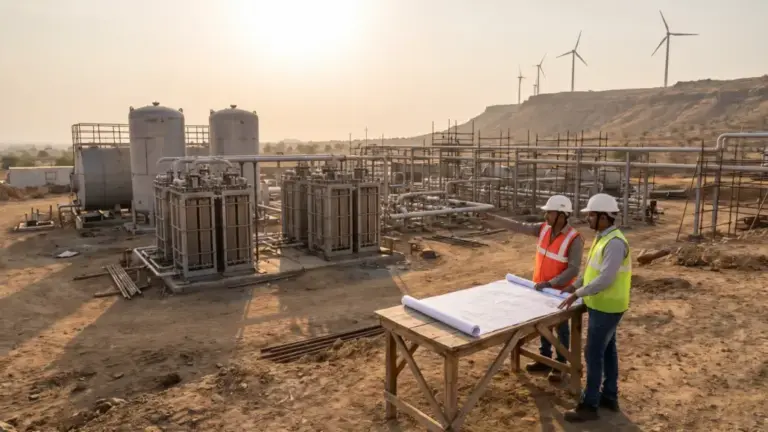
The shift toward a hydrogen-based economy is accelerating, but the real challenge lies in moving from small-scale pilot programs to large, bankable hydrogen projects in India that can attract significant global capital. Bankability in the context of green hydrogen refers to a project’s ability to demonstrate a clear and predictable revenue stream, manageable risk profile, and a return on investment that satisfies both equity investors and debt providers. As the Indian government sets ambitious targets under the National Green Hydrogen Mission, the focus is sharpening on the commercial viability of these ventures. For a project to be considered bankable, it must align several critical factors, including low-cost renewable power, reliable electrolysis technology, long-term offtake agreements, and a supportive regulatory environment. Without these pillars, even the most technologically advanced projects will struggle to secure the financing necessary for full-scale implementation across India’s industrial landscape.
The Foundation of Bankability: Reliable Offtake Agreements
The most critical factor for bankable hydrogen projects in India is the presence of a robust and creditworthy offtake agreement. Lenders and investors need assurance that the hydrogen produced will have a guaranteed buyer at a price that covers operational costs and debt service. In the current market, finding long-term “take-or-pay” contracts is challenging because green hydrogen is still more expensive than conventional grey hydrogen. However, the emergence of mandatory green hydrogen consumption targets in sectors like refineries and fertilizers is providing the necessary demand signals. By securing contracts with state-owned enterprises or large multinational corporations, project developers can significantly reduce the perceived market risk, making the project far more attractive to international banks and development finance institutions.
Optimizing the Levelized Cost of Hydrogen
Cost competitiveness is the engine that drives the bankability of green hydrogen ventures. To build bankable hydrogen projects in India, developers must relentlessly focus on lowering the Levelized Cost of Hydrogen (LCOH). This involves optimizing two primary cost components: the capital expenditure of the electrolyser plant and the operational expenditure associated with renewable electricity. India’s competitive edge lies in its ability to generate some of the world’s cheapest solar and wind power. By co-locating production facilities with renewable energy plants or utilizing open-access regulations to procure green power, developers can minimize energy costs, which account for nearly seventy percent of the total production expense. Furthermore, technological improvements and local manufacturing of electrolysers are expected to further compress capital costs, enhancing the overall commercial appeal of these projects.
Navigating Regulatory and Policy Frameworks
A stable and transparent policy environment is essential for the long-term success of bankable hydrogen projects in India. The government has already taken significant steps by waiving inter-state transmission charges for renewable energy used in green hydrogen production and providing long-term visibility through the Green Hydrogen Policy. However, for a project to remain bankable over its twenty-year lifespan, there must be clarity on land acquisition, water allocation, and environmental clearances. Investors are particularly sensitive to policy reversals or bureaucratic delays that could inflate costs or push back commissioning dates. Ensuring a “single-window” clearance system and providing clear guidelines on the certification of green hydrogen are vital steps that the government must continue to refine to maintain investor confidence.
Strategic Financing Models and Risk Mitigation
Financing large-scale green hydrogen projects requires a sophisticated mix of equity, debt, and concessional finance. To make hydrogen projects in India bankable, developers are increasingly looking toward green bonds, sustainability-linked loans, and blended finance models that involve multilateral agencies like the World Bank or the Asian Development Bank. These institutions can provide partial risk guarantees or low-interest loans that improve the project’s debt-service coverage ratio. Additionally, mitigating technical risks through comprehensive insurance products and performance guarantees from electrolyser manufacturers is crucial. By spreading the risk across multiple stakeholders and utilizing innovative financial instruments, developers can create a structure that appeals to conservative lenders while providing sufficient upside for equity holders.
The Importance of Infrastructure and Supply Chain Integration
A project’s bankability is also tied to its physical and logistical surroundings. Even the most efficient production plant can fail if it lacks the infrastructure to move hydrogen to the end-user. Bankable hydrogen projects in India often prioritize locations near existing industrial hubs or ports where pipelines and storage facilities can be shared or easily developed. The integration of the supply chain from the sourcing of rare earth metals for electrolysers to the transport of green ammonia must be meticulously planned to avoid bottlenecks. Projects that demonstrate a complete “source-to-sink” solution are viewed much more favorably by financiers, as they eliminate the uncertainty associated with third-party logistics and fragmented infrastructure.
Addressing Operational and Technical Performance Risks
Maintaining high operational performance is fundamental to ensuring that bankable hydrogen projects in India remain profitable throughout their lifecycle. Investors scrutinize the technical specifications of electrolysers, looking for high efficiency, durability, and low degradation rates. To mitigate these risks, developers often enter into long-term service agreements (LTSAs) with technology providers who guarantee plant availability and performance benchmarks. The use of advanced digital monitoring and predictive maintenance can further reduce downtime, ensuring that the project consistently meets its delivery obligations. High operational reliability translates into predictable cash flows, which is the cornerstone of debt repayment and investor trust in the nascent hydrogen economy.
The Role of Credit Enhancement and Government Support
In the early stages of market development, credit enhancement mechanisms are often necessary to make hydrogen projects in India bankable. This can include first-loss guarantees or viability gap funding (VGF) provided by the government to bridge the cost difference between green and grey hydrogen. Such supports help in lowering the cost of capital and making the projects attractive to a broader range of financial institutions. As the market matures and the technology becomes more mainstream, the need for these government-backed interventions will decrease. However, for the first wave of mega-projects, this support is vital for demonstrating commercial viability and setting a precedent for future private-sector-led investments.
Leveraging International Markets and Export Potential
The bankability of large-scale hydrogen ventures can be significantly enhanced by exploring international export opportunities. By converting green hydrogen into green ammonia or liquid hydrogen, Indian developers can tap into high-value markets in Europe and East Asia, where carbon taxes and stringent emission standards make imported green fuels highly competitive. Securing an international offtake agreement can provide a project with hard-currency revenues, which is particularly attractive to global investors looking to hedge against local currency depreciation. This global perspective not only improves the financial metrics of the project but also positions India as a key player in the international energy trade, attracting even more foreign direct investment.
Environmental and Social Governance (ESG) Compliance
Modern investors are increasingly focused on the ESG impact of their portfolios, and bankable hydrogen projects in India are no exception. To secure capital from global pension funds and ESG-focused asset managers, projects must demonstrate not only their environmental benefits but also their social responsibility. This includes fair land acquisition practices, local employment generation, and sustainable water sourcing. Projects that go beyond the basic regulatory requirements to implement high-standard ESG frameworks are often able to access capital at more favorable terms. This holistic approach to sustainability ensures that the project is resilient to social and regulatory changes, further solidifying its long-term bankability.
Risk Assessment Matrices for Hydrogen Lenders
A key component in the development of bankable hydrogen projects in India is the use of comprehensive risk assessment matrices by lenders and investors. These matrices evaluate every potential point of failure, from the intermittency of renewable energy supply to the technical degradation of electrolyser membranes. By quantifying these risks and assigning mitigation strategies such as liquidity buffers or performance guarantees developers can provide the level of certainty that conservative financial institutions require. This systematic approach to risk management is what separates a speculative venture from a bankable project. Furthermore, as more projects come online, the database of operational risks will grow, allowing for more precise insurance products and lower risk premiums. This evolution in risk assessment is vital for scaling the market, as it allows for the entry of a wider range of debt providers, including commercial banks that may have previously viewed the sector as too high-risk for large-scale exposure.
Conclusion: A Collaborative Path to Commercial Maturity
Building bankable hydrogen projects in India is a complex but rewarding endeavor that requires the seamless collaboration of policymakers, technologists, and financiers. The journey from a promising technology to a commercially viable industry is paved with strategic planning and risk mitigation. As the first few large-scale projects reach financial close and begin operations, they will provide the necessary data and confidence to scale the industry even further. The lessons learned from these early movers will refine the standards for what constitutes a bankable project, creating a virtuous cycle of investment and innovation. Ultimately, these bankable ventures will be the engines of India’s green industrial revolution, driving economic growth while fulfilling the nation’s commitment to a sustainable and clean energy future for all, ensuring that the legacy of these projects is one of long-term economic and environmental prosperity.