
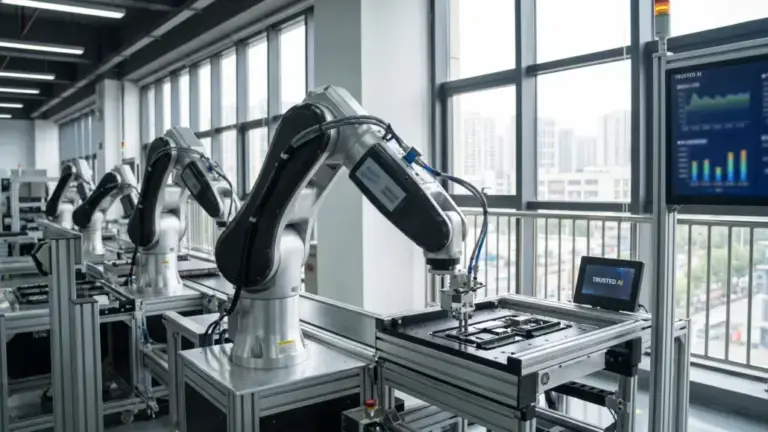
Artificial intelligence – AI is becoming a trustworthy engine for industries in China when it comes to industrial transformation in China at a rapid speed. Right from the factory floor and the mine shaft to the classroom and the hospital wing, novel uses of artificial intelligence are creating new businesses and transforming the second-largest economy in the world.
Officials and industry leaders have gathered at the 2026 World AI Conference -WAIC and also a high-level meeting on global AI governance in Shanghai from July 17 to 20 to talk about deeper global collaboration on AI.
The occurrence comes as the AI is gaining momentum across industries in China. China’s primary AI industry in 2025 is more than 1.2 trillion yuan, which is about $176.7 billion with more than 6,200 firms. Over 30% of large industrial enterprises in China have embraced AI, and the technology has been incorporated into over 70% of operations at prominent intelligent factories.
Where AI Meets the Real Economy
TBEA Shenyang Transformer Group Co., Ltd. operates two parallel factories in Shenyang, which is the capital of Liaoning Province in northeast China – one physical, in which robotic arms as well as automated guided vehicles collaborate with operators, and another digital, where standard simulated systems validate production schedules in order to minimize physical trials.
According to the head of process and digital management at the company, Xu Linlin, “This intelligent system, covering simulation, scheduling, execution, and monitoring, has shortened product development cycles by 21 percent and boosted efficiency by 40 percent.”
Also, it is worth noting that AI is tackling hard challenges in the old industries. One of the providers of autonomous-driving solutions when it comes to the mining industry, EACON Mining Technology Co., Ltd., said that its system when it comes to open-pit mines, which can work in extreme cold, heat, and high altitude, has been executed in over 40 mines and has powered more than 3,100 autonomous trucks in everyday operations.
At the same time, in shared mobility, AI models function as the core of bike-sharing platforms, decreasing idle rate and maximizing vehicle usage.
It is well to be noted that China’s market for the embodied AI sector, which is led by humanoid robots and the like, is growing by over 50% a year. AGIBOT – the Chinese embodied AI company, announced on June 28, 2026, that it handed over its 15,000th embodied AI robot directly to a Shanghai factory for typical production-line use.
The deputy director of the science and technology department of the Ministry of Industry and Information Technology, Gan Xiaobin, said the country is projected to produce more than 100,000 humanoid robots annually.
Large language models and AI agents are constantly iterating fast, too. In late May 2026, China’s main models had several hundred trillion per day token calls, which is among the highest in the world.
From Industry to Routine Life
AI is also altering consumption patterns and entering everyday life. Retail sales of wearable smart devices increased over twofold year on year in the first 5 months of 2026, while sales at autonomous stores increased by over 20%.
As per iFlytek, its AI blackboards as well as education tools now reach in excess of 50,000 schools and 130 million students and educators. AI paediatric doctors are working in hospitals in Beijing, elderly-care robots are assisting in nursing homes located in Shenzhen, which is south China, and patrol bots are guarding West Lake located in Hangzhou in east China at night.
Interestingly, this drive is supported by a solid policy backing and a high-quality design that promotes AI innovation throughout all sectors. New policies are being introduced, such as a set of standards issued lately for thorough execution of the AI Plus campaign, and the 15th Five-Year Plan of China – 2026-2030 has called for full execution of the effort.
The ninth Shanghai AI event, which is themed around AI Partnership for a Brighter Future, has signed up in excess of 1,100 enterprises in 2026, in addition to over 100,000 square meters of space for exhibits.
Apparently, more than 140 forums will be held, drawing 1,400 guests from both home and abroad, as well as more than 3,000 products and technologies on exhibit, with over 300 products making their world introductions.
Remarks Pang Chaoran, a researcher at the Chinese Academy of International Trade and Economic Cooperation under the Ministry of Commerce, “By capitalizing on the latest wave of scientific and industrial change and fostering a two-way flow between AI innovation and real-world applications, China can leverage its integrated industrial system and wide range of use cases to inject fresh momentum into high-quality development and ensure that the gains of AI reach everyone.”