
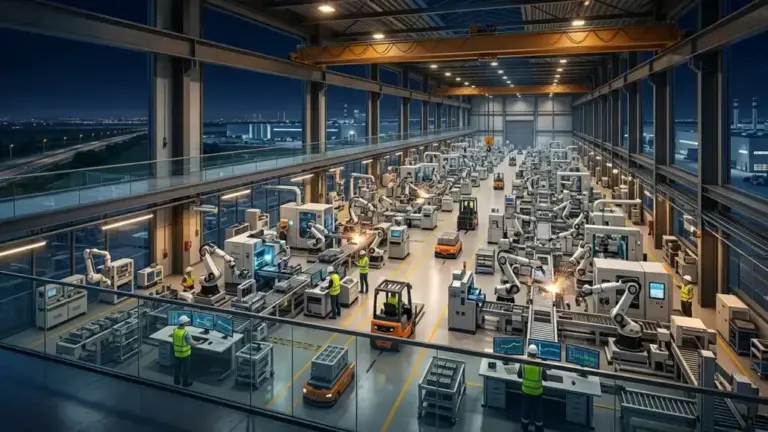
It has been seen that AI-enabled factories are altering aspects of global manufacturing, with the possibility to unlock productivity improvements of around 60%. Such shifts are giving rise to a new logic of competitiveness, in which the measure of success is the extent to which production setups are reconfigured and rolled out. Even if lower-cost nations make improvements, the first time anyone upgrades to factory-of-the-future capacities in a high-cost country can be a more advantageous option compared to offshoring. But without an upgrade to the factory of the future, some $1.03 trillion of value of manufacture is at risk of leaving Western Europe, with an additional $440 billion at risk in the US.
It is well to be noted that the latest report from Boston Consulting Group – BCG and the BCG Institute, How the Factory of the Future Is Reshaping the Economics of Manufacturing, integrates a worldwide survey of 1,000 manufacturers with proprietary quantitative analysis so as to explore how advances in AI and automation, as well as digital systems, are changing production at scale.
According to BCG managing director and senior partner, fellow at the BCG Institute, and coauthor of the report, Daniel Kuepper, “Manufacturers are entering a new era where competitiveness is no longer defined by static cost comparisons but by how effectively they can redesign production setups end to end. The factory of the future is fundamentally changing how companies create value and how they think about where to produce.”
Addressing the difficulties of geopolitical instability
Keeping in mind altering aspects of global manufacturing, the whole factory of the next-generation production setup is revamped holistically and powered by AI, leading to simultaneous gains when it comes to energy, materials, and output, as well as throughput. The most important variables in footprint decisions are no longer relative labour costs and logistics from suppliers as well as to customers but how well a facility can be turned into an extremely productive factory of tomorrow. This is becoming increasingly important as geopolitical instability mounts and supply chain turbulence emerges as a structural risk for manufacturers who want to build robustness by manufacturing where they sell.
Advantages vary in terms of Sector and Location
But not all locations or industries benefit from the factory of the future equally. Important variables are local cost factors including energy, labour and supplies, as well as automation potential based on the sector and proportion of logistics costs. The benefits to higher-cost locations are greater for the automation of labour-intensive tasks, optimisation of the use of energy, improvement of output and throughput, and narrowing the gap via low-cost locations. Proximity to end markets is most beneficial for industries with a significant portion of logistics costs, like food and beverages.
Other enablers for successful implementation include accessibility to talent and preparedness of digital infrastructure. In a survey that was done by the BCG Institute, 87% of those surveyed said having access to talent and skills is more important to keep up with the implementation of the factory of tomorrow, and 69% said for digital infrastructure.
A More Innovative Global Manufacturing Scene
The fact is that together these dynamics are developing a more diverse and fluid global manufacturing scenario in which competitive advantage hinges on the alignment of sector attributes, location capabilities and successful deployment of advanced production technologies. The consequences for business leaders are immense. Companies must start thinking about production choices via a new lens, the one that combines the deployment of technology alongside footprint strategy and examines how production structures can be reimagined for value.
Adds Kuepper, “Companies that integrate footprint strategy with advanced manufacturing capabilities will be best positioned to compete in the decade ahead.”